
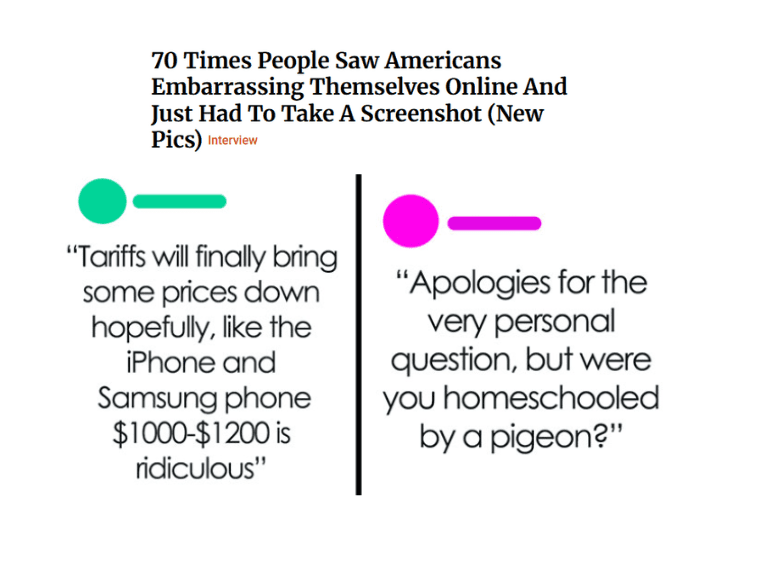
There is a peculiar and pervasive phenomenon that has emerged in the age of global social media, a specific kind of digital wince that occurs when you see a post, an advertisement, or a public declaration from a fellow countryman that makes you want to gently close your laptop and take a long, thoughtful walk. This feeling, a potent mix of secondhand embarrassment and bewildered amusement, is what many have come to know as the uniquely American brand of cultural cringe. It is not about malice, but about a certain breathtaking lack of self-awareness, a bold and unvarnished presentation of local quirks on a world stage that was not quite prepared for them. We are living in a golden era for this specific genre of content, where the sheer volume of American users online means that these moments are captured, screenshot, and shared with a global audience that often responds with a mixture of laughter and sheer disbelief. The internet has become a vast museum of these artifacts, curated by people who saw something so profoundly confusing or earnest that they just had to preserve it for posterity. This collection is a testament to those moments, a gentle ribbing at the things that make American internet culture so simultaneously fascinating and baffling to the rest of the world, and sometimes, to a growing number of Americans themselves.
The most common exhibits in this unofficial museum often revolve around a profound and startling confidence in matters of geography and world knowledge. It is one thing to not know something, which is a universal human experience, but it is another entirely to proclaim one’s ignorance with the unwavering certainty of a seasoned expert. Think of the tweets from Americans genuinely surprised to learn that Europe has diverse weather patterns, or that people in Australia speak English, or the classic confusion of mistaking entire continents for single countries. These are not just simple errors; they are conceptual collapses, a folding of the complex tapestry of the world into a much simpler, and often America-centric, map. The cultural cringe here is palpable because it reflects a educational system, or perhaps a cultural bubble, that has failed to provide a basic framework for global understanding, and the result is a person earnestly asking on a public forum if they need a passport to travel from California to Texas. The world looks on, jaws slightly agape, as these digital missives make their way across platforms, becoming instant classics of a genre built on a foundation of sheer, unadulterated geographic bewilderment.
Then we have the fascinating world of American consumerism, which provides a deep and endless well of material for this specific form of online shame. The United States is a nation built on shopping, but the products and marketing strategies that emerge can sometimes defy all logic and reason. We are talking about the discovery of a pre-peeled orange sold in a plastic container, a single, sad garlic clove floating in a vast plastic tub of oil, or a “gluten-free water” label that makes a scientist somewhere weep softly into their notebook. The screenshots of these products, usually taken in a grocery store aisle by a stunned bystander, speak to a culture of convenience that has perhaps spiraled out of control. The commentary that accompanies these images is a symphony of facepalms, as people from other countries, where peeling an orange is considered a basic life skill, try to comprehend the market forces that would make such a product viable. This is not just about strange items; it is about a whole ecosystem of consumption that can appear deeply wasteful and illogical from the outside, creating a powerful sense of secondhand embarrassment for those who understand the broader implications of such bizarre inventions.
Of course, no discussion of American online behavior would be complete without a nod to the country’s unique and often tumultuous relationship with food. The internet is littered with photographic evidence of culinary creations that can only be described as ambitious, if not outright declarations of war on the very concept of cuisine. These are the “dinner ideas” that involve an entire block of cream cheese, a pound of ground beef, and a can of condensed soup, all baked inside a crescent roll casing and proudly presented as “gourmet.” They are the desserts that involve a dozen different types of candy bar, multiple layers of frosting, and a sprinkle of rainbow jimmies, creating a visual and glycemic spectacle that is both awe-inspiring and slightly terrifying. The cultural cringe evoked by these images is a complex one; it is a mixture of horror at the nutritional content and a strange, grudging respect for the unapologetic audacity of it all. When these pictures travel beyond national borders, they are met with reactions ranging from disgust to a sort of fascinated curiosity, as if people are watching a nature documentary about a strange and wonderful creature whose dietary habits are both shocking and mesmerizing.
The American healthcare and insurance system is another fertile ground for these moments of profound digital embarrassment, though the laughter it provokes is often tinged with a deep, existential dread. Screenshots of medical bills listing a $50 charge for “skin-to-skin contact” with a newborn baby or a $800 fee for a single stitch in an emergency room circulate online not as humor, but as horror stories. The cultural cringe here is different; it is less about a quirky lack of self-awareness and more about a systemic failure that is so bizarre and cruel it becomes a source of international shame. People from countries with universal healthcare look upon these posts with a mixture of pity and disbelief, while many Americans share them with a weary, resigned anger. These are not funny mistakes, but they are deeply embarrassing artifacts of a system that is, from many perspectives, fundamentally broken, and sharing them is a way of screaming into the void, a desperate attempt to showcase a reality that feels too absurd to be true.
Moving into the realm of politics and social discourse, the content becomes even more potent. The American political landscape is a theater of the absurd played out on a global stage, and the participants are often eager to share their most passionately held, if not entirely fact-based, opinions. We see screenshots of town hall meetings where a constituent earnestly argues that a new bike lane is a secret plot for United Nations invasion, or social media posts decrying the dangers of dihydrogen monoxide with the fervor of a seasoned activist. The confidence with which these conspiracy theories and misinterpretations are presented is the true engine of the cultural cringe. It is the spectacle of a person fighting a dragon of their own imagination, armed with a wealth of misinformation gathered from the darker corners of the internet. For the rest of the world, and for many Americans, watching these performances is like witnessing a car crash in slow motion; you cannot look away, even as you feel a profound sadness for the state of public discourse and the erosion of shared reality that such moments represent.
The sheer volume and velocity of this content can make it feel like a relentless parade of national humiliation, but it is important to step back and consider the context. The United States is an enormous, diverse country, and the voices that scream the loudest online are not always the most representative. For every screenshot of a baffling political take, there are millions of Americans rolling their eyes in unison. For every photograph of a culinary crime against humanity, there are countless home cooks preparing simple, healthy, and delicious meals. The internet, by its very nature, amplifies the extreme, the unusual, and the outrageous. It is a distortion filter that takes the quirks of a culture and blows them up to epic proportions, creating a funhouse mirror image that is both hilarious and not entirely accurate. The feeling of cultural cringe is a natural reaction to seeing your own culture reflected back at you through this chaotic, global lens, where nuance is the first casualty and the most absurd statements rise to the top of the feed.
In the end, this vast collection of screenshots, these seventy times and countless more that people felt compelled to capture and share, serves as a fascinating social document. It is a record of a superpower’s idiosyncrasies, a study in the gap between self-perception and how a nation is perceived by the wider world. Engaging with this content, whether with a groan, a laugh, or a sigh, is a participatory act in the global conversation. It is a way of acknowledging our shared humanity, our capacity for folly, and our universal tendency to sometimes miss the mark in spectacular fashion. While it is easy to feel a sense of cultural cringe when confronted with the more bewildering aspects of American life displayed online, this phenomenon ultimately reminds us that no single culture has a monopoly on strangeness, and that in the great, sprawling digital town square, we are all both the audience and the occasional, unwitting performer.
#1 “There Has Never Been Another Nation That Has Existed Much Beyond 250 Years”

Image credits: SamCham10
The [Stuff] Americans Say subreddit has been around since 2013 and has amassed an impressive 239K members. The group’s goal is to call out amusing and shockingly ignorant comments that Americans make online, but of course, it’s all done in good fun.
To find out how the community has been since the last time we featured it on Bored Panda, we got in touch with one of the group’s moderators. “Not much has changed,” the mod says. “Trump and his administration (former and present) were already treated as ‘low-hanging fruit’ here (and in any case, there are many subs dedicated to stupid things Trump and his entourage say, so we want to avoid duplication).”
“There are more posts about things like ICE and tariffs (though most ICE posts tend not to be very lighthearted, so [many] don’t make it past pre-moderation),” the mod added.
#2 “Tarrifs Will Bring Some Prices Down Hopefully, Like iPhone. And Samsung Phone $1000-$1200 Is Ridiculous”

Image credits: AlertResolution
#3 ‘In A Third World Country Like Spain’

Image credits: HollyMCheek
We also asked the moderator what advice they would give to Americans who want to avoid being featured on their page. “Don’t assume everyone understands US cultural references (TV shows, fast food chains, measurements, date formats, currency etc.),” they told Bored Panda. “You’ll find examples of this on our sister sub r/USDefaultism too.”
“In particular, don’t say, ‘I’m Irish/Italian/German/whatever’ unless you’re an actual citizen. You should clarify that you mean ‘heritage,’ otherwise you risk the wrath of your (claimed) countrymen,” the mod warns.
#4 “How Do People In England Feel About America Celebrating Today??? Is Wimbledon Their Way Of Snubbing Their Nose At Our Holiday???”

Image credits: IrrayaQ
Finally, the moderator shared some suggestions for how Americans can educate themselves about the rest of the world. “Look for foreign news sources (e.g. BBC, The Guardian, Deutsche Welle, France 24, Telesur, etc., which have pages in English) to get different points of view about current events and foreign cultures, as well as how US culture and politics are perceived abroad.”
#5 “Ahhhh Just Another European Cope Chart”

Image credits: Kyr1500
It’s no secret that the United States is a global powerhouse. The nation is home to the largest economy in the world, and culturally, it’s considered one of the most influential countries as well. The US is the planet’s fourth largest producer of film, and the world’s largest producer of music. You can ask plenty of people around the globe what their favorite movie, television show or song is, and there will be a chance that their response came from the United States, regardless of their native country or language.
#6 “While In Germany I Found An Aldi. The Aldi Is Nothing Like An American Aldi”

Image credits: Present_Leg_4597
As a young nation, the United States has done incredible things in less than 250 years. But with great power comes great responsibility. And when you’re the third most populated country on the planet, all eyes are on you. So you better be prepared to be held accountable by your audience.
Everyone deserves to be held accountable for their mistakes, and the internet is a wonderful place to learn and grow! It’s just unfortunate that the most ignorant voices are often the loudest. And in the United States, there are simply more people in general than almost any other country. So with a large population comes a greater amount of people who probably shouldn’t have access to social media.
#7 Most People Around The World Move To The United States

Image credits: MathematicianIll2865
#8 We Invented Cars

Image credits: Haaannooo
#9 For The Local People $1 Is A Lot Of Money

Image credits: ALazy_Cat
Now, let’s break down some of the most common assumptions people around the world make about Americans. One is that we’re absolutely terrible at geography. Now, it’s estimated that only about half of the country’s population can actually label all 50 states on a map. And one survey found that 44% of Americans can’t correctly identify EU nations on a map.
So perhaps it’s true that Americans aren’t the best at geography. But plenty of Europeans probably can’t identify more than a handful of American states either. So it might not be fair to dunk on Americans for their geographical knowledge (or lack thereof).
#10 Imagine Saying: “Oh I’m 1.829 Meters Tall…”

Image credits: megistos86
#11 “Is English Your First Language?” “No I’m An American”

Image credits: Islarf
#12 Millenials Hear Socialism And Think Canada And Switzerland

Image credits: notabotmkay
Something else the world loves to criticize Americans for is being monolingual. While it’s true that you can certainly make your way through the American school system without becoming fluent in another language, students are typically required to study a foreign language for at least two years in high school. Meanwhile, data from the US Census Bureau found that 22% of Americans actually don’t speak English at home. So it’s not exactly fair to paint the whole nation as monolingual.
#13 “Isn’t This A Violation Of FAA Regulations?”

Image credits: cameronchalmers
#14 Europeans Are Way More Susceptible To Propaganda *then* Americans

Image credits: OB1UK
#15 Dutch Is The American Spelling, Deutsch Is The English

Image credits: sandiercy
This next assumption about the United States doesn’t have to do with intelligence, but it’s certainly something that the rest of the world likes to clown on us for: being unhealthy and/or overweight. It’s true that 40% of the nation is considered obese, according to the CDC. However, when it comes to the most obese countries in the world, the United States ranks 19th. And in the United Kingdom, 28% of adults are considered obese. So while this is certainly an issue in the US, it’s not the only nation that is struggling with an obesity epidemic.
#16 “Sounds Like Socialism To Me”

Image credits: Nidzovantije
#17 On A Map About Which Way European Traffic Lights Are Walking, “Idiotic Icons” Guy Gets A Good Point Made Against Him

Image credits: Exact_Actuary_9287
#18 “Insulin Is A Privilege, Not A Right”

Image credits: BuffaloExotic
It’s easy to assume that the United States is full of ignorant people when that’s all you see online. But in reality, the nation has plenty of brilliant, innovative individuals. Futura published an article celebrating the greatest scientific advancements from the 20th century, and many actually came from the good old USA. They noted that the country was home to the first successful organ transplant. And who can forget NASA putting the first man on the moon in 1969?
#19 “Probably Paid For By American Taxpayers Through Overcharging Tariffs To Americans”

Image credits: juanbuis
#20 “We Simply Choose Not To”

Image credits: yellow-subaru
#21 Hospitals Are Businesses. Their Job Is To Attract High Paying Clients

Image credits: ALazy_Cat
The first ever email was also sent by an American, Ray Tomlinson, in 1971. And the world’s first animated film, Snow White and the Seven Dwarves, came straight from the USA. Meanwhile, the first GPS also came from America, as it was created by the US Department of Defense in 1973. Who says this nation isn’t full of brilliant minds?
#22 Coffee Shops Weren’t Even Really A Thing Until A Few Decades Ago!

Image credits: Honkerstonkers
#23 That’s For Pearl Harbour

Image credits: Mitleab
#26 « US Citizen Are More Important »

Image credits: ErodeZ57
#27 “Server Makes $2.13 Please Tip Generously” Beggar Culture

Image credits: FenderBender3000
#28 The USA Invented Trains

Image credits: neilm1000
#29 “We Hate Giving Even A Dime To Waiters…”

Image credits: DaBe99
#30 “Nonsense Numbers”

Image credits: StandardLivid8199
#31 “Why Don’t They Use Normal American Numbers On Their Clock”

Image credits: hungry_murdock
#32 “Is 6 Days Off For 2025 Excessive?”

Image credits: AnonymousTimewaster
#33 They Don’t Have Ranch…

Image credits: deathbykoolaidman
#34 ”at The Airport. America Will Be Lost To The Immigrants Thanks To Biden And K*mala. Norway Here I Come!”

Image credits: Lemonade348
#35 “The USA Has Back To Back World War Wins”

Image credits: generic_username-92
#36 “I Am More Scottish Than That Guy And I’ve Never Left The Us”

Image credits: BadNameThinkerOfer
#37 “Good Luck Finding Breakfast In Italy”

Image credits: smashedspuds
#38 Use Fahrenheit It’s More Accurate

Image credits: Nidzovantije
#39 “Your Country Exists Because Of What America Provides To You, Don’t Forget That”

Image credits: BuffaloExotic
#40 “America Is The World Most Greatest Nation… Without America There Were Not Denmark… You Will Probably Be Speaking German Right Now…”

Image credits: BeastMode149
#41 “I’m Swedish American. I Don’t Speak Swedish”

Image credits: RotaPander
#42 “In German There Was No Word For “Thank You” So The ‘German Sounding’ Word ‘Danka Shoen” Was Coined By A Songwriter”

Image credits: cattbug
#43 Military Time😬

Image credits: THUND3R_23
#44 Meat And Milk Are Rarer In Europe

Image credits: Shadow-Imperial
#45 Big Difference

Image credits: veifarer
#46 Europe Is A Bunch Of Third-World Countries With Better Branding

Image credits: OriginalTuna
#47 “So He Could Born On American Soil”

Image credits: Content_Study_1575
#48 “USA! USA! USA!” Bro Canada Is #6 In Quality Of Life While Us Is #22

Image credits: Short-Knowledge-3393
#49 “If You Can’t Tip Your Server… Don’t Go Out To Eat!”

Image credits: ricogatenby99
#50 Ambulance Ride In UK…… Not £0. Paid For. With Taxes. Every Single Penny You Ever Earned… 20% Gone. For That Ambulance

Image credits: miklcct
Don’t miss our daily roundup.
Stay informed with a handpicked selection of the day’s top AOL stories, delivered to your inbox.
#24 Bro Nobody Uses Euros

Image credits: ActuatorPotential567
We hope you’re enjoying your scroll through these hilarious screenshots, pandas. While some of them might make you lose faith in humanity, perhaps they can inspire you to never stop your own journey of learning. Keep upvoting the ones that you can’t believe aren’t satire. And if you’re looking for another list featuring ridiculous things Americans have said, you can check out this Bored Panda article next!
#25 Where In The World? Everywhere

Image credits: Lunax_4432
Content Source and pict by: AOL / BoredPanda / W1Network


I don’t think the title of your article matches the content lol. Just kidding, mainly because I had some doubts after reading the article.
Your point of view caught my eye and was very interesting. Thanks. I have a question for you.