

It’s a quiet rebellion happening in kitchens everywhere, a secret shared with a hushed laugh between friends or a triumphant confession in online forums. People are finally opening up about the little cheats that make cooking so much easier, even though they’re downright weird. There’s a certain pride in admitting these unconventional methods, a declaration that the sacred rules of gourmet cooking can be bent, or even broken, in the name of efficiency, sanity, or simply a better result on a Tuesday night. The beautiful part is that these cooking cheats are not about being lazy; they are about being clever. They represent a deep understanding of one’s own rhythm in the kitchen and a refusal to be shackled by tradition when a simpler path exists. I think we’ve all reached a point where we value the joy of eating a good meal just as much as the process of creating it, and if that means employing a strange trick or two, then so be it. The goal is to get a delicious dinner on the table without feeling like you’ve just run a culinary marathon, and these brilliant workarounds are the key to achieving that.
One of the most common battlegrounds for these cooking cheats is the humble onion, a vegetable known for reducing even the most stoic among us to tears. We’ve all heard the advice to chill the onion or use a sharper knife, but the real pros have a different tactic altogether. They simply chew a piece of gum while chopping. It sounds bizarre, and the science behind it is debated, but countless home cooks swear by it. The theory is that the act of chewing forces you to breathe through your mouth, which draws the onion’s volatile sulfur compounds away from your nose and eyes, where they would normally react to create that stinging sensation. It’s a physical diversion for a physical problem, and it works surprisingly well. This is the perfect example of a kitchen shortcut that feels a little silly but is so effective you’ll never look back. It turns a dreaded, tear-filled task into a quick, dry-eyed affair, getting you through your prep work with a lot less drama and a lot more minty-fresh breath.
When it comes to weeknight dinners, speed is often of the essence, and nothing tests your patience like waiting for a large pot of water to come to a rolling boil. This is where another one of those brilliant cooking cheats comes into play, one that would make a classic French chef shudder. Instead of starting with cold tap water, many people now fill their kettle, bring it to a boil, and then pour that already-boiling water into their pot on the stove. You cut the waiting time down to a fraction, saving precious minutes and a significant amount of energy. It’s a simple transfer of technology from one appliance to another, leveraging the superior speed of an electric kettle to serve the needs of the stovetop. This little trick is a game-changer for pasta nights, or for when you need to quickly blanch some vegetables for a salad. It’s a perfect illustration of how a small change in routine can have a cumulative effect, saving you hours over the course of a year and making the prospect of cooking from scratch feel a little less daunting.
The quest for perfectly fluffy rice has led to more than one kitchen disaster, with pots boiling over and grains turning into a sticky, gummy mess. The traditional method of simmering and waiting can feel like a high-stakes gamble. This is why the ultimate cooking cheats for rice have emerged, and they are wonderfully counterintuitive. The first involves cooking rice exactly like pasta, in an enormous pot of heavily salted, boiling water. You just pour the raw rice in, let it cook for the recommended time, and then drain it in a fine-mesh sieve. The result is each grain distinct and perfectly cooked, with no risk of a burned bottom. The other popular method is the oven method, where you combine rice and boiling water or broth in a baking dish, cover it tightly with foil, and bake it. This creates an incredibly even, hands-off cooking environment where you literally cannot stir it and make it gummy. These techniques bypass the finicky absorption method entirely, offering foolproof paths to rice perfection every single time.
Salad dressing is another area where these clever kitchen tricks can save you from buying overpriced, preservative-laden bottles from the store. The standard instruction is to whisk the oil and vinegar together vigorously, but we all know that emulsion breaks almost immediately, leaving you with a puddle of oil at the bottom of the bowl. The solution is so simple it feels like a secret weapon. You put all your dressing ingredients oil, vinegar, mustard, honey, whatever you like into a small jar, screw the lid on tightly, and shake it like you’re mad at it. In seconds, you have a perfectly emulsified, creamy-looking vinaigrette that will cling to your lettuce leaves instead of sliding off. This jar method is not just easy; it’s also practical for storage, as you can just pop the same jar right into the fridge. It’s a small act that transforms dressing-making from a chore into a satisfying, ten-second ritual, ensuring you always have a fresh, homemade option on hand.
Perhaps one of the most universally acknowledged but rarely discussed cooking cheats involves the humble kitchen shear. Most people relegate them to opening packaging, but for those in the know, a sturdy pair of kitchen shears is one of the most versatile tools on the counter. Why painstakingly chop fresh herbs on a cutting board with a knife when you can pile them into a measuring cup and snip them directly with the shears? It’s faster, contained, and just as effective. They are perfect for cutting bacon directly into a pan for bits, for quickly snipping green onions over a finished soup, or for cutting pizza for kids without dragging a wheel cutter through the toppings. You can even use them to spatchcock a chicken, a task that sounds intimidating but becomes a thirty-second job with the right tool. This is a prime example of a kitchen hack that is less about a specific recipe and more about a mindset of using the tools you have in the most efficient way possible, saving you time on cleanup and prep work.
When a recipe calls for softened butter, the impatient cook is faced with a dilemma. Do you wait an hour for that brick to come to room temperature, or do you risk melting it in the microwave with unpredictable bursts of power? The answer, it turns out, is neither. One of the most celebrated cooking cheats for this problem involves taking your cold stick of butter and grating it on a standard box grater. The thin, delicate shreds of butter will come to room temperature in a matter of minutes, perfectly ready for creaming with sugar for cookies or spreading on bread. If you need it even faster, you can place the grated butter on a plate and give it a brief, gentle zap of heat, watching it carefully. The increased surface area is the key, allowing the butter to warm evenly and quickly without any liquid oil forming. It’s a brilliant workaround that feels almost like a magic trick, turning a hard, cold ingredient into a pliable, ready-to-use component in the time it takes to wash the grater.
The world of baking is rife with these strange but effective cooking cheats, especially when it comes to substitutions. Realizing you’re out of buttermilk minutes before you need to add it to your batter can feel like a crisis, but it’s a problem with a famously simple and weird solution. You just take a cup of regular milk and add a tablespoon of either white vinegar or lemon juice to it, stir it, and let it sit for about five minutes. The acid will curdle the milk slightly, thickening it and giving it that distinctive tang that buttermilk provides in recipes. It’s a chemical reaction performed right on your countertop, and it works flawlessly for pancakes, biscuits, and cakes. Similarly, a common substitution for a single egg is a tablespoon of ground flaxseed mixed with three tablespoons of water, which gels up to create a binding agent perfect for vegan baking. These are not just desperation moves; they are legitimate, science-backed techniques that empower you to keep baking without an emergency trip to the store.
Even the simple act of peeling garlic, a task that can be frustrating and sticky, has been revolutionized by a series of these clever cooking tricks. The classic method is to place a clove under the flat side of a chef’s knife, give it a firm whack with the heel of your hand, and then peel away the shattered skin. But for a larger quantity, people have gotten even more creative. Some swear by shaking the cloves vigorously inside two nested metal bowls, the agitation banging the skins right off. Others use a specialized silicone tube, rolling it back and forth to achieve the same effect. The goal is the same: to minimize the tedious, finger-nail breaking work of peeling each clove individually. These methods are fast, efficient, and strangely satisfying, turning a mundane prep task into a moment of kitchen theatrics. They free up your time and energy for the actual cooking, which is the whole point of embracing these little cheats in the first place.
The philosophy behind all these cooking cheats is not about cutting corners in a way that sacrifices quality; it’s about optimizing the process to reduce frustration and increase enjoyment. It’s about recognizing that the “right” way is not always the only way, and that sometimes, the path of greatest resistance is completely unnecessary. These tricks are born from experience, from the countless hours spent in the kitchen where you learn what truly matters for the flavor and what is merely ceremonial. They are a form of collective wisdom, passed along in whispers and social media comments, making the art of cooking more accessible to everyone. They democratize good food, proving that you don’t need a culinary degree or a battery of expensive equipment to feed yourself and your family well. You just need a willingness to try something a little unconventional, to listen to the hacks that other home cooks have discovered through their own trial and error.
In the end, embracing these strange and wonderful cooking cheats is a celebration of practicality and personal empowerment in the kitchen. It is an acknowledgment that our time and mental energy are valuable, and that any trick which preserves those resources without compromising the final meal is not just valid, but brilliant. The next time you find yourself chewing gum over a pile of onions, shaking a jar of vinaigrette, or grating a stick of butter, remember that you are part of a quiet revolution. You are part of a community of cooks who have decided that efficiency and flavor can go hand-in-hand, and that the weirdest methods often produce the most satisfying results. So go ahead and share your own strange tip with a friend, because these clever cooking cheats are the secret ingredients that make the daily ritual of preparing food not just easier, but a whole lot more fun.
#1
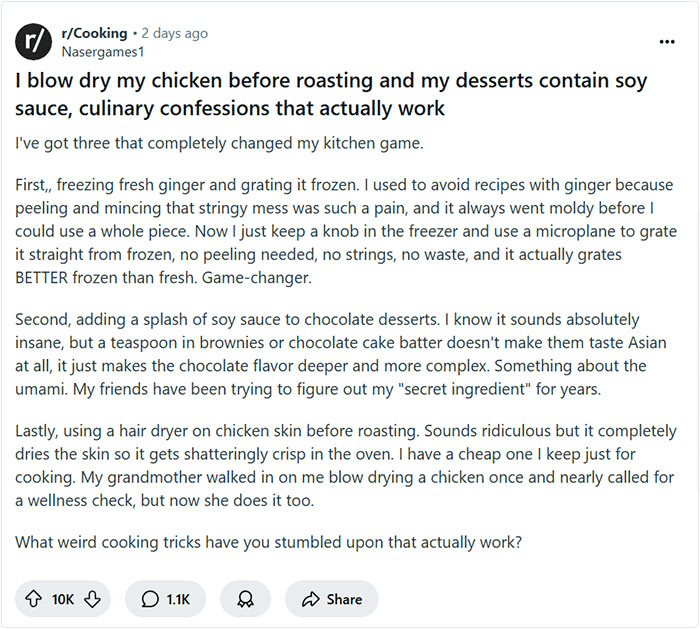
Uhhh using a blow dryer on raw chicken is a terrible idea. That’s how you get chicken juices and salmonella all over everything. Just pat it with paper towels or leave it uncovered in the fridge for an hour or two.

Image credits: natalietest234
#2
I learnt that blow drying was the secret to crispy duck skin. One Christmas I was cooking duck and thought I’d try it out. I’d just got a high speed “blaster” for drying the dogs so stood at the kitchen door with the duck, pointed the nozzle to between the skin and flesh and turned it on. I then discovered why it was called a blaster and had a low-flying headless duck fly down the garden with dogs in hot pursuit 🤣.

Image credits: Electronic_Cream_780
#3
I dunno about the blow drying…. Seems unsanitary and also unnecessary. I salt my chicken and leave it in the fridge overnight and the skin completely dehydrates – much more than you could achieve with a blow dryer.

Image credits: 4Looper
#4
When I make chili I put chocolate and coffee in right before I serve, it adds a another level of flavor that nobody understands but they love it.

Image credits: rgbkng
#5
-Cocoa powder in chili
-peach jam in bbq sauce
-touch of sour cream in scrambled eggs.

Image credits: Fromaggio119
#6
I peel Ginger, cut it into cubes, blended into a paste, a thin layer in a ziplock bag , freeze , break off as needed. .

Image credits: ExpressLab6564
#7
Keep your saran wrap/ plastic wrap in the fridge. It won’t stock to itself, ever, while you’re cutting it. But it warms up immediately & sticks to your bowl you’re covering. Yes, even the cheap kind will work better.

Image credits: GingerIsTheBestSpice
#8
I freeze any veg that is about to go off, I will even cut off anything that looks bad and still throw it in. I like freezing tomatoes the best so I can peel and then throw them in a pot. Having been frozen the skin releases easy with just a quick rinse under hot water. I have even used them for fresh salsa. If I need grated onion I go to the freezer and find one of the many pieces that have been sealed and stored. Easy peasy. (avocados freeze well too)
I always have little pieces of veg or even whole veg that isn’t used right away so I do the usual, throw them in a cooked dish if they dont need to be crunchy. All my asparagus ends get frozen and then made into a cream of asparagus soup later which is then used for all sorts of sauces/flavoring and of course soup. I also freeze cheese ends or any that looks funny after cleaning it up for the same reason. Cheese and Grits, to the freezer for the cheese ends. I also freeze leftover rice on a tray and then bag it up for later use – usually breakfast fried rice.
I make yellow rice a lot – turmeric, chicken broth and rice. Turmeric is really nice for adding color to mac n cheese, queso and of course yellow rice and anything in between that needs to have that orange/yellow color.
I make garlic butter ahead of time and sealed in a glass dish. Its always been my hubs fav but he doesn’t know whats in it. His is never the same so I get asked to make it. Its a 1/3 butter 1/3 margarine and 1/3 olive oil combined with a hefty amount of grated garlic, a dash of italian seasoning and a pinch of ground red pepper or just plain pepper. The trio of fats keeps it somewhat spreadable but still rich and delicious. Sometimes I get fancy and press the garlic bread on a plate of parm after they have been buttered before baking them slowly.
I buy bolillo bread instead of french/italian for garlic bread, sub sandwiches/phillys/french dips and hot ham and cheese sandwiches (ham/cheese/mayo/mustard rolled tight in parchment and then foil to slowly bake in the toaster oven, ooey gooey and delicious).
I put a teeny tiny bit of mayo between each layer of ingredients in a sandwich to make everything stick together.
Those are probably all obvious – and now for the dastardly dirty little secret:
I put marmite in just about everything that needs to be savory with an extra kick of umami. It makes sauces, gravies, stews and even spag extra special. It doesnt take much so start with a little (like less than a tsp for 2 people) and adjust. It also has the benefit of adding a darker color to sauces/gravies.

Image credits: sputtertots
#9
I’ve posted about this before, but blow-drying freshly made rice on low so I can make fried rice with it.
Takes only a few minutes and you can do it in the rice pot as opposed to spreading it out onto a pan and cooling it slowly with a fan. Saves time and avoids needing to wash another dish.
Day-old rice from the fridge is the best, but I don’t always have it prepared.

Image credits: CatCatExpress
#10
Any soup will be made more flavorful and brighter by adding a bit of apple cider vinegar.

Image credits: HardCoreNorthShore
#11
Splash a bit of soy sauce on a hamburger in a skillet just after you flip it–it caramelizes at once and is the best thing about the burger.

Image credits: xiopan
#12
Use potato chips instead of graham crackers for s’mores. Not the kettle-type chips. Use something cheap and salty like Lays. S’mores are super sweet normally, so the saltiness makes it a more balanced treat. It’s also easier to eat and gluten free! (Which is how I discovered it. Food allergies lead to some delightful discoveries).

Image credits: Spidersensei
#13
This is completely counter intuitive, but we pour boiling water over our skin-on chicken before baking, and then broil it a bit right at the end. Perfect crispy skin every time.

Image credits: alliegata
#32
Ginger, stored in a dark room, lasts a long time.
You can also store it submerged in vodka and it’ll last forever, it doesn’t impact the taste for cooked dishes (weirdly) and when you are done you have ginger infused vodka (win!).

Image credits: com2kid
#14
I buy my garlic prepeeled from Costco and put it in the freezer. It’s so much easier to mash this way. You can also still mince or use whole.
#15
I always pat chicken dry too for roasting, it really does help. Never thought of soy sauce for desserts.
I do make ice cubes of seasoning though. Eg mince up some garlic and chilli’s in a blender and put the paste into an ice cube tray. Then when you make a curry or whatever you just drop one or 2 cubes into your sauce. Can bulk prepare lots of basic sauce ingredients like this.
#14
When I make pie crust, I replace half of the water with vodka.
Thanks old school ATK!

Image credits: tdibugman
#15
I cook a week worth of rice and freeze it in one serving containers so when I don’t have energy to cook I can just microwave one and put some hot sauce on it for a quick fix.

Image credits: Absulus
#16
To line a pan with foil, wet it first and the foil sticks to it.

Image credits: r_spandit
#17
Two things about salmon 🐟🍣
1) SKIN ON- make SURE your salmon is actually descaled!!! If the skin feels “smooth” it’s probably not. Salmon scales are thin and smooth, running a knife against the grain will pull them off and it makes a huge difference if you are trying to get crispy skin because the skin can be directly in contact with the pan instead of boiling/steaming under the scales.
2) SKIN OFF- Run a kettle of boiling water, then pour over the skin side until it shrinks slightly. Maybe like 10-20sec. This will release the skin from the salmon and you can literally peel it off
bonus, if you descale then remove the skin you can make a salmon skin crisp :P.

Image credits: haruhaystudio
#18
Unsweetened baking chocolate. Added to chili that you want to cut heat without changing flavor. Needs to be done very carefully, but it works.

Image credits: BlkDragon7
#19
I use fish sauce in everything savory. Just a dash, splash, or glug depending lol.

Image credits: gracelesspsychonaut
#20
Salt on meat àfter frying. Especially coarse salt. To taste.

Image credits: Lickthorn
#21
This is not new news, but baking soda on proteins is the way.

Image credits: Piratical88
#22
Years ago, I worked at a kitchen store, and I had to watch all these training videos about the products we sold. One video showed a use for parchment paper that I thought was SO dumb, but I tried it and have done it religiously ever since. It’s using parchment paper to cook scrambled eggs. You crumple a sheet of parchment paper, open it back up, and press it into the bottom of your pan. Then pour in your eggs and just cook them as usual through the parchment paper. I do it all the time because I hate cleaning eggs out of the pan. When they’re done, I just lift out the parchment paper, scrape the eggs onto my plate, and toss the paper in the compost. The pan is perfectly clean!
Also, this is kinda just for the Jews, but I’m a vegetarian (relevant because there’s no meat in the meal) and my “secret ingredient” when I make matzo balls is to replace half the oil with yogurt and add 1/4 tsp of baking soda. The reaction between the yogurt and soda makes them super fluffy and light, and the yogurt adds back some richness and flavor lost by not using schmaltz. They’re sooo good.

Image credits: spiralsequences
#23
My wife makes homemade chocolate frosting with cream and chocolate pudding powder. Her secret ingredient? – A dash of freeze-dried coffee.

Image credits: Ok-Lawfulness-6820
#24
I have a secret to making the best mashed potatoes. Lame… I know, but here goes. After boiling is finished and chunks are soft, drain the water, and return the potatoes to the burner… evap ALL the moisture, THEN add butter salt cream and milk while stirring.

Image credits: oilcantommy
#25
Citric acid powder in the right amount, instead of vinegar, makes your salad tangy but not shloshy.
And if you are doing that top it of with a bit of honey. The salad gets really tasty and it brings out the tomato and onion.

Image credits: Lickthorn
#26
I blow dry potatoes before making French fries, hash browns or home fries. I’m glad I’m not alone.

Image credits: ButterscotchAware402
#27
One of the Zuni roasted chicken recipes I’ve used, the chicken is seasoned under skin & laid out uncovered for 2 days in the fridge. Crispy results.

Image credits: kitchenjudoka
#28
You can make parmesan ice cream actually tastes good.

Image credits: Massive-Exercise4474
#29
I imagine miso in caramel, brown sugar based or coffee dessert would be good too.

Image credits: DConstructed
#30
Vanilla ice cream with a drizzle of Angostura bitters over too.
#31
If you put a head of lettuce in tin foil, it stays crisp and doesn’t wilt or spoil as soon. I have no idea why but it works.
#33
I have an inverse tip to the soy sauce/chocolate desserts – whenever I make Japanese curry, I add a piece of dark chocolate. I believe this would work for chilli as well. Really amps up the depth of flavour.
Content Source and pict by: AOL / BoredPanda / W1Network





This web page is mostly a walk-through for the entire info you needed about this and didn’t know who to ask. Glimpse right here, and you’ll undoubtedly discover it.
I don’t think the title of your article matches the content lol. Just kidding, mainly because I had some doubts after reading the article. https://www.binance.info/register?ref=IHJUI7TF
I loved as much as you’ll receive carried out right here. The sketch is attractive, your authored material stylish. nonetheless, you command get got an impatience over that you wish be delivering the following. unwell unquestionably come further formerly again as exactly the same nearly very often inside case you shield this increase.