
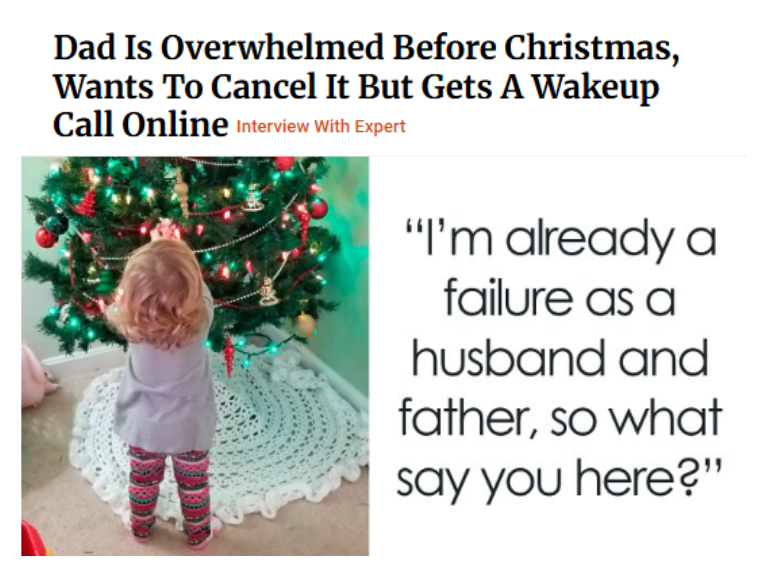
The confession, typed out in the bleak glow of a 2 a.m. laptop screen, felt like a dam breaking. “I’m already a failure as a husband and father, so what say you here?” For Michael, the words were a raw and honest snapshot of a soul-deep exhaustion that the twinkling lights outside his window seemed to mock. The pressure of the season had condensed into a heavy, personal fog of inadequacy, where every unwritten card and unbought gift felt like another piece of evidence against him. This profound sense of parental burnout wasn’t about mere tiredness; it was a crushing emotional and physical depletion that made the very thought of orchestrating holiday joy seem not just impossible, but laughable. The idea of canceling Christmas, of just stopping the whole frantic machine, emerged not as a Grinch-like whim, but as a desperate cry for survival from a man who believed he had nothing left to give. His story, however, did not end in cancellation, but in an unexpected wakeup call found in the quiet digital communion of strangers and later, through clarifying words from an expert. This journey from overwhelm to understanding speaks directly to the silent struggle countless parents face, especially during times of heightened expectation, and it highlights a crucial conversation we need to have about the unsustainable weights we often carry in silence.
Michael’s breaking point was, as it is for so many, a slow accumulation rather than a single event. It was the layered stress of a demanding year-end at work, the anxious glances at bank statements, the internalized mandate to create “magic” for his kids, and the unspoken competition with the curated holiday perfection plastered across social media. The holiday stress became the final, oppressive layer on a year already full of its own challenges. He felt himself performing a role the jovial, capable dad, the thoughtful husband while inside he was hollow, running on fumes and fear. The guilt was a constant companion, whispering that his fatigue was a moral failing, a sign he wasn’t trying hard enough or loving deeply enough. This toxic cocktail of pressure, exhaustion, and shame is the very essence of parental burnout, a state of chronic stress that depletes a parent’s emotional and physical reserves to the point where even basic caregiving can feel overwhelming. When he finally articulated that feeling of being a “failure,” it wasn’t a statement of fact, but a symptom of a system pushed far beyond its limits.
The anonymous online forum where he posted his desperate question became an unlikely lifeline. He expected judgment or perhaps cynical agreement. What he received was a flood of empathy and shared stories that mirrored his own. Other dads and moms spoke of similar feelings of defeat, of hiding in bathrooms for moments of quiet, of crying in the car after a failed shopping trip. This digital wakeup call was profound in its simplicity: he was not alone. The shared vocabulary of their struggles terms like mental load, emotional labor, caregiver fatigue, and family pressure gave name to the nebulous weight he carried. They spoke not just of the burden, but of small acts of resistance: choosing a small, pre-lit tree over a hours-long decorating ordeal, instituting a four-gift rule, or replacing a hectic Christmas Eve itinerary with a family movie and popcorn night. These stories reframed the problem. It wasn’t that Michael was failing at Christmas; it was that his definition of a “successful” holiday, likely built from a lifetime of commercial and societal messages, was itself flawed and impossibly heavy. The conversation was a crucial first step in externalizing the blame from himself onto the unrealistic expectations he had internalized.
To delve deeper into this common yet often unspoken experience, we spoke with Dr. Alisha Carter, a clinical psychologist specializing in family dynamics and caregiver stress. She immediately validated Michael’s feelings, noting that the holiday season acts as a perfect storm for parental burnout. “We see a massive convergence of pressures,” Dr. Carter explained. “Financial strain, increased social obligations, the labor of decorating and cooking, and the immense psychological mental load of planning and executing a ‘perfect’ day for everyone else. When a parent, particularly one who identifies as a primary planner or provider, hits a wall, they often interpret that wall as personal failure, not as the logical result of an unsustainable workload.” She emphasized that this feeling of being overwhelmed is a signal, not a verdict. “That thought, ‘I’m a failure,’ is the brain’s distress flare. It’s the body and mind saying the current model of operation is not working and needs reevaluation, not that the person is fundamentally broken.”
Dr. Carter’s insights provided a framework for understanding Michael’s crisis. The desire to “cancel” something, she noted, is a classic burnout response a longing to eliminate the perceived source of the stress entirely because modulating it feels beyond reach. “The brain, when overwhelmed, seeks binary solutions: perfect holiday or no holiday. The healthier, more sustainable path is almost always in the nuanced middle,” she said. This involves a conscious process of expectation management, both internal and within the family unit. The goal is to shift from a performance-based holiday, where the parent is the director of a play, to a connection-based experience, where they are a participant. This requires a radical, yet simple, act of delegation and honesty. “Sit down and have a real conversation. Ask your family what their two or three absolute must-haves are for the season. You’ll often find the list is shorter and simpler than the one you’ve constructed in your head. This act of shared decision-making immediately lightens the mental load because you are no longer bearing the sole responsibility of mind-reading and manifesting everyone’s unspoken dreams.”
The practical application of this advice was transformative for Michael. After his online wakeup call and armed with a new understanding of his parental burnout as a systemic issue, he approached his family differently. He shared his feelings of being overwhelmed, not as a failure, but as a fact. He asked his children what made Christmas feel like Christmas to them. Their answers decorating the tree together, making their grandmother’s pancakes on Christmas morning, watching a specific movie were notably devoid of expensive demands. With his wife, he audited their holiday commitments, giving themselves explicit permission to decline invitations that felt more obligatory than joyful. They implemented a gift-giving framework that was financially manageable, focusing on experiences and one meaningful item rather than a mountain of presents. This process of intentional simplification was not about deprivation, but about prioritization. It was about choosing the activities that fostered family connection and discarding those that only fed the stress monster.
The relief was almost immediate, not because the work disappeared, but because its purpose was reclaimed. Wrapping a gift became an act of love rather than a checkbox on a draining list. Putting up decorations became a shared activity with music and laughter, not a solitary, resentful chore. Michael began to notice moments of actual joy the smell of cookies baking, the quiet beauty of the lit tree at night, the easy camaraderie of a game night because he was finally psychologically present for them. He was no longer the frantic backstage manager; he was in the audience, enjoying the show with his loved ones. This shift from producer to participant is the single most powerful antidote to holiday stress. It allows the Christmas spirit, which is fundamentally about peace and togetherness, to seep in naturally, rather than being forcibly manufactured under duress. The emotional labor was redistributed and shared, making the load feel lighter for everyone.
Dr. Carter underscored this point, noting that sustainable family traditions are built on authenticity, not spectacle. “The memories children cherish are rarely the most expensive or elaborate. They are the consistent, loving rituals, the inside jokes, the small traditions that are uniquely yours. A parent suffering from caregiver fatigue is not creating those memories; they are just surviving the event. By scaling back to what is genuinely meaningful, you free up the emotional and physical bandwidth to actually be in those moments, which is what builds true connection and lasting positive memories.” This approach requires letting go of the comparison game the neighbor’s more elaborate light display, the cousin’s seemingly flawless holiday card and embracing the perfectly imperfect reality of your own family. It’s about understanding that the goal is family well-being, not external validation, and that sometimes the most loving thing a parent can do is to model healthy boundaries and self-care.
For Michael, the ultimate outcome was a Christmas that felt different than any before. The day itself was quieter, less cluttered with packaging and frenzy, and more focused on simply being together. There was space for laughter, for relaxation, for genuine gratitude. The crushing weight of his earlier “failure” narrative had been lifted, not because he had suddenly become a perfect father, but because he had redefined what success looked like. Success was no longer a flawless production; it was a connected, present, and honestly joyful experience. He realized that his initial urge to cancel came from a love so strained by pressure it had turned into despair. The online community and professional insights helped him channel that same love into creating a healthier, more sustainable celebration. His story is a powerful testament to the fact that parental burnout is a real and valid experience, especially during the holidays, but it is not a life sentence.
The journey from overwhelm to renewal is paved with permission permission to feel tired, permission to ask for help, permission to set boundaries, and most importantly, permission to redefine what a holiday means for your unique family. The societal script for Christmas is often written by advertisers and nostalgia, but the truest, most enduring script is the one you write with your loved ones, in the language of your shared values and capacities. If you find yourself, like Michael, drowning in the “shoulds” and feeling like a failure, please know that your feelings are a signal, not a truth. Seek your wakeup call, whether in a trusted friend, a professional, or the honest words of others who have been there. The goal is not to power through the exhaustion, but to navigate through it with compassion for yourself and your family. By addressing the root causes of parental burnout and consciously choosing connection over performance, you don’t cancel the magic of the season; you finally clear away the clutter to let its true, gentle light shine through.
Dad Is Overwhelmed Before Christmas, Wants To Cancel It But Gets A Wakeup Call Online




Hey mates, tried yo88vina the other day. It’s kinda neat! Registration’s easy and I won a bit. Might be worth a shot. yo88vina
Thank you for your sharing. I am worried that I lack creative ideas. It is your article that makes me full of hope. Thank you. But, I have a question, can you help me?