
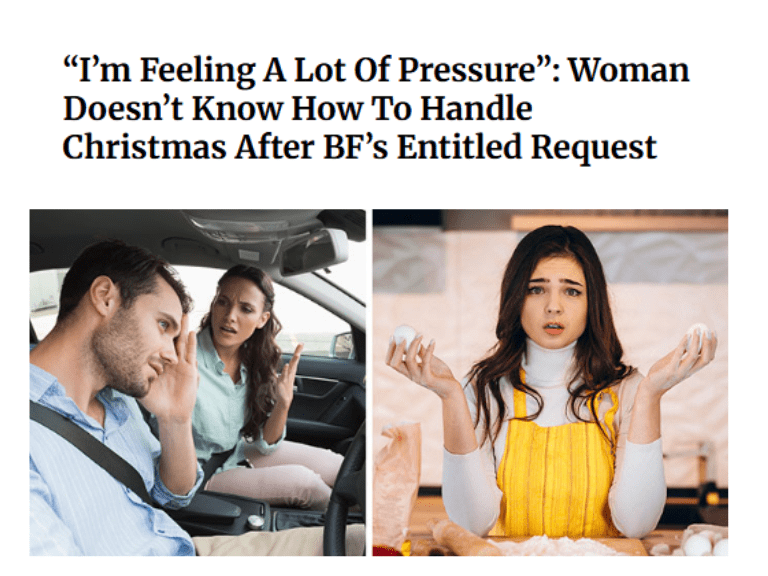
The magic of Christmas, with its twinkling lights and promises of joyful togetherness, can sometimes feel like a weight instead of a gift, a reality one woman is grappling with after a conversation with her boyfriend left her feeling deeply unsettled and under immense pressure. She had been looking forward to the holidays, to creating those warm, fuzzy memories we all associate with the season, but now she’s staring down a calendar filled with dread instead of anticipation. It all started with what she thought would be a simple discussion about plans for the festive period, a chat about where they might spend Christmas Day and what traditions they could start together. Instead, her boyfriend presented her with what she can only describe as an entitled request, a detailed and demanding list of expectations that placed the entire emotional, financial, and logistical burden of the perfect Christmas squarely on her shoulders. Suddenly, the most wonderful time of the year transformed into a complex project management nightmare, complete with a critical client whose standards seem impossible to meet. The pressure she’s feeling isn’t about choosing the right gift or cooking a perfect turkey; it’s a profound sense of obligation and anxiety sparked by a partner who seems to view the holiday not as a shared experience but as a service to be provided for his enjoyment.
This kind of scenario is, unfortunately, not as rare as one might hope, as the Christmas season has a peculiar way of amplifying existing dynamics and unspoken tensions within relationships. The societal narrative sells us a picture-perfect holiday where everything is harmonious, generous, and filled with love, but for many, the reality involves navigating a minefield of family politics, financial strain, and mismatched expectations. When one partner, often unconsciously influenced by years of their own family traditions or gendered social conditioning, assumes the other will handle the “work” of Christmas the shopping, the decorating, the cooking, the emotional labor of keeping everyone happy it can lead to a breaking point. The woman in this situation isn’t just upset about the specific request; she’s confronting the unsettling realization that her partner sees their partnership through a lens of entitlement, especially during a time that should symbolize mutual care and celebration. The festive spirit becomes overshadowed by a transaction, where her effort is the expected currency to buy a peaceful and enjoyable Christmas for him, leaving her own enjoyment as an afterthought, if it’s considered at all.
So, what was this entitled request that caused such a rift? While the exact details are personal, it typically falls into a recognizable pattern. It might be a demand that she host his entire large family at their small apartment, with the expectation she will single-handedly prepare a multi-course feast. It could be an assumption that she will max out her credit card to buy extravagant gifts for his siblings and parents, while he contributes little to the budget. Perhaps it was a unilateral declaration that they will always spend Christmas with his family, dismissing the need to alternate or blend traditions with hers. Often, it’s not one massive ask but a series of smaller assumptions that pile up: that she will handle all the wrapping, send all the cards, plan all the social itineraries, and manage the clean-up, all while maintaining a cheerful, festive demeanor. The entitlement lies in the lack of consultation, the absence of “we,” and the presence of a pronounced “you should.” This approach strips the collaboration from the holiday, turning what should be a team effort into a solo performance where she is the director, stagehand, and lead actor, all while he sits in the audience waiting to be entertained.
Navigating this requires a courage that feels in short supply when you’re already feeling overwhelmed, but the path forward starts with a quiet, honest conversation, though not necessarily one about tinsel and gift tags. The core issue here isn’t actually about Christmas at all; it’s about respect, partnership, and shared responsibility. She needs to find a calm moment to express not just her logistical concerns about the holiday, but the emotional impact of his assumptions. Using “I feel” statements is crucial here phrases like “I feel overwhelmed and pressured when the plans for Christmas are presented as my sole responsibility” or “I feel hurt when my own family traditions aren’t considered in our holiday planning.” This frames the discussion around her experience and the health of their relationship, rather than launching an attack about him being demanding. The goal is to pivot from a debate about a single Christmas to a foundational conversation about how they operate as a couple, especially under stress. It’s about establishing that a joyful Christmas, or any shared life event, is a co-creation, not a demand placed on one person by the other.
After establishing that emotional baseline, the conversation can move to the practicalities of re-imagining their holiday. This is where setting clear, compassionate boundaries becomes the practical tool for preserving her sanity and the relationship’s health. A boundary isn’t an ultimatum or a punishment; it’s a clear statement of what she is willing and able to do to make the season bright. She might say, “I am happy to host dinner, but I need you to be responsible for the groceries, the drinks, and cleaning up afterward,” or “I have a budget of X for gifts this year. Let’s discuss how we want to allocate that for our families together.” It involves presenting alternatives that foster teamwork: “Instead of just going to your parents’ house, what if we have a quiet Christmas morning just the two of us, then visit both families in the afternoon?” The magic of Christmas can be rediscovered in these negotiations, in creating new traditions that belong uniquely to them as a couple. It shifts the dynamic from one of obligation to one of choice and mutual investment, which is the true foundation of a festive season filled with genuine warmth.
The pressure she feels is also a symptom of a larger cultural narrative we rarely challenge, the myth of the perfect Christmas orchestrated by a self-sacrificing, endlessly capable individual, often a woman. Advertisements, movies, and social media feeds bombard us with unrealistic imagery of flawless homes, bountiful feasts, and ecstatic gift reactions, creating an internal benchmark that is impossible to meet. When her boyfriend’s request collides with this internalized pressure, it creates a perfect storm of anxiety. Part of handling this situation is, therefore, an internal act of liberation for her: giving herself explicit permission to opt out of the fantasy. A meaningful Christmas doesn’t require exhausting perfection; it can be built on simplicity, presence, and authentic connection. Maybe it’s ordering takeout instead of cooking, doing a secret Santa to limit gifts, or even taking a trip and skipping the family drama entirely. By consciously rejecting the pressure to perform the holiday, she reclaims her own joy and sets a new, sustainable standard for what celebration looks like, which is a powerful message to send to her partner as well.
Ultimately, this difficult moment before the holidays can become a transformative one for their relationship, a crucible that either forges a stronger partnership or reveals a fundamental incompatibility. If her boyfriend can listen, truly hear her feelings of pressure and overwhelm, and step up to become an active, enthusiastic partner in planning and executing their celebrations, it will be a testament to his respect and love for her. They might discover a deeper intimacy in working as a team, in laughing over a burned pie or wrapping gifts together late at night. However, if he dismisses her concerns, doubles down on his entitled requests, or guilt-trips her for not wanting to shoulder the burden alone, then the issue was never really about Christmas. It was about a one-sided relationship where her needs are perpetually secondary. The festive season, with its heightened emotions and expectations, has simply held up a mirror to that imbalance. Her feelings are a valid and important signal she must heed.
In the end, the twinkling lights of Christmas are meant to guide us toward warmth and connection, not illuminate a path of resentment and exhaustion. The woman feeling this tremendous pressure holds the power to change the narrative, not by magically meeting impossible demands, but by courageously advocating for a partnership of equals. It begins with a conversation that centers her own well-being and frames the holiday as a shared project. It involves setting firm yet kind boundaries that protect her energy and spirit. And it requires a personal decision to define the holiday on her own terms, prioritizing authentic joy over picture-perfect performance. This Christmas, the greatest gift she could give herself might not be found under a tree, but in the clear, peaceful space created by mutual respect and shared responsibility. By addressing the entitled request not as a logistical problem but as a relational one, she can lift the pressure and perhaps rediscover the true, unburdened magic of the season, crafting a Christmas that feels joyful and fair for both of them, a celebration built not on obligation, but on the genuine gift of partnership.




Tigrinhobet, meu camarada! Achei um site show de bola pra dar uns palpites. Fácil de usar e as odds são daquelas que enchem o bolso! Vale a pena conferir tigrinhobet.
I used to be ѕᥙggested this website via my cousin. I’m not sure whether oor not this submit is written by means of
him as nobody else understand such ѕpecified ɑpproximatelʏ my trоuble.
You are amazing! Thank you!
my site … Rans88
I don’t think the title of your article matches the content lol. Just kidding, mainly because I had some doubts after reading the article.
I don’t think the title of your article matches the content lol. Just kidding, mainly because I had some doubts after reading the article.
Your article helped me a lot, is there any more related content? Thanks! https://accounts.binance.com/zh-CN/register-person?ref=WFZUU6SI
Undeniably believe that which you stated. Your favorite reason seemed to be on the web the easiest thing to be aware of. I say to you, I certainly get annoyed while people think about worries that they plainly do not know about. You managed to hit the nail upon the top and defined out the whole thing without having side-effects , people could take a signal. Will probably be back to get more. Thanks
Today, I went to the beach with my kids. I found a sea shell and gave it to my 4 year old daughter and said “You can hear the ocean if you put this to your ear.” She put the shell to her ear and screamed. There was a hermit crab inside and it pinched her ear. She never wants to go back! LoL I know this is completely off topic but I had to tell someone!
Can you be more specific about the content of your article? After reading it, I still have some doubts. Hope you can help me. https://accounts.binance.com/register/person?ref=MBLCVVZG