Bride Mortified After 20 Prom Teens And Their Families Use Her Venue And Decorations For Their Pics
It was supposed to be the most perfectly curated day of her life, a culmination of a year’s worth of planning, budgeting, and painstaking attention to every aesthetic detail. The bride had envisioned her walk down the aisle amidst the specific floral arrangements, the precise drapery, and the personally selected centerpieces that transformed a mere space into her venue. The decorations were not just background items; they were emotional investments and physical manifestations of a dream, carefully placed to create a once-in-a-lifetime atmosphere for her and her guests. Imagine her shock, then, when in the middle of her own wedding day, she discovered that the very same decorations she had financed and fashioned were serving as a picturesque backdrop for two dozen prom-goers and their families, all capturing their own milestone moments without her knowledge or consent. The story, which erupted from a simple text message oversight, taps into a deep-seated anxiety for anyone who has ever planned a major event: the violation of personal vision and the unsettling feeling of sharing what you believed was yours, if only for the day.
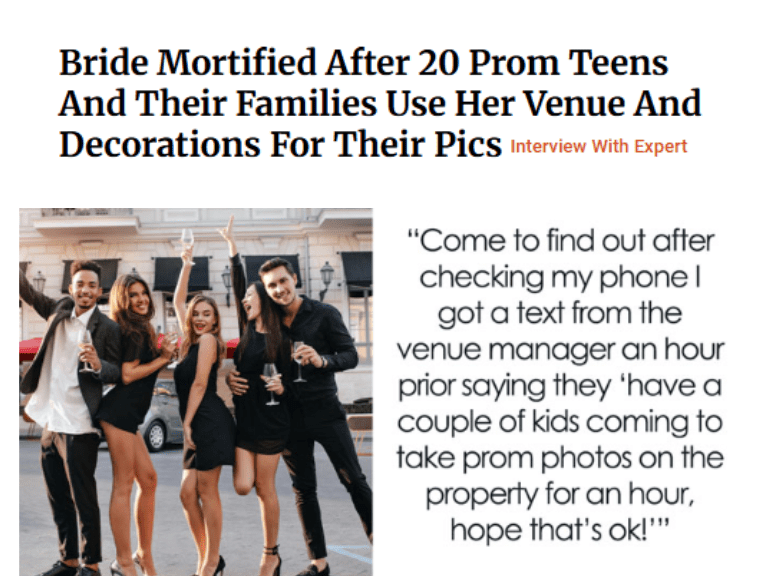
The incident came to light not through a confrontational moment, but through a delayed digital revelation. After the whirlwind of the ceremony and reception had begun to settle, the bride checked her phone, finding a message from the venue manager that had been sent a full hour before her wedding commenced. The text casually noted that the manager had given permission for “a couple of kids” to come and take prom photos on the property for about an hour, concluding with a breezy “hope that’s ok!” This message, arriving without prior consultation and framed as a mere formality, was the first and only notification the paying client received. The reality, as witnessed by the wedding party and guests, was far from a “couple of kids.” Instead, it was a full-scale invasion of approximately twenty teenagers in formal wear, accompanied by what seemed like their entire families, complete with professional photographers, all meandering through the meticulously arranged decorations. The bridal suite, which offered a vantage point of the grounds, became a front-row seat to this surreal and disrespectful spectacle, turning a private celebration into an unwelcome public photo shoot.
This situation spirals far beyond a simple misunderstanding or a minor nuisance. At its core, it represents a significant breach of contract and a profound failure of professional etiquette on the part of the venue management. When a couple books a venue for their wedding, they are not merely renting four walls and a lawn for a time slot; they are purchasing exclusive access and the right to control the environment for which they have paid a considerable sum. The decorations, in this context, are the client’s private property temporarily installed in a rented space. Allowing a secondary group to utilize those decorations—which include everything from arches and linens to personalized signage and floral installations—is akin to letting strangers traipse through a staged home you’ve just bought before you’ve moved in. It dilutes the exclusivity of the event and commodifies the couple’s personal taste and investment for the benefit of outsiders, all without compensation or consent.
The emotional impact of such an intrusion cannot be overstated. A wedding day is a deeply personal, emotionally charged experience where every element is symbolic. The decorations are chosen to reflect a couple’s story, their personalities, and their vision for the beginning of their marriage. They are focal points for ceremony, conversation, and memory. To see strangers posing with them, treating them as a public park’s photo op, robs the couple of the sanctity of those moments. The bride in this story described feeling “mortified,” a word that captures the unique blend of shock, embarrassment, and violation. It introduces a layer of chaos and external energy into a day that is meticulously orchestrated to flow with a certain tone and privacy. The mental image of those prom photos now existing in countless social media feeds and family albums, all featuring her custom decorations, creates a lasting sense of shared ownership over memories that were never meant to be communal.
From a logistical and financial perspective, the ramifications are equally serious. Wedding decorations are fragile and expensive. Floral arrangements can be knocked over, silk draping can be stained, and custom-built installations can be damaged by a crowd much larger than anticipated. Who bears the liability if a teen’s heel punctures a linen or a family leans too heavily on a floral wall? The initial text’s description of “a couple of kids” grossly misrepresented the scale of the incursion, leaving the bride with no opportunity to assess risk or demand insurance verification from the interlopers. Furthermore, this event potentially disrupted the wedding timeline. Photographers and videographers for the wedding have a strict schedule to capture bridal party portraits before guests arrive. Having another large photo session occupying the prime scenic spots, which are often enhanced by those very decorations, can cause delays and force the hired professionals to work around the outsiders, compromising the coverage the couple paid for.
The venue manager’s role in this fiasco is the most glaring point of failure. Their duty is to act as a steward of the client’s interests for the contracted period. A professional protocol would involve discussing any potential dual-use of the property well in advance with the primary client, perhaps during the planning stages, and establishing clear, written boundaries. If such a request arose last-minute, the only acceptable response would be, “I must check with my client and get their explicit permission, as they have exclusive use of the property and their personal decorations are on-site.” The manager’s decision to unilaterally grant permission, followed by a passive-aggressive text notification just an hour before the event, demonstrates a shocking disregard for the client-vendor relationship. It prioritizes a casual favor for an unrelated party over the core service for which the venue was being paid handsomely, treating the wedding as a secondary concern.
This story also opens a broader conversation about social etiquette and entitlement in shared social spaces. The prom teens and their families likely arrived under the impression they had received official permission, which they had from the manager. However, a degree of social awareness is also warranted. Seeing a venue fully decked out in obvious wedding decorations, with a setup clearly indicating a major event is imminent, should prompt a question about appropriateness. Their actions, while facilitated by the manager, show a lack of consideration for the private event they were encroaching upon. It reflects a culture where the pursuit of the perfect picture often overrides basic courtesy, and where access, once granted by any authority figure, is exploited to its fullest extent without thought for the primary stakeholders. The families turned a blind eye to the context, seeing only a beautiful backdrop, not someone else’s personal and paid-for celebration.
In the aftermath, the bride’s recourse is fraught with difficulty. While she can leave scathing reviews and demand a partial refund, the intangible damage to her wedding day experience is irreparable. No apology or financial compensation can un-see the intrusion or restore the exclusive atmosphere she purchased. This case serves as a critical cautionary tale for future couples. It underscores the necessity of having explicit clauses in venue contracts regarding exclusive access and use of personal property like decorations. Questions about venue policy on other photo shoots, tours, or events during the contracted setup and teardown times must be asked upfront and documented. The power dynamic needs to shift from a hopeful trust in the venue’s professionalism to a detailed, legally-backed understanding of what “exclusive use” truly means, ensuring the decorations and the space they occupy remain sacred for the duration of the event.
Ultimately, the heartbreak of this story lies in the theft of a singular moment. Wedding planning is an exercise in focused creation, building a temporary world that embodies a couple’s love. The decorations are the visual language of that world. When outsiders are invited to participate in that world without invitation, its magic is broken, and its meaning is diluted. The venue manager failed to protect that world, choosing instead to offer it as a courtesy to passersby. For any couple planning their day, this experience is a sobering reminder to vet vendors thoroughly, communicate boundaries in writing, and be prepared to advocate fiercely for the sanctity of their vision. Your decorations are more than just pretty things; they are the curated environment of your most important memories, and they deserve to be treated with the same respect and exclusivity as the vows themselves, shielded from any uninvited guests seeking a free backdrop for their own celebrations.
Bride Mortified After 20 Prom Teens And Their Families Use Her Venue And Decorations For Their Pics















5 comments