
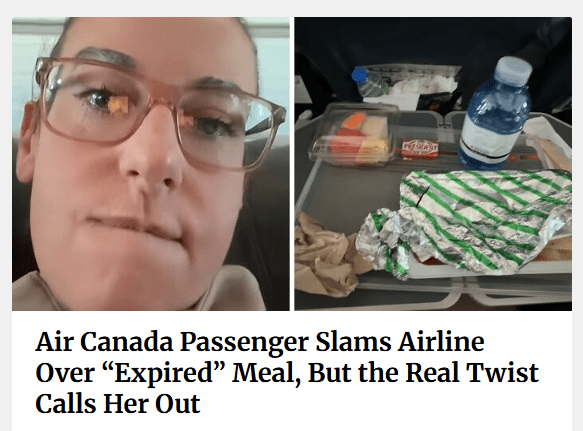
The modern travel landscape is uniquely shaped by the instantaneous power of social media, where a single post can ignite a global conversation before a plane even touches down on the tarmac. This dynamic recently played out in a very public and instructive manner involving Air Canada, when a passenger took to online platforms to express her considerable frustration over what she believed was a serious lapse in safety and service. According to her viral account, she had been served an expired meal during her flight, presenting a photograph of the meal’s packaging with a date stamp that had clearly passed as undeniable proof of the airline’s negligence. This passenger meal complaint quickly captured the collective imagination of the internet, tapping into a deep well of shared air travel grievances and becoming a focal point for discussions about corporate accountability at 30,000 feet. The story spread with the familiar velocity of outrage, painting a seemingly straightforward picture of a cost-cutting airline disregarding the basic well-being of those in its care. Yet, as is so often the case in our interconnected digital world, the initial narrative was merely the opening act, and the full story contained a pivotal twist that would reframe the entire incident, challenging not just the facts of the case but our very understanding of how we interpret the complex systems that operate around us every day.
The passenger’s position was, from her perspective, rooted in irrefutable everyday logic. In our daily lives, we are conditioned to view date stamps on food packaging with utmost seriousness, treating them as clear, binary indicators of safety. We check the expiration on a carton of milk, we scrutinize the best-before label on canned goods, and we discard leftovers that have lingered too long in the refrigerator. This ingrained habit forms a fundamental pillar of our consumer awareness, a simple rule to guard against illness. So, when presented with a packaged meal on an Air Canada flight bearing a date that had come and gone, her reaction was not just reasonable but instinctive. The confined environment of an aircraft cabin amplifies such concerns; you are in a sealed space with limited options, entirely dependent on the carrier for your welfare. A perceived failure in something as basic as food safety feels like a profound breach of trust, transforming a simple tray of food into a symbol of disrespect and systemic failure. Her decision to share this inflight food issue online was therefore driven by a sense of civic duty as much as personal irritation, a warning to others and a demand for accountability from a major corporation that many feel has become impersonal and detached from the human experience of travel.
Air Canada’s response, however, introduced a crucial layer of complexity that the initial viral post had completely overlooked. The airline did not apologize for serving unsafe food but instead provided a detailed clarification regarding the specialized world of airline catering logistics. They explained that the date on the meal packaging was not a passenger-facing expiration date but an internal “production date” or “use-by” label intended for the catering company’s inventory management. In the highly synchronized ballet of preparing tens of thousands of meals daily for hundreds of flights, these dates are essential for kitchen staff to ensure proper stock rotation meals prepared on a Monday for Thursday flights are used before those prepared on a Tuesday for Friday flights. The absolute safety of the food, the airline stressed, is maintained not by that date alone but by a rigorously controlled and unbroken “cold chain.” From the moment meals are assembled and rapidly chilled in the catering facility, through transportation in refrigerated trucks, to storage in chilled aircraft galleys, the temperature is constantly monitored and kept within a strict range that prevents bacterial growth. Therefore, while the meal might have been past its internal kitchen rotation date, it was, according to the carrier’s standards and food safety protocols, perfectly safe for consumption.
This explanation created the unexpected twist in the narrative, effectively calling out the passenger’s complaint not on the grounds of her right to be concerned, but on a fundamental misunderstanding of industry practice. The core of the airline catering explanation revolved around a gap in common knowledge. What the passenger interpreted as a black-and-white safety warning was, in reality, a piece of internal logistical data, akin to a warehouse shelf-life label not meant for the end consumer. The revelation shifted the controversy from a clear-cut case of serving expired food to a more nuanced debate about transparency, communication, and the assumptions we make about the services we use. It raised compelling questions about whether airlines have a responsibility to better educate flyers on these processes or to use more consumer-friendly labeling that differentiates between kitchen management codes and safety expiration dates. The passenger was not wrong to question a past-date stamp, but the airline was also not wrong in its adherence to a different, industry-standard system for ensuring food safety through temperature control rather than date alone.
The entire episode serves as a powerful lens through which to examine the immense and hidden complexity of airline catering, an operation most of us never consider as we unwrap our breakfast omelet over Nebraska. These are not simple kitchens but massive, factory-scale facilities operating with precision akin to a military campaign. A single hub, like the one that likely prepared the meal at the center of this travel controversy, plans menus months in advance, sources ingredients globally, and must account for a dizzying array of variables: flight durations, destination import restrictions, special dietary needs, and the loading sequence of specific aircraft. Meals are prepared in vast quantities, assembled on conveyor lines into trays, flash-chilled to just above freezing, and stored in high-tech refrigerated warehouses. Their journey from that warehouse to your seat is a meticulously timed and temperature-tracked operation, involving refrigerated carts and loaders. The internal date codes are the roadmap for workers navigating this labyrinth, ensuring the first meal prepared is the first one loaded onto the plane. This system, while incredibly efficient, exists almost entirely out of passenger view, making its internal language easily misinterpreted when suddenly presented in the intimate context of a personal meal.
Beyond the logistics, the story also touches on the peculiar psychology of consuming food in the air, which undoubtedly influenced the passenger’s strong reaction. Scientific studies have shown that the aircraft environment itself characterized by low cabin pressure, dry air, and persistent background engine noise significantly dulls our taste buds and sense of smell. This is why airline food is often seasoned more heavily on the ground than food we would eat at home; chefs are compensating for the sensory deprivation we experience aloft. When you combine this physiological effect with the general stressors of travel crowded airports, security lines, cramped seats the in-flight meal becomes more than just nutrition. It transforms into an emotional touchpoint, a small moment of care or disappointment in an otherwise impersonal journey. A good meal can surprisingly elevate the experience, while a disappointing one can cement a feeling of discontent. This underlying emotional charge is the kindling that allows a social media travel story like this one to catch fire so rapidly. The complaint was not merely about a date on a package; it was a visceral reaction that resonated with anyone who has ever felt marginalized or poorly served by the modern travel industrial complex.
Furthermore, the incident highlights the transformed nature of customer service and corporate accountability in the age of viral social media. Decades ago, a similar complaint would have traveled via a letter to corporate headquarters, resulting in a private exchange and, perhaps, a travel voucher. Today, that same complaint is a public performance, broadcast to millions in real-time, with the potential to inflict immediate reputational damage. This shift empowers consumers, giving them a powerful megaphone to demand attention and rectification from large, often faceless, corporations. Airlines like Air Canada must now maintain sophisticated social media teams poised to respond to such public relations events within hours, not days. This new reality can drive higher standards and faster resolutions, benefiting all consumers. However, this dynamic also has a significant downside: it prioritizes the speed of reaction over the depth of understanding. The emotionally charged first narrative sets the agenda, and the company is forced to play defense, attempting to insert factual, often technical, corrections into a conversation that has already solidified around a simpler, more emotionally satisfying storyline of corporate wrongdoing. Managing a public relations crisis in this environment requires a delicate balance of empathy for the customer’s concern and firm clarity in explaining operational realities.
For the average air traveler, this story offers several practical takeaways that extend far beyond a single meal on a single airline. First, it is a reminder that specialized industries often operate with internal protocols and jargon that are not immediately intuitive to outsiders. This doesn’t absolve companies of their duty to communicate clearly, but it does encourage a moment of pause before jumping to the worst possible conclusion. Second, it underscores the importance of context. A date stamp in a home refrigerator means something different than a date stamp on a product held in a verified, unbroken cold chain from factory to point of service. The safest course of action for any passenger with a genuine concern is to politely alert a flight attendant in the moment, allowing the crew to address it directly, whether by offering a replacement or documenting the issue for the catering provider. Finally, as consumers of digital media, we should all practice a degree of healthy skepticism when encountering viral tales of corporate malfeasance. The initial story is frequently compelling, but the full truth is often waiting in the details, requiring us to listen for the twist before rendering our final judgment on the court of public opinion.
In the final analysis, the Air Canada passenger meal complaint that rocketed across social media serves as a profound case study for our times. It began with a familiar and emotionally resonant script: the little guy versus the uncaring corporate giant, with apparent photographic evidence sealing the deal. The twist, emerging from the dry, technical world of food logistics and safety protocols, complicated that clean narrative, revealing a significant chasm between public perception and industrial practice. The meal was likely safe, but the trust was momentarily broken. That rupture was not caused by a failure of refrigeration or sanitation but by a longstanding failure of communication and consumer education. The real lesson here is not about who was right or wrong in a specific dispute over a date label. Instead, it is a broader lesson about the world we now navigate, where complex systems are constantly interacting with individual experiences, and where a single piece of misunderstood data can spiral into a global headline. It argues for greater transparency from corporations in demystifying their operations and for more thoughtful engagement from consumers in seeking understanding before condemnation. The next time we fly, we might look at that sealed meal tray with a bit more curiosity about its incredible journey, a journey governed by science, logistics, and codes we weren’t meant to decipher, all in an effort to deliver us, and our meals, safely to our destination.
Air Canada Passenger Slams Airline Over “Expired” Meal, But the Real Twist Calls Her Out





Downloaded the sv66apps a few days back and I like it! Much easier to play on my phone. Pretty smooth too. Give it a try at sv66apps. May your odds be forever in your favour.