My Family Does A Funny Christmas Card Every Year, And Here Are 17 Of The Best
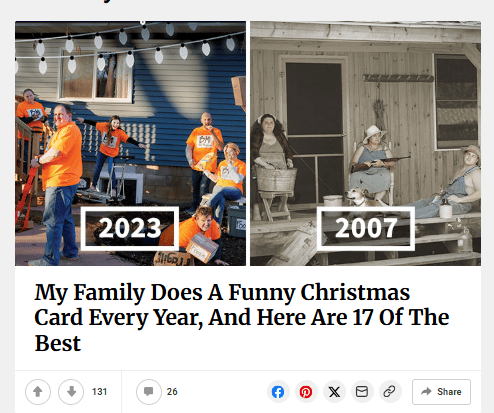
Some families collect ornaments, some families bake the same recipes every December, and some families build gingerbread houses that collapse before anyone gets a photo but our family does something a little different, and after years of keeping it mostly to our mailing list, we are finally sharing the 17 best funny Christmas cards we have ever made with the rest of the world. Every year without exception, rain or shine, busy or exhausted, we carve out time in early December to brainstorm, build, costume, photograph, and print a holiday card that our friends and family will hopefully be laughing about long after the tree comes down. It is one of those beloved American Christmas yearly traditions that started almost by accident and became completely non-negotiable the moment we realized how much joy it spread to everyone on our list. Looking back across 17 of our personal favorites, we are struck by how much each card captures not just a joke but an entire chapter of our family’s life the homes we have lived in, the ages our kids were, the inside jokes that were running that particular year, and the unmistakable spirit of a family that has always believed laughter is the most emotionally powerful Christmas gift you can give the people you love most in the world this time of year.
Of all 17, a handful have earned permanent legendary status in our household and among the people who have followed our card tradition the longest. Card number two made when our kids were barely school age featured the whole family re-enacting a nature documentary with dad narrating from a laminated cue card while the children attempted to look like wildlife in their natural habitat amid a catastrophically decorated living room. Card number six went viral in our neighborhood after we staged a full detective crime scene investigation around a mysteriously missing plate of Christmas cookies, complete with chalk outlines, evidence bags, and a very guilty-looking golden retriever seated next to an empty plate at the center of the scene. These kinds of perfectly cringe-worthy yet completely charming moments are what make a card go from cute to truly unforgettable in the hands of whoever pulls it out of their mailbox on a cold December afternoon. Our cards have always been less about looking good and more about creating something that delivers a genuine burst of joy the kind of deeply thoughtful holiday gift that costs almost nothing to produce but means everything to the person on the receiving end of it every single year.
The process of making each card has changed and grown considerably over the years, evolving from quick-turnaround smartphone snapshots into something that more closely resembles a small independent film production staged in our garage and backyard. Early cards were conceived and shot in a single afternoon, but by card number nine we were dedicating entire weekends to set construction, lighting tests, and what our family now affectionately calls the dress rehearsal a full run-through of poses and expressions the evening before the actual shoot. Card number twelve, our most technically ambitious to date, required building a miniature replica of our town’s main street using foam core and craft paint as a backdrop, then photographing the family as tiny figurines placed inside it using forced perspective. The planning involved a spreadsheet, three separate trips to the craft store, and one very long argument about the correct scale ratio of a stop sign, which we still laugh about every time that card comes up in conversation. This growing commitment to craft and creative ambition reflects something that intentional and deeply purposeful living advocates consistently celebrate the idea that investing real time and energy into joy-making is never a waste but rather one of the most meaningful things a family can choose to do with the natural and fleeting journey of life they share together under one roof.
One of the things we are most proud of when we look across all 17 cards is that they tell an honest story not a curated or filtered one, but a real account of who we actually were in each of those Decembers, including the hard ones. Card number fourteen was made during a year when our family was navigating a significant health challenge, and the concept that year was deliberately simple everyone in pajamas on the couch under a pile of blankets with the caption “We Showed Up. That’s Enough. Happy Holidays.” The response to that card was unlike anything we had received before, with dozens of people reaching out to say it was the most honest and comforting holiday greeting they had received in years. Mental health professionals who focus on emotional resilience and wellness often talk about the healing power of being seen in your imperfection by people who love you, and that card was our family’s most vulnerable and most beloved expression of exactly that truth. It reminded us that the goal of our tradition was never to be the funniest or the most creative it was to be real, to stay connected, and to show the people on our list that no matter what kind of year it had been, we were still here and we still loved them through the lens of a strong and deeply caring family relationship that holds together even in the most challenging and uncertain of seasons.
Seventeen cards in, we cannot imagine December without this tradition, and we genuinely hope that sharing our favorites inspires at least a few families reading this to start their own version whatever that looks like for your household, your budget, your sense of humor, and your crew. You do not need a foam core miniature town or a detective crime scene kit to make something wonderful you need a camera, your people, and the willingness to look completely ridiculous in the name of making someone else smile on a cold December morning when they check their mail. Pair your very first funny card with one of the best Christmas gift ideas of 2026 and you have already created a holiday package that stands out from everything else in the pile. Families working with a careful budget will find plenty of inspiration in a collection of affordable Christmas gifts that look beautifully expensive and pair perfectly with a handmade card full of personality. And for anyone still scrambling to pull it together in the final stretch, the right last-minute Christmas gift idea combined with a genuinely funny card is always, always the combination that people remember and talk about long after every piece of Christmas home decor has been carefully packed away until next year.
A Real-Life Daily Example: It is a grey Wednesday evening in early December in Minneapolis, Minnesota, and the Okafor family is spread across the dining room table surrounded by printed reference photos, a half-eaten bowl of popcorn, and a whiteboard that reads “CARD IDEAS” at the top with eleven increasingly ridiculous suggestions listed underneath it. Mom Adaeze had proposed the tradition three years ago after receiving a particularly brilliant funny card from a cousin in Atlanta, and now it is the one December activity her husband Emeka and their three kids refuse to skip no matter how busy the month gets. This year the family has narrowed it down to two finalists a dramatic soap opera scene staged on the living room couch, or a full wilderness survival parody set in the backyard. The deciding vote goes to their ten-year-old son who picks the wilderness option specifically because he wants to build a fake campfire out of orange tissue paper and flashlights, a detail so specific and so perfectly him that everyone immediately agrees it is the right call. Two weekends later, standing in their snow-dusted backyard in borrowed camping gear while Emeka holds a marshmallow on a stick over a very convincing tissue paper fire, Adaeze realizes this is her favorite afternoon of the entire year not because the card will be perfect, but because her whole family is fully, joyfully, completely present in a single shared moment of pure and uncomplicated joy that no amount of money, planning, or intentional daily routine could have manufactured better than this perfectly imperfect December afternoon together as a family.













4 comments