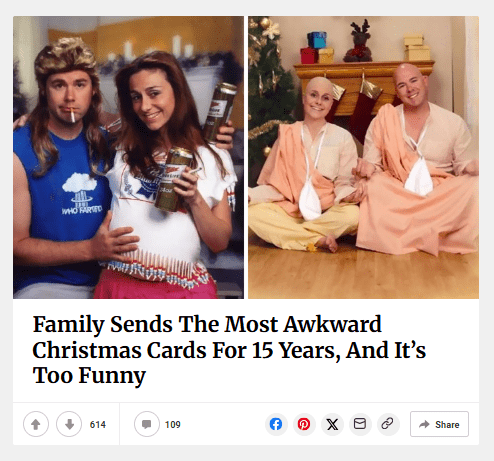
Family Sends The Most Awkward Christmas Cards For 15 Years, And It’s Too Funny

The quest for the perfect family Christmas card is an annual tradition that often involves forced smiles, matching sweaters, and a palpable sense of stress. But for one ingenious family, the entire concept was flipped on its head fifteen years ago, launching a legacy of deliberate, cringe-worthy, and side-splittingly funny holiday greetings that have redefined Christmas family fun. What began as a single sarcastic retort to the pressure of festive perfection has evolved into a beloved, year-anticipated spectacle, proving that sometimes, the most memorable moments are the ones that go gloriously, intentionally wrong. This family’s commitment to engineered awkwardness offers a masterclass in ditching pretense and embracing genuine, laughter-filled connection during the holidays. Their archive of photos isn’t just a collection of jokes; it’s a testament to a shared sense of humor that has bonded them together and, in sharing it with the world, reminded countless others that perfection is overrated.

It all started, as the best family traditions often do, with a mild sense of rebellion. The mother of the family, let’s call her Susan for the sake of their cherished privacy, was poring over the impeccably tidy, beautifully lit cards from friends and feeling the familiar seasonal inadequacy creeping in. Her children were antsy during photo sessions, her husband hated wearing stiff collars, and the whole process felt like a performance. So one year, fueled by a desire to break the cycle, she proposed an idea: what if, instead of fighting the chaos, they simply celebrated it? The initial concept was for just one card, a single release valve for the pressure. They staged a photo where one child was mid-sneeze, another was staring blankly off-camera, and the parents wore painfully forced, exaggerated grins. The result was so instantly hilarious to them that mailing it out felt less like sending a greeting and more like sharing an inside joke.

The reaction from their extended circle was instantaneous and overwhelmingly positive. Relatives called, not to offer polite compliments, but to laugh genuinely and inquire about the backstory. Friends remarked how refreshing it was to receive something that felt authentically human amidst a sea of flawless portraits. That first foray into intentional awkwardness was so successful that it demanded a sequel. Thus, without formally declaring it, a tradition was born. Each subsequent year became a creative challenge, a puzzle to solve in the pursuit of the perfect imperfect picture. The planning, which once was a chore, transformed into a collaborative and eagerly anticipated Christmas family fun event. Discussions would begin as early as fall, with family members pitching increasingly absurd concepts around the dinner table, the laughter building as ideas grew more outrageous.

Over a decade and a half, their portfolio of awkwardness has become impressively diverse, showcasing a remarkable range of comedic timing and commitment to the bit. There was the year they all wore matching neon sweaters several sizes too small, their faces a mix of pained discomfort and resignation. Another classic features the family “hiking” in their living room, complete with a backdrop of a mountain scene, one member holding a compass upside down, and another sipping tea from a floral china cup in full backpacking gear. The commitment to the theme is absolute, which is precisely what sells the comedy. They understand that the humor doesn’t come from a lack of effort, but from an immense amount of effort applied in the wrong, wonderfully bizarre direction. This dedication is the core of their unique brand of holiday celebration.

The logistics of these photoshoots are a form of Christmas family fun in themselves, often more enjoyable than any conventional holiday party. The shoot day is treated as an event, marked on the calendar with a sense of giddy anticipation. There are no arguments about hair being out of place or smiles not being bright enough. Instead, the friction comes from trying not to break character and dissolve into giggles before the timer goes off. Props are sourced from thrift stores or crafted with loving care, costumes are tried on and deemed “awful enough,” and the direction is all about leaning into the awkwardness. The photographer, often a tripod and a remote or a bemused but onboard relative, is tasked with capturing the precise moment of beautifully staged disaster. It’s a collaborative art project where everyone has a role, and the objective is shared joy.

What makes this tradition so profoundly impactful, beyond the laughs, is the authentic bonding it fosters. In a cultural landscape where family interactions can sometimes be reduced to curated snippets on social media, this practice demands real, present, and cooperative engagement. The teenagers, who might typically groan at the idea of a family activity, are often the chief architects of the most cringe-inducing concepts. The parents get to step out of their usual roles and be silly alongside their kids. It creates a shared history not of perfect moments, but of perfectly hilarious ones. The inside jokes born on these photoshoots become part of the family lexicon, referenced throughout the year. This tradition has, in essence, built a fortress of fun around their relationship, with a new brick of shared memory added every holiday season.

The decision to share these cards beyond their immediate circle, eventually leading to viral fame, was almost an accident. A relative posted one of the cards online with a caption about their hilarious family, and the internet, perpetually hungry for authentic and relatable content, seized upon it. Suddenly, this private joke became a public delight. Comments and messages poured in from people across the globe, expressing how the cards had made their day or inspired their own families to take the pressure off the holidays. The family found themselves unintentional ambassadors for imperfect Christmas family fun. They began receiving stories from others who had started their own “awkward card” traditions, finding liberation and connection in the embrace of festive silliness.

This phenomenon touches on a deeper, almost universal holiday experience: the anxiety of performance. The pressure to create a “perfect” Christmas, from the meal to the decorations to the family photo, can be immense and ironically joy-sapping. This family’s fifteen-year project serves as a brilliant, ongoing satire of that very pressure. By willfully creating the “disaster” everyone fears, they completely disarm it. They demonstrate that the moments we remember and cherish are rarely the pristine ones, but the ones filled with genuine emotion, even if that emotion is uncontrollable laughter at a ridiculous situation. Their cards are a permission slip for everyone to exhale and embrace the beautiful, messy reality of family life.

The artistic evolution of the cards over fifteen years is also worth noting. What began as simple, spur-of-the-moment awkwardness has grown into elaborate tableaus with intricate narratives. There’s a cinematic quality to some of the later cards, as if they are stills from a particularly offbeat indie comedy. One might depict a tense, faux-family board game night, with cards flying and someone mock-upsetting the monopoly board. Another might show them attempting to build a tent in the snow, with the tent clearly collapsing in the background. This progression shows that their commitment has never wavered; it has only deepened, with more thought, creativity, and resources poured into each year’s project. It’s a creative outlet that the entire family owns together.

Furthermore, this tradition has provided a remarkable, visual timeline of the family’s life. Flipping through the fifteen cards, you see children grow up, hairstyles change, and backgrounds shift. Yet, the through-line of intentional, loving humor remains constant. It’s a poignant record, not just of aging, but of a consistent choice to find joy together. In years that may have contained personal challenges or global difficulties, the card photoshoot was a sacred space of levity. This highlights another layer of the tradition’s meaning: it’s a resilient ritual. No matter what the year brought, they came together to create something absurd and joyful, reinforcing their unit and their unique identity as a family that doesn’t take itself too seriously.

The viral acclaim and media attention have been handled by the family with a gracious and grounded spirit. They haven’t commercialized their tradition or let the outside noise distort its original, private purpose. They still create the cards first and foremost for themselves and their loved ones. The public enjoyment is a happy bonus. This integrity is key to why the story remains so heartwarming and not just a fleeting internet meme. It feels authentic because it is. The Christmas family fun they experience is the core product; the viral fame is merely a byproduct. This authenticity resonates deeply in an age where so much content is manufactured for clicks alone.

Engaging in this level of planned awkwardness also requires a healthy dose of confidence and security. Sending a card where you’re deliberately portrayed in an unflattering or bizarre light is an act of vulnerability. It says, “This is us, we are not perfect, and we find joy in that fact.” It’s a rejection of external validation in favor of internal celebration. This kind of confidence is a powerful gift that the parents have modeled for their children. It teaches that self-worth isn’t tied to presenting a flawless image, but to being authentic and connected. The tradition, therefore, is imparting life lessons wrapped in the guise of holiday hijinks, lessons about creativity, resilience, and the strength of familial bonds forged in laughter.

As we look toward future holiday seasons, one can’t help but wonder what this inventive family will dream up next. The anticipation from their now-global audience is a testament to the bright spot they’ve carved into the holiday landscape. Their story encourages us all to examine our own traditions. Must the Christmas card be a source of stress, or can it be a canvas for creativity and connection? Do our holiday gatherings need to be Pinterest-worthy, or can they be platforms for genuine, unscripted interaction? The invitation is clear: to prioritize connection over curation and to find the Christmas family fun that is uniquely yours, even if it looks wonderfully weird to everyone else.

In a world that often feels overly curated and intensely serious, the fifteen-year saga of these awkward Christmas cards is a beacon of delightful, unadulterated joy. It reminds us that the spirit of the holidays isn’t found in flawless execution, but in the shared experience, the inside jokes, and the courage to be authentically, hilariously ourselves with the people we love most. Their legacy is one of laughter, a visual chronicle proving that the strongest family traditions are often the ones that break all the rules of convention. This family, through their unwavering commitment to cringe and comedy, has given us all a timeless recipe for holiday happiness: take one part rebellion against perfection, mix with equal doses of creativity and collaboration, and garnish with the liberating power of not caring what anyone else thinks. The result is the purest, most memorable form of Christmas family fun imaginable.

Family Sends The Most Awkward Christmas Cards For 15 Years, And It’s Too Funny

One thought on “Family Sends The Most Awkward Christmas Cards For 15 Years, And It’s Too Funny

Leave a Reply

Your email address will not be published. Required fields are marked *