
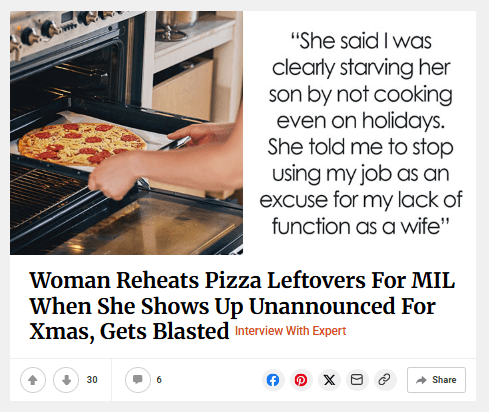
The festive season is supposed to be a time of joy, connection, and cherished traditions, but for one woman, a single unexpected knock on the door turned her quiet Christmas celebration into a viral family feud that has everyone talking. The core of the story is simple yet profoundly relatable: a mother-in-law decides to show up for Christmas dinner completely unannounced, expecting a feast, only to be served reheated pizza leftovers from the night before. The fallout was immediate and severe, sparking a fierce debate that stretches far beyond a single kitchen and touches on modern family dynamics, the weight of holiday expectations, and the very definition of hospitality during what many consider the most important family holiday of the year. This incident, shared anonymously on a popular forum, didn’t just cause a family argument; it ignited a global conversation about the unspoken rules of Christmas and whether they need a serious rewrite for our current era.
Imagine the scene: a couple, let’s call them Anna and Mark, had decided on a low-key holiday. After a hectic year, with both working demanding jobs, they chose to forgo the stress of hosting a large gathering or traveling. Their Christmas plan was beautifully simple a cozy day in, enjoying each other’s company, perhaps watching a movie, and definitely eating the delicious homemade pizza they had lovingly made together as a special treat on Christmas Eve. The day itself was unfolding in that peaceful, slow manner that feels like a gift in our busy world. The tree was lit, the atmosphere was relaxed, and the leftover pizza was in the fridge, a planned part of their relaxed festive menu. There was no elaborate turkey in the oven, no table set for a crowd. Their version of Christmas was intentionally minimalist, a conscious choice to prioritize rest and personal connection over performative tradition.
This carefully cultivated peace was shattered by a firm knock at the door. To their utter surprise, it was Mark’s mother, standing on the doorstep with a wrapped present in hand and an unmistakable expectation of a full holiday welcome. She had driven over an hour on a whim, believing that of course her son would be home and of course there would be a Christmas dinner happening. The initial shock gave way to a flurry of awkward greetings. Anna, feeling completely blindsided, scrambled to be a gracious hostess despite the total lack of preparation. She offered drinks, made pleasant conversation, and as the lunch hour approached, faced the inevitable dilemma. With no prepared meal beyond their personal leftovers, her options were stark: order expensive takeout last-minute on a day when most places are closed, attempt to whip up a feast from sparse pantry staples, or serve what they had. She chose the path of honest, if unconventional, hospitality: she warmly offered the homemade pizza, reheated to perfection and presented on their nice plates.
The reaction was not one of understanding or shared amusement at the situation. Instead, it was a cold silence that deepened into clear disapproval. According to Anna’s account, her mother-in-law ate a single slice with palpable disdain before the criticisms began to flow. The central accusation, which has become the lightning rod of the online debate, was that Anna was “clearly starving her son by not cooking even on holidays.” The older woman expressed her shock and disappointment that a wife would allow her husband to eat leftovers on Christmas Day, interpreting the lack of a traditional roast dinner not as a mutual choice but as a personal failing. She reportedly told Anna to “stop using my job as an excuse for my lack of function as a wife,” framing career commitment as a convenient cover for domestic neglect. This moment transcended a simple disagreement over food; it was a clash of ideologies, where the mother-in-law’s deeply ingrained blueprint for a proper Christmas centered on a wife’s labor of love in the kitchen collided head-on with the couple’s modern, egalitarian partnership.
The aftermath within the home was tense and painful. Mark, caught in the classic crossfire between his wife and his mother, initially seemed paralyzed. The visit ended early and frostily, leaving a cloud of resentment hanging over the remainder of the couple’s holiday. Feeling isolated, judged, and furious, Anna turned to the internet, posting her story to a community forum seeking validation and advice. What she received was a firestorm. The post quickly bled from that forum onto major social media platforms, generating tens of thousands of comments, shares, and think-pieces. The court of public opinion was immediately, and passionately, divided. One camp rallied firmly behind Anna, championing her right to a peaceful holiday and her creative solution to an unreasonable situation. They argued that an unannounced guest, on any day but especially on Christmas, forfeits the right to make demands on the host’s menu or effort. For them, the real transgression was the mother-in-law’s entitlement, not the pizza.
The other camp, however, was equally vehement in its condemnation of Anna’s actions. For this group, Christmas carries a non-negotiable social contract. It is a day when hospitality, abundance, and effort are paramount, regardless of circumstance. To serve leftovers to a guest, and a family elder no less, was seen as the ultimate act of disrespect a passive-aggressive snub that deliberately undermined the spirit of the day. These commentators argued that even with minimal notice, a simple pasta dish or a quick run to the store could have and should have been mobilized. The pizza, in their view, was a symbol of laziness and a pointed message that the guest was not valued enough to warrant even basic effort. This side of the debate often echoed the mother-in-law’s own words, framing the issue as one of fundamental care and respect, with the meal serving as its primary currency.
To move beyond the emotional ping-pong of online comments, it’s crucial to examine the deeper social frameworks at play. Dr. Eleanor Vance, a sociologist who studies family rituals and holiday stress, provides some illuminating context when asked about such conflicts. “The Christmas holiday is arguably the most ritual-saturated event in the modern secular calendar,” she explains. “It comes loaded with a specific script decorations, gifts, specific foods, and specific roles. The ‘Christmas dinner’ is the central act of this script, and historically, its preparation has been coded as a feminine, wifely duty of care.” Dr. Vance notes that when someone, like the mother-in-law in this story, operates strictly from this traditional script, any deviation is not merely a different choice but can feel like a personal rejection or a failure of morality. The accusation of “starving her son” is particularly telling, as it connects the act of cooking directly to a wife’s core function of nurturing and sustaining her family.
Conversely, Dr. Vance points out, younger couples are increasingly authoring their own scripts. “For many modern couples, especially dual-career ones, the value of a holiday might be consciously placed on relaxation, equality, and escaping the very performance pressures their parents’ generation upheld. A homemade pizza made together on Christmas Eve can represent a shared, joyful ritual that holds more meaning for them than a stressful, solo day of cooking a turkey.” The conflict, therefore, is less about pepperoni versus ham and more about whose definition of a “proper” Christmas holds authority. The unannounced arrival was, in a symbolic sense, an enforcement of the old script, a surprise audit on whether the couple was performing the holiday correctly. The reheated pizza was the couple’s lived reality and their chosen script asserting itself in response.
This brings us to the pivotal, and often overlooked, figure in the drama: Mark, the husband and son. His role in the unfolding events is a critical piece of the puzzle. According to Anna’s narrative, his reaction in the moment was muted, a fact that undoubtedly amplified her feeling of being alone under attack. The dynamics of a marriage are tested acutely when original family and chosen family collide, and holidays are the prime battlefield. A key question many online debaters posed was: where was his voice? Should he have more firmly managed his mother’s expectations from the door? Could he have gracefully run interference, perhaps by enthusiastically praising the pizza as a special tradition he and his wife loved? His perceived silence places the entire burden of the confrontation and the subsequent “failure” of hospitality squarely on Anna’s shoulders, reinforcing the very gendered dynamic their low-key Christmas was meant to avoid.
The concept of hospitality itself is under a microscope in this story. Traditional etiquette guides are quite clear: a host should provide the best they can to a guest. However, those same guides also emphasize the responsibility of the guest, which includes, fundamentally, not arriving unexpectedly at mealtime on a major holiday. Modern interpretations of hospitality are increasingly leaning toward mutuality and authenticity. It values the host’s right to set the tone of their own home and the guest’s responsibility to be grateful for whatever welcome is offered. In this framework, Anna’s offer of a thoughtfully made, homemade meal even if it was from the previous night could be seen as an authentic extension of her home’s current reality. It was a genuine, if unconventional, sharing of what they had. The mother-in-law’s rejection of it was a rejection of that authenticity in favor of a rigid performance she had anticipated.
Financial and logistical realities also cannot be dismissed as mere “excuses,” as the mother-in-law framed them. The week of Christmas is notoriously expensive. Grocery bills skyrocket, and planning a large meal requires a significant budget and a detailed shopping list done days in advance. To suddenly scale a meal for an extra person, especially when that person expects a holiday feast, is not always a simple or affordable task. Many commenters shared their own stories of the intense financial stress the season brings, arguing that the expectation to always have a lavish, expandable spread ready is a relic of a different economic time. For a couple who had intentionally kept their celebration small and within a tight budget, the unplanned arrival created an implicit pressure to spend money they may not have allocated, adding financial anxiety to the social conflict.
At its heart, this story is about boundaries how we set them, how we communicate them, and how we react when they are crossed. A holiday, especially one as symbolically charged as Christmas, amplifies every interaction. An unannounced visit on a regular Tuesday might be a minor annoyance. On Christmas Day, it feels like a fundamental invasion of a private, sacrosanct space. The couple had a clear, implicit boundary: this was to be their quiet day together. The mother-in-law, whether out of loneliness, tradition, or a desire for control, crossed that boundary without permission. Anna’s response with the pizza can be interpreted as a boundary-setting act in itself. It was a quiet statement that said, “You are welcome in our home, but you have entered our existing plan, not a plan designed for you.” The explosive reaction proves just how threatening such a statement can be to established family hierarchies.
The viral nature of the story itself is a fascinating modern twist. Decades ago, this would have remained a private family argument, rehashed at gatherings for years. Today, it is global public property, dissected by strangers who project their own family dramas, hopes, and frustrations onto Anna and her mother-in-law. This public dissection creates a strange form of social benchmarking. People are not just commenting; they are implicitly defining their own family’s normal. They are asking themselves, “What would I have done?” and, more tellingly, “What would I expect?” The story has become a Rorschach test for our collective values around family, obligation, and the right to personal peace during the holidays. It holds up a mirror to our own potential for entitlement or for rebellion against outdated norms.
So, where does this leave us when the last slice of pizza is gone and the comments finally slow down? The path forward for this particular family, should they choose reconciliation, will require difficult, honest conversations. It would require the mother-in-law to examine her assumptions and the hurtful nature of her words, to see her son not as someone being deprived but as an adult man actively co-creating a happy life with his partner. It would require Mark to step fully into his role as a husband, to communicate their shared choices to his mother with clarity and unity, and to protect the sanctity of the home he is building. And it would require Anna, if she wishes, to find a way to understand the generational script her mother-in-law was following, even while firmly holding to her right to write a different one for her own marriage.
The broader lesson, however, is for all of us navigating the complex tapestry of modern family life. This Christmas drama is a potent reminder that the spirit of the season is not stored in a particular menu or a mandatory display of domestic labor. The true spirit of Christmas, stripped of its commercial and performative baggage, is supposed to be about goodwill, generosity of spirit, and love. Sometimes, generosity of spirit looks like a perfectly set table with a golden turkey. Other times, and just as validly, it looks like warmly sharing the simple, honest food you have with an unexpected guest, without apology. It can look like respecting a couple’s chosen peace. It can look like accepting a gift of hospitality in the form it is offered.
Perhaps the most radical act of Christmas love is releasing each other from the prison of expectation. It is understanding that a family’s holiday can be joyful and meaningful even if it doesn’t match the picture on a greeting card. It is recognizing that roles have evolved, that “function” in a marriage is now a shared duty, and that a wife’s worth is in no way measured by her oven’s output on December 25th. The next time we feel a judgment rising about how someone else chooses to celebrate or not celebrate we might pause and remember this story. We might choose curiosity over criticism, and we might ask ourselves if our idea of a perfect Christmas is leaving room for others to find their own version of perfection, even if it’s served on a paper plate with a side of cold disbelief. The hope is that future holiday seasons can be less about audited traditions and more about mutual understanding, ensuring that the joy of Christmas isn’t lost in the heat of an unexpected oven or the reheating of a very symbolic pizza.
Post Reference:
Woman Reheats Pizza Leftovers For MIL When She Shows Up Unannounced For Xmas, Gets Blasted




S666welcome, eh? Never heard of ’em ’til now. Gave their site a quick once-over. Looks kinda flashy. Wonder if the games are any good. Anyone tried it? Here’s the link: s666welcome
After research just a few of the blog posts on your web site now, and I truly like your approach of blogging. I bookmarked it to my bookmark website checklist and will be checking back soon. Pls take a look at my website online as well and let me know what you think.