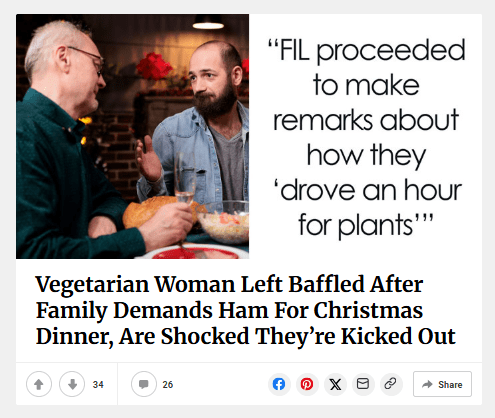
The holiday season, with its twinkling lights and familiar carols, is meant to be a time of joyful reunions and cherished traditions. For many, the heart of Christmas beats strongest around the dining table, where generations gather to share a meal steeped in memory and meaning. Yet, for one woman, this year’s Christmas celebration transformed from a anticipated gathering into a bewildering clash of values, leaving her questioning the very essence of family and tradition during what should be the most wonderful time of the year. Her story, which has resonated with thousands online, begins with a simple, heartfelt invitation to her closest relatives for a festive Christmas dinner at her home. As a long-term vegetarian who had built a life around conscious, plant-based choices, she envisioned a celebration that reflected her values while honoring the spirit of generous hospitality. She spent days meticulously planning a lavish menu free of animal products, sourcing the finest ingredients to create a feast that was both ethically sound and culinary delightful, hoping to show her family that a Christmas spread could be abundant and joyous without a centerpiece of meat. The conflict, however, was simmering long before the first guest arrived, rooted in a fundamental disconnect about what constitutes a proper holiday meal and whether personal convictions must bow to familial expectation when the Christmas clock strikes December twenty-fifth.
The woman, whom we’ll refer to as Sarah to respect her privacy, had been transparent about her lifestyle with her family for years. Her decision to embrace vegetarianism was born from a deep concern for animal welfare and environmental sustainability, principles she held as core to her identity. She never preached or demanded others change, but quietly lived her truth, hoping her choices would be respected as hers alone. When she offered to host the major family Christmas gathering, she saw it as an opportunity to share a piece of her world, to demonstrate the creativity and richness of plant-based cuisine during a holiday often dominated by turkey and ham. She excitedly detailed her menu in a group chat: a savory nut roast with rich gravy, crispy roast potatoes and parsnips, homemade stuffing bursting with herbs, a colorful array of honey-glazed carrots and Brussels sprouts, and even a show-stopping vegan dessert. The response, initially, was muted a few thumbs-up emojis and a “sounds interesting” from her mother. The silence, she would later realize, was not acceptance but a quiet assumption that she would, of course, provide the “real” Christmas staples for everyone else.
The tension erupted into a full-blown crisis just three days before Christmas. Sarah’s brother-in-law, Mark, called her directly. His tone was not one of holiday cheer but of blunt demand. “Listen, Sarah,” he said, bypassing any seasonal pleasantries. “We’re all driving an hour to get to your place. My wife and the kids, we’re making a real effort to be there for Christmas. But we need to know you’re serving a proper dinner. We need a ham. A real, traditional honey-baked ham. You can’t expect everyone to just eat… plants.” Sarah was stunned into silence. The phrase “just eat plants” echoed in her ear, reducing her carefully planned, labor-intensive feast to an inadequate sideshow. She took a breath and calmly explained, once again, that her home was a meat-free space and that the dinner would be a beautiful, complete Christmas meal honoring her ethics. The call ended tersely, with Mark grumbling that he would “figure something out.” Sarah hoped that was the end of it, a minor grumble that would dissolve in the face of good food and company. She was wrong.
Christmas Day arrived, crisp and clear. Sarah’s home was filled with the warm, comforting scents of roasting vegetables, herbs, and spices a symphony of aromas that, to her, spelled Christmas. The table was set with her best china and a centerpiece of pine and holly, everything ready for a peaceful, loving gathering. When the doorbell rang, her heart lifted. That lift was short-lived. As she opened the door, her smile froze. There stood her sister, brother-in-law Mark, their two children, and her parents. And in Mark’s arms, resting on a disposable foil tray as if it were a sacred offering, was a large, glazed ham. It was still warm, steaming slightly in the cold air, a direct and visceral challenge to everything Sarah stood for in her own home. “We figured you wouldn’t mind,” Mark said, already stepping across the threshold. “We stopped by a market on the way. Now we can all have a real Christmas dinner.”
The scene that unfolded was one of surreal discomfort and rising disbelief. Sarah, rooted to the spot, felt a wave of emotions disrespect, anger, and profound bafflement wash over her. This was not a minor oversight or a forgotten dietary preference; this was a deliberate, premeditated act of disregard. They had not only dismissed her values but had actively planned to override them in the one space where she should have had autonomy. She asked them, her voice trembling slightly, to please leave the ham outside or in their car, explaining that its presence in her kitchen and on her table violated a fundamental boundary. What followed was not an apology or a retreat, but outrage. Her mother chimed in, saying, “Sarah, don’t be difficult. It’s Christmas! We drove an hour for this. We can’t just throw away a perfectly good ham.” The phrase “drove an hour” became a weaponized mantra, a justification for trampling her clearly stated rules. It was as if the effort of their travel had purchased them a license to dictate the terms of her hospitality, turning the guest-host relationship on its head during a holiday built on mutual giving.
The standoff in the doorway encapsulated a much larger cultural debate about family obligations, personal boundaries, and the sometimes tyrannical weight of holiday tradition. For Sarah’s family, Christmas was an immutable script: certain foods, certain rituals, certain concessions for the sake of “togetherness.” Their demand for ham was not merely a culinary preference but a symbolic insistence on normalcy, on a version of Christmas that felt familiar and unchallenged. In their view, Sarah’s vegetarianism was the disruption, the inconvenient variable that needed to be managed or worked around. They saw bringing the ham as a pragmatic compromise “everyone gets what they want.” They completely failed to see that for Sarah, it was an invasion, a statement that her deeply held ethical beliefs were less important than their temporary desire for a specific flavor. The confrontation was about far more than meat versus plants; it was about whether an individual’s identity must be shelved for the comfort of the group when the calendar reads December twenty-fifth, and who bears the burden of flexibility during the Christmas holiday.
Sarah’s decision, made in a flash of clarity amidst the rising din of argument, was one she never imagined making on Christmas Day. She looked at the faces before her faces she loved, now etched with entitlement and annoyance rather than holiday warmth and at the ham that symbolized their collective dismissal of her. With a calm she didn’t know she possessed, she reiterated her boundary. “I invited you into my home for a Christmas dinner I worked very hard to make,” she said. “I told you it would be vegetarian. You chose to disrespect that and bring something I explicitly said was not welcome here. I am sorry, but you cannot come in with that. If you cannot respect my home, you cannot come in.” The shock that registered on their faces was total. Spluttering protests followed accusations of ruining Christmas, of being unreasonable, of putting “animals before family.” But Sarah held firm, the pain of the moment sharpened by a fierce resolve to stand by her principles. Eventually, in a storm of muttered insults and slammed car doors, her family left, taking their Christmas ham with them. She was left alone in her beautifully decorated, silent home, the aromas of a now-orphaned feast filling the air, her heart pounding with a mixture of devastation and unexpected empowerment.
In the days that followed, Sarah shared her experience in an online community, seeking solace and understanding. She was braced for criticism, for being labeled the “difficult” one who broke up a family Christmas. Instead, she was met with an avalanche of support from thousands of people who had faced similar clashes. Her story struck a nerve because it was about more than dietary choices; it was a parable for anyone who has ever felt pressured to shrink their beliefs, mute their identity, or surrender their boundaries for the sake of “keeping the peace” during a holiday. The responses poured in, with many sharing their own tales of family friction over politics, lifestyle choices, and personal values that come to a head under the intense, magnifying lens of Christmas pressure. People discussed the emotional labor of hosting, the one-sided expectation of compromise, and the pain of realizing that familial love sometimes comes with rigid conditions, especially when traditions are perceived to be under threat.
The incident forces us to examine the often-unquestioned dynamics of family gatherings, particularly during high-stakes holidays like Christmas. Why is the onus of accommodation so frequently placed on the person who deviates from the norm, rather than on the group to expand its definition of tradition? The family’s perspective, while delivered with profound insensitivity, likely stemmed from a place of their own rigidity. For them, a Christmas without the specific iconography of a ham or turkey might have felt empty, less authentic, a break in a chain of memory that connected them to their own past Christmases. Their error was in believing their tradition was the tradition, an objective truth to which Sarah was willfully blind, rather than one subjective way of celebrating. They framed her boundaries as an attack on Christmas itself, rather than an invitation to experience the holiday through a new, equally valid lens. This failure of imagination and empathy is at the core of so many family conflicts, where love becomes conditional on conformity, and the holiday spirit is mistaken for unanimous surrender to a single, unchanging script.
Sarah’s story also highlights the evolving nature of Christmas in a rapidly changing world. The holiday, for all its ancient roots, is not a museum piece but a living tradition that has always adapted to the cultures and times that celebrate it. The “traditional” Christmas dinner varies enormously from country to country and even from family to family. For Sarah to create a new tradition a compassionate, plant-based feast was not an act of erasure but one of contribution, an offering of a new kind of Christmas abundance. Her family’s violent rejection of that offering speaks to a fear of change, a clinging to symbols as anchors in an uncertain world. Yet, the true spirit of Christmas, one could argue, is not found in the preservation of specific menu items but in the principles of kindness, generosity, and respect for one another. By demanding she violate her ethics, Sarah’s family ironically abandoned those very principles in the name of upholding the holiday’s superficial form.
The concept of hospitality, so central to the Christmas story itself, became twisted in this encounter. Traditionally, hospitality involves a host offering what they have with an open heart, and a guest receiving that gift with gratitude. Sarah fulfilled her role with painstaking care and generosity. Her family, as guests, transformed their role into one of demand and entitlement. They confused an invitation with a catering contract, believing their attendance was a favor that required specific compensation in the form of a ham. This transactional view of a family holiday gathering strips it of its grace and turns it into a tense negotiation of wants and obligations. The magic of Christmas, when it works, exists in the space beyond transaction in the unearned gift, the unwarranted kindness, the welcome extended without a list of preconditions. Sarah offered that; her family, tragically, could not see it through the glaze of their expected ham.
In the aftermath, the path forward for Sarah and her family is fraught but not necessarily hopeless. Such a dramatic rupture can sometimes serve as a painful but necessary catalyst for clearer communication and healthier dynamics. For reconciliation to occur, her family would need to move beyond seeing her actions as a simple rejection of them, and begin to understand them as an affirmation of her own self. They would need to apologize not for wanting ham, but for disrespecting her home and her convictions, for using the pressure of Christmas as a tool of coercion. Sarah, for her part, may need to find ways to reaffirm her love for them while remaining steadfast in her boundaries, perhaps suggesting alternative ways to celebrate that don’t center on a shared meal at her home until mutual respect is re-established. The work of repairing this rift is immense, and it may forever change the texture of their future Christmases, potentially making them quieter, or more distant, or perhaps, eventually, more authentic and respectful.
This singular Christmas dinner debacle serves as a powerful microcosm for the countless quiet battles fought in homes every December. It asks us where we draw the line between family harmony and personal integrity, between tradition and progress, between the meal we expect and the hospitality we are offered. Sarah’s bafflement is understandable; it is shocking to confront the depth of disregard that can surface under the banner of holiday cheer. Yet, her ultimate decision, while painful, speaks to a growing cultural recognition that love should not require self-betrayal, not even on Christmas. The holidays can amplify both the best and worst in our relationships, testing our capacities for empathy and respect under a spotlight of shared expectation. The hope, perhaps, is that stories like Sarah’s encourage more families to enter the season with open hearts rather than rigid checklists, to prioritize the people over the props, and to remember that the greatest Christmas gift one can offer or receive is the gift of being seen, accepted, and respected for exactly who you are, at the dinner table and beyond. The true spirit of the season must be flexible enough to include new traditions and deep respect, or it risks becoming a hollow ritual that divides rather than unites, a lesson learned too late by a family who chose a ham over harmony one unforgettable Christmas.
Post Refence:

Yo, 58win1vip, heard about this site from a buddy. Gave it a look, seems decent enough. I’d say give it a try: 58win1vip
Spot on with this write-up, I really suppose this web site wants far more consideration. I’ll most likely be again to learn rather more, thanks for that info.