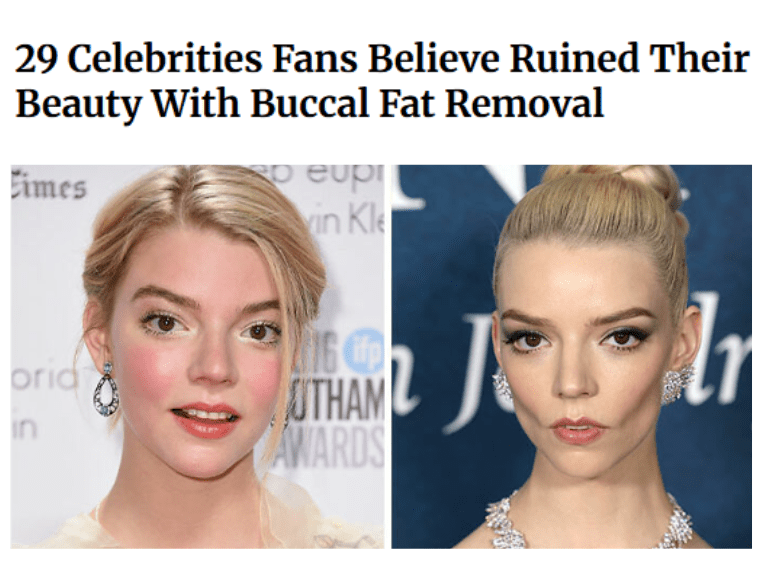
The world of celebrity beauty is a constantly shifting landscape, where trends emerge with the ferocity of a summer storm and often fade just as quickly. Among the most talked-about and, according to a vocal contingent of fans, most regrettable trends of recent years is the surgical procedure known as buccal fat removal. This cosmetic surgery, which involves the removal of the buccal fat pads from the lower cheeks, promises a more sculpted, defined, and often more mature facial structure by creating a pronounced hollow beneath the cheekbones. The allure of this chiseled, high-fashion aesthetic has proven irresistible to a surprising number of stars, leading to a wave of transformations that have left audiences and admirers deeply divided. While the intention is typically to refine one’s appearance, a growing consensus suggests that for many celebrities, buccal fat removal has inadvertently stripped away the very essence of their signature beauty, leaving behind a look that can appear gaunt, aged, or unnaturally severe. This conversation moves beyond mere critique of personal choice and ventures into a fascinating discussion about facial harmony, the permanence of surgical decisions, and how a single alteration can fundamentally alter the public’s perception of a familiar face.
The procedure itself is deceptively simple in concept but monumental in its impact. The buccal fat pads are natural, rounded pockets of fat located in the lower part of our cheeks. For some individuals, these pads are more prominent, contributing to what is often colloquially called a “baby face” or a rounder, softer facial contour. Buccal fat removal surgically excises a portion or all of this fat, a change that is entirely permanent, as the removed tissue does not grow back. The immediate goal is to carve out a sharper jawline and more pronounced cheekbones, an aesthetic that aligns with certain runway and editorial beauty standards that prize angularity and bone structure over softness. In the right candidate someone with naturally full cheeks and strong bone structure underneath the results can be subtle and enhancing. However, the irreversible nature of this surgery becomes a significant point of contention, especially as the human face naturally loses volume with age. What might look sculpted and chic at thirty can evolve into a overly hollowed and aged appearance by forty, as the body’s own natural aging process compounds the surgical reduction.
This is precisely where fans have observed what they believe to be a cascade of aesthetic missteps across Hollywood. The list of celebrities who have reportedly undergone the procedure reads like a roster of some of the most distinctive and beloved faces in the industry. Take, for instance, an actress renowned for her girl-next-door charm and relatable persona; fans argue that her decision to undergo buccal fat removal traded her warm, approachable glow for a somewhat stern and generic sharpness. Her cheeks, once full of youthful expression, now seem taut and less mobile, subtly changing the character of her smile and the way light falls on her face in every on-screen close-up. Similarly, a young starlet who rose to fame with a plump, cherubic visage that defined her early career now sports a dramatically more mature and hollow look, a transformation so stark it often becomes the primary topic of discussion around her new projects, overshadowing her performances. The alteration has aged her significantly in the eyes of the public, demonstrating how a procedure sought for refinement can have the opposite effect.
The critique extends deeply into the realm of male celebrities as well, challenging the notion that these procedures are solely the domain of actresses. A certain heartthrob actor, famous for his boyish, all-American looks that launched a thousand teen magazine covers, emerged one year with strikingly sunken cheeks. The change was jarring for his fanbase, who had associated his appeal with a certain robust, youthful vitality. The new hollows where softness once resided introduced a harder, more fatigued aura to his appearance, one that seemed at odds with the roles that made him famous. In another case, a comedian and actor known for his expressive, rubber-faced antics found his signature expressions somewhat muted after the apparent procedure. The reduced padding in his lower cheeks seemed to pull his facial movements into a different, tighter configuration, leading some fans to lament that a tool of his comedic trade his wonderfully mobile face had been subtly compromised in pursuit of a sculpted cheekbone.
Beyond individual cases, the phenomenon sparks a broader conversation about beauty standards, conformity, and the loss of unique character in an era of cosmetic homogenization. Hollywood has long been criticized for a certain sameness in beauty, but buccal fat removal appears to be creating a new subtype of uniform look: the hollow-cheeked, ultra-sculpted face. Fans mourn not just the changed appearance of a specific star, but the erosion of the diverse spectrum of faces that populate our screens. The round face, the square jaw, the soft cheek these are all being funneled toward a singular ideal of sharp angularity. This trend raises poignant questions about industry pressure. Are actors and actresses feeling compelled to adopt this look to be considered for serious, dramatic roles, as if softness equates to a lack of depth? The message being perceived is that to transition from a “teen star” to an “adult actor,” one must literally carve away the youthfulness of their face, a metaphor that is as disturbing as it is literal.
The medical and aesthetic community is also divided on the trend. Many responsible plastic surgeons now express caution, highlighting the permanence of buccal fat removal and its potential long-term consequences. They emphasize that facial fat is a precious commodity that depletes over time; removing it surgically in youth is like spending a retirement savings account in your twenties. As one ages, the face naturally loses subcutaneous fat and collagen, leading to a descent of tissues. Without the buccal fat pads to provide underlying support and volume, this aging process can accelerate in the mid-face, leading to deeper nasolabial folds, a more pronounced jowling effect, and a generally gaunt appearance that can be difficult to correct later. Some surgeons report an increase in patients seeking fat transfer or filler procedures to restore volume lost from overly aggressive buccal fat removal years prior, a sobering testament to the procedure’s irreversible impact.
Public reaction on social media and fan forums has been unforgiving and emotionally charged. Comment sections beneath recent photos of affected celebrities are often filled with concerned questions like, “What did she do to her face?” or expressions of loss: “I miss her old smile.” This feedback loop is fascinating because it highlights a disconnect between the perceived ideal within certain industry circles and the aesthetic preferences of the general audience. While a star might be pursuing a look celebrated in high-fashion editorials, their everyday fans often prefer the version of the star they fell in love with the version whose face held a unique character, a specific charm that felt authentic and relatable. The shift to a more sculpted, albeit perhaps more conventionally “model-esque” look, can feel like a betrayal of that original connection, making the star seem more distant and part of a monolithic, unattainable ideal.
The discussion also inevitably turns to the psychological drivers behind such a permanent decision. In an industry where appearance is currency and careers can hinge on perception, the pressure to preemptively “fix” perceived flaws is immense. A round face might be labeled as “puffy” or “not photogenic enough” by harsh critics or even advisors, pushing an individual toward surgical solutions. Furthermore, in the age of the selfie and constant HD scrutiny, the temptation to tweak one’s profile to achieve a specific filter-like hollow in the cheeks can be overwhelming. However, what looks striking in a static, lit photograph can translate very differently in moving pictures, in candid shots, and under the unforgiving glare of everyday life. The dynamic, expressive quality of a human face in motion is complex, and reducing its architecture can have unintended consequences on how emotion reads and how charisma projects.
Examining the before-and-after trajectories of these 29 celebrities provides a compelling, if cautionary, visual narrative. Side-by-side comparisons consistently show a common thread: a loss of what many would call “spark” or “light.” The softness that is removed often carries with it a quality of approachability and youth. Its absence can lend a stern, skeptical, or weary air to the countenance, even when the individual is neutral or happy. This transformation can inadvertently typecast an actor in new, often more limited ways. An actress formerly sought for romantic comedies or ingenuine roles may now be perceived as more suited to icy villains or hardened characters, not necessarily by choice but by the altered topography of her face. The surgery, intended to open doors, may in fact be closing others, demonstrating the profound power our facial architecture holds in communicating non-verbal narrative.
It is crucial to frame this discussion with empathy and acknowledge the personal autonomy of every individual, including celebrities, over their own bodies. The choice to undergo any cosmetic procedure is deeply personal and often made after significant consideration. However, the very public nature of celebrity means their choices become case studies, cultural talking points, and examples for millions. The collective fan reaction to the buccal fat removal trend is less about policing bodies and more about expressing a preference for natural diversity and a lament for what is perceived as a loss of iconic beauty. It serves as a public service announcement on a grand scale about the risks of chasing a transient trend with a permanent solution. The faces we see on screen are part of our shared cultural tapestry, and when they change dramatically, it resonates.
As we look at the broader beauty and wellness industry, a counter-movement is already gaining momentum, one that celebrates volume, hydration, and a “healthy glow” over severe sculpting. Treatments focused on non-surgical fat preservation, skin quality, and subtle enhancement are rising in popularity, suggesting a possible pendulum swing. The conversation around buccal fat removal may well be a pivotal moment, a cautionary tale that encourages both the public and those in the spotlight to consider the long-term view of beauty one that prioritizes harmony, expression, and the graceful acceptance of one’s unique structure over the surgical adoption of a fleeting standard.
In the final analysis, the discourse surrounding these 29 celebrities and their experience with buccal fat removal is about more than gossip or superficial judgment. It is a complex exploration of identity, aging in the public eye, and the powerful, sometimes painful, intersection of personal desire and public perception. The overwhelming fan sentiment that this particular procedure has “ruined” the beauty of these stars is a stark reminder that beauty is inherently tied to character, expression, and individuality. While the intent behind buccal fat removal is to enhance and refine, the collective observation suggests that for many, it has done the opposite, trading distinctive charm for a homogenized sharpness and raising serious questions about the long-term consequences of such irreversible decisions. The story of buccal fat removal in Hollywood serves as a powerful testament to the idea that in the quest for aesthetic perfection, the greatest beauty often lies in the unique, unaltered features that make a face not just photographable, but truly memorable and alive.
29 Celebrities Fans Believe Ruined Their Beauty With Buccal Fat Removal