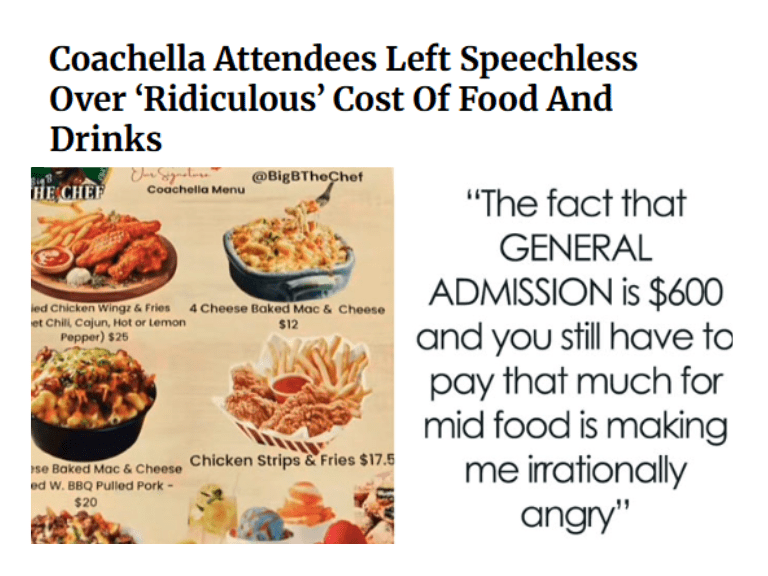
It’s the moment hundreds of thousands wait for all year, the pilgrimage to the sun-drenched Empire Polo Club in Indio, California, for the Coachella Valley Music and Arts Festival. The promise is one of legendary performances, iconic art installations, and a collective cultural experience that defines a season. Yet, for a growing number of attendees in recent years, the post-festival conversation has pivoted sharply from the headline-making sets to a far more mundane, yet deeply impactful, topic: the staggering cost of simply eating and drinking while there. The sentiment captured online, where one frustrated fan wrote, “The fact that GENERAL ADMISSION is $600 and you still have to pay that much for mid food is making me irrationally angry,” resonates with a palpable wave of agreement. This isn’t just casual grumbling; it’s a fundamental critique of the value proposition at one of the world’s most famous festivals. What was once perhaps a minor line-item in the overall Coachella budget has ballooned into a primary point of contention, leaving many to question the very economics and ethics of the modern festival experience, where the price of admission feels like just the starting bid for a weekend of financial bleed.
The initial sting of the general admission ticket price, which indeed hovers around the six-hundred-dollar mark before fees, is a calculated pain point fans have largely accepted, rationalizing it as the cost for seeing dozens of their favorite artists across multiple days in a uniquely curated environment. However, the financial reality truly sets in the moment one passes through the gates and confronts the marketplace within. The term “mid food,” as used in the viral complaint, is a telling piece of modern slang that perfectly encapsulates the grievance it’s not that the offerings are inedible or even bad, per se, but they are overwhelmingly average, pedestrian, and wildly inconsistent, especially when measured against their premium price tags. We’re talking about a slice of pizza for eighteen dollars, a modest portion of french fries for fourteen, or a basic chicken rice bowl nudging twenty-five. A single canned cocktail or a modest draft beer routinely costs seventeen or eighteen dollars, turning a simple round for a small group into a transaction worthy of a fine dining establishment, but without any of the accompanying service, ambiance, or quality. This pricing strategy creates a brutal cognitive dissonance: you are surrounded by breathtaking art and world-class music, yet you are paying luxury resort prices for what is essentially high-volume concession stand fare.
This dynamic forces attendees into a complex and often stressful calculus that extends far beyond the music schedule. Do you eat a prohibitively expensive meal inside the venue, or do you trek back to your camping spot or rental, losing precious time and energy in the desert heat? Do you budget hundreds of dollars extra, on top of tickets, travel, and accommodation, solely for sustenance, or do you resort to smuggling in prohibited snacks, playing a game of cat-and-mouse with security? The experience becomes gamified in the least fun way possible, where financial prudence directly conflicts with immersive enjoyment. The frustration is compounded by the sense of a captive audience. Once inside the Coachella grounds, your options are singular: buy what is offered or go without. There are no competing food trucks across the street offering a better deal, no affordable grocery stores within walking distance. This lack of choice is the bedrock upon which these premium prices are built, and festivalgoers are acutely aware of it, feeling less like valued customers and more like a revenue stream to be maximized at every turn.
The conversation around these costs also taps into a broader, more cultural critique about the commercialization and elitism creeping into festival culture at large. Coachella, as the perennial trendsetter, sits squarely at the center of this storm. What began as a grassroots, artist-focused event has undeniably evolved into a massive corporate-engineered spectacle, where brand activations and influencer photo-ops sometimes seem to share equal footing with the musical performances. The exorbitant food and drink prices feel like a logical, if cynical, extension of this evolution. They are a microtransaction model applied to physical reality, a way to extract maximum value from every single moment of an attendee’s presence. For many, it undermines the communal, almost utopian promise of a music festival. The shared struggle should be about securing a good spot for your favorite band or weathering the dust together, not collectively commiserating over being financially rinsed for a bottle of water. The term “irrationally angry,” from that original post, is so effective because it acknowledges that the response feels disproportionate, yet it is fueled by this deeper sense of betrayal a feeling that the spirit of the event has been commodified down to the last french fry.
It’s worth examining where this money might theoretically go, as defenders of the model might point to the high costs of logistics in a remote desert location, the fees paid to vendors and workers, and the general insanity of mounting such a production. There is undeniable truth there. However, the opacity of these financials leaves room for skepticism. Attendees see a stark contrast: their own wallets draining rapidly versus reports of record-breaking revenue years for the festival and its parent company. The disconnect fosters a perception, whether entirely accurate or not, of profiteering. Furthermore, the quality inconsistency is a major aggravating factor. At a certain price point, expectations shift. A fifteen-dollar gourmet donut from a celebrated local bakery might be accepted as a splurge, but a fifteen-dollar mediocre hot dog from an anonymous concessionaire feels like an insult. The issue isn’t solely the number on the price tag; it’s the perceived lack of corresponding value, craftsmanship, or care. When you pay a premium, you expect a premium experience, and for many at Coachella, the culinary offering fails to clear that bar spectacularly, making the expense feel like a mandatory toll rather than a choice worth making.
The impact of this pricing extends into the social fabric of the festival itself. It creates invisible class divisions within the crowd. Those who can casually drop several hundred dollars a day on food and drink without a second thought enjoy a fundamentally different Coachella than those who are anxiously counting each purchase, limiting themselves, or going hungry. It can stifle spontaneity the simple joy of saying “let’s grab a bite” becomes a loaded decision requiring budget review. This financial tension is the antithesis of the carefree liberation that music festivals are supposed to represent. Instead of bonding over shared musical discovery, friends are bonding over shared financial trauma, comparing receipts in disbelief. The memory of the event becomes intertwined with the memory of the cost, a lingering aftertaste that can sour an otherwise incredible weekend. In an era where the cost of living is a primary concern for so many, the blatant extravagance of festival pricing feels particularly tone-deaf, highlighting a gap between the reality of everyday fans and the commercial engine of the event they love.
So, what is the path forward? Is there a solution that satisfies the legitimate operational needs of the festival while restoring a sense of fairness for the attendee? Some have suggested more transparent pricing models, where part of the ticket cost explicitly includes a set food and drink credit, managing expectations from the outset. Others advocate for a greater diversity of vendors, including truly affordable options, to reintroduce choice and competition into the ecosystem. There is also a strong argument for significantly improving the quality and sourcing of the food to justify the high prices, transforming the culinary experience into a legitimate attraction in its own right, much like at some high-end culinary festivals. The backlash, loud and clear across social media, is a form of market feedback. The Coachella brand is incredibly powerful, but it is not immune to the erosion of goodwill. When the story coming out of the festival shifts from the magic on stage to the shock at the concession stand, it represents a tangible reputational risk. The festival’s longevity relies on more than just booking great acts; it relies on maintaining its status as a desirable, positive, and overall worthwhile experience from gate to gate.
In the final analysis, the uproar over Coachella‘s food and drink prices is about much more than simple sticker shock. It is a referendum on value, fairness, and the soul of the festival experience itself. That “irrational anger” is a perfectly rational response to feeling exploited in a space where you are supposed to feel euphoric. It’s the frustration of paying a premium for the privilege of then being subjected to what feels like a financial squeeze play at every turn. As Coachella continues to set the standard for the global festival circuit, how it addresses this growing discontent will be closely watched. Will it double down on its current model, betting that the allure of the lineup will always outweigh the pain of the prices? Or will it listen to the chorus of its attendees and innovate a more equitable, transparent, and satisfying way to feed and water its massive desert congregation? The answer will determine not only the future tone of post-festival discussions but also the fundamental relationship between this iconic Coachella festival and the fans who make its existence possible. For an event built on vibes and connection, ensuring those aren’t shattered at the point of sale is perhaps the most critical encore it could perform.
Coachella Attendees Left Speechless Over ‘Ridiculous’ Cost Of Food And Drinks