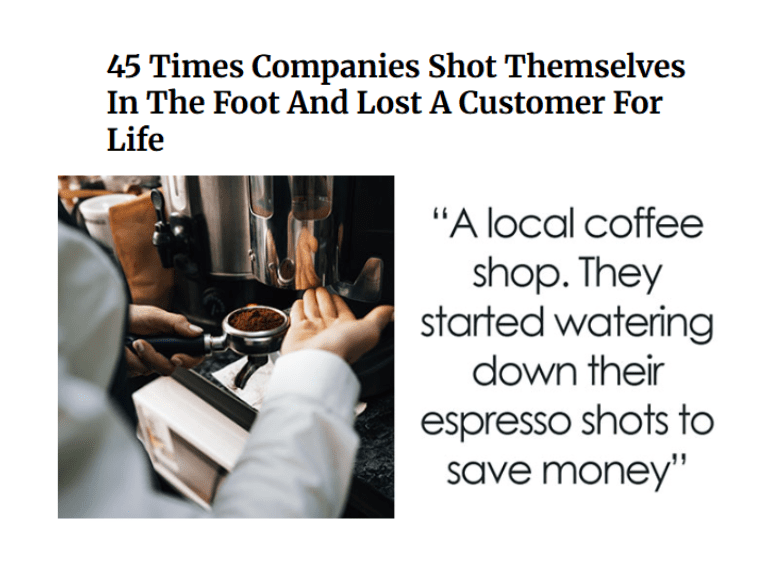
We have all been there, standing in a long, unmoving line, listening to the same tinny hold music for the twenty-fifth minute, or staring in disbelief at an email response that completely ignores the very simple question we asked. Most of the time, we grumble, we vent to a friend, and we eventually move on, the minor irritation fading into the background noise of daily life. But sometimes, a company makes a mistake so profound, demonstrates an attitude so dismissive, or executes a policy so blatantly unfair that it crosses an invisible threshold. In that singular moment, something inside you just clicks off. The loyalty evaporates, the goodwill vanishes, and you make a quiet but resolute decision: you are done, forever. They have not just lost a sale; they have, irrevocably, lost a customer for life. This finality does not usually stem from a single, catastrophic product failure; things break, after all. It almost always stems from a failure of people, of process, or of principle. It is the how of the mistake, not the what, that does the permanent damage. What follows is a deep dive into the myriad ways, both spectacular and subtle, that businesses teach us they do not value our patronage, ensuring they join the ranks of those who have lost a customer for life.
The most immediate and visceral catalyst for a permanent breakup is, without a doubt, abysmal customer service. Imagine purchasing a high-end appliance, only to have it malfunction within weeks. You call for support, ready for a solution, but instead you are met with a defensive wall of scripted apologies and a refusal to honor the warranty based on a technicality so minute it feels invented on the spot. The representative does not listen, does not empathize, and ultimately does not help. You are left not only with a broken machine but with the sour taste of being treated like an adversary rather than a patron. This is a classic path to ensuring a consumer feels so disrespected that they vow never to return. Another common scenario is the endless runaround, a Kafkaesque journey where you are transferred from department to department, each one claiming it is not their responsibility, forcing you to repeat your story until you are hoarse. After investing hours of your life into resolving a problem the company created, the sheer emotional and time cost becomes a permanent barrier to ever doing business with them again. They have effectively told you that your time, and by extension you, are worthless to them.
Beyond the impersonal phone call, public interactions can amplify the humiliation and solidify the decision to never return. A server who is openly rude or condescending in front of your dinner guests, a retail clerk who loudly challenges the legitimacy of your return, a hotel manager who dismisses your valid complaints with a condescending smile—these public-facing failures add a layer of social embarrassment to the frustration. You are not just wronged in private; you feel your character has been publicly slighted. This emotional component is a powerful glue that cements the memory of the negative experience, making it far more likely that the brand becomes permanently associated with that feeling of personal disrespect. It is one thing to have a bad experience; it is another to be made to feel small because of it. This is a guaranteed method for any business to ensure they have lost a customer for life, as the desire to avoid that feeling of shame will forever outweigh any lure of a product or a promotional discount.
Then there is the modern-day colosseum of public opinion: social media. A customer who feels ignored through traditional channels will often turn to Twitter or Facebook as a last resort, airing their grievance in the hopes that public pressure will achieve what private pleas could not. How a company responds here—or fails to respond—is a defining moment. An automated, copy-pasted response that does not address the specific issue tells the customer, and everyone watching, that they are just a number. A defensive or sarcastic reply from a brand’s social media manager, as has happened in several infamous cases, is like pouring gasoline on a fire. It signals an institutional arrogance, a belief that the company is above criticism. Conversely, completely ignoring the public complaint signals apathy. In the digital age, where every interaction is visible, treating a public complaint with anything less than utmost seriousness and a genuine desire to fix the problem is a spectacularly efficient way to lose not just one customer, but dozens or hundreds of potential customers who are watching the exchange unfold and deciding they want no part of such a company.
Pricing and billing disputes are another fertile ground for creating permanent ex-customers. Hidden fees that magically appear on the final bill, automatic renewals for subscriptions that are notoriously difficult to cancel, and price increases that are sprung on long-term customers without any warning or added value—these tactics might squeeze a few extra dollars of revenue in the short term, but they incinerate trust. When a customer feels tricked or manipulated financially, the relationship shifts from a voluntary exchange of value to something that feels predatory. The feeling is no longer mere disappointment; it is betrayal. A customer who has to spend hours on the phone arguing over fraudulent charges or fighting to cancel a service they no longer want will remember the company not for its product, but for the ordeal it put them through. That memory is a powerful deterrent, ensuring that even if the company later offers a stellar deal, the customer will remember the stress and hassle and walk the other way, having decided long ago that the company was not to be trusted.
The actual product or service failure, when severe enough, can also be the direct cause of a permanent separation, though it is often the supporting response that seals the deal. Buying a new car that spends more time in the shop than in your garage, a smartphone that is plagued with a fundamental hardware flaw the manufacturer refuses to acknowledge, or booking a vacation rental that is dangerously misrepresented online—these are not minor inconveniences. They represent a significant financial loss and a profound breach of the fundamental promise of commerce: that the product will work as advertised. When the company’s response to such a core failure is to hide behind legalese, deny the problem exists, or offer a partial credit instead of a full refund or replacement, it demonstrates a lack of stand-behind-your-product integrity. The customer is left holding the bag, both literally and figuratively, and learns a harsh lesson about the brand’s lack of reliability. This combination of a catastrophic product fail and an inadequate corporate response is a surefire recipe for making someone feel so burned that they become a vocal critic, forever warning others away from the brand that failed them so completely.
Corporate policies, often designed in boardrooms far removed from the reality of customer interactions, can be the silent assassins of customer loyalty. A return policy so strict it feels punitive, a warranty that is rendered nearly useless by fine print, or a loyalty program that is devalued overnight without consultation—these structural decisions communicate a company’s values louder than any advertising campaign. They say, “We prioritize our bottom line over your satisfaction.” When a long-time, high-value customer is denied a simple exception to a rigid policy because “the system won’t allow it,” the message is clear: your years of loyalty are less important to us than adhering to an arbitrary rule. This bureaucratic inflexibility can be incredibly alienating. It tells the customer that they are not a valued individual but merely a transaction ID, and that the company lacks the human judgment and empowerment to do the right thing in a unique situation. This cold, impersonal approach is a slow-acting poison that erodes the very foundation of a relationship, ensuring that when the customer finds a viable alternative, they will leave without a second thought, feeling that their loyalty was never reciprocated.
Data privacy and security breaches represent a particularly modern and profound form of betrayal that can instantly lost a customer for life. When a company is negligent with the incredibly sensitive personal and financial information we entrust to it, and that data is stolen in a preventable breach, the violation feels personal. It is not just about the inconvenience of canceling credit cards and monitoring accounts; it is about the feeling of being exposed, of having your trust weaponized against you. If the company’s response is slow, opaque, or attempts to downplay the severity of the incident, it compounds the offense. The customer is left thinking, “Not only did you fail to protect me, but you are not even being honest with me about it.” This destruction of trust is almost impossible to repair. How can you ever feel safe giving your information to that company again? The risk is simply too high, and the memory of the breach and its aftermath will forever color your perception of the brand, marking it as careless and untrustworthy with what matters most.
Perhaps the most subtle, yet increasingly powerful, reason a person decides a company has lost a customer for life is a misalignment of values. In today’s world, consumers often look beyond the product itself to the ethics of the company behind it. Discovering that a clothing brand uses sweatshop labor, that a corporation engages in predatory environmental practices, or that the owner of a local business holds and publicly espouses bigoted views can be a deal-breaker. This is not about the quality of the product or the efficiency of the service; the product could be perfect and the service impeccable. It is about conscience. Continuing to spend money with that company would make the customer complicit in something they find morally objectionable. This values-based rejection is powerful because it is not transactional; it is ideological. No amount of discounts or improved features can lure a customer back once they believe that their money is funding something harmful or unjust. The company has, in their eyes, forfeited the right to their patronage not through a service failure, but through a failure of character.
In the final analysis, the common thread running through all these stories is a fundamental breakdown in the covenant of mutual respect that should underpin any commercial relationship. Customers understand that mistakes happen. What they cannot and will not abide is being treated as an inconvenience, a liar, or a fool. The companies that find themselves permanently crossed off someone’s list are those that failed to listen, failed to act with integrity, failed to empower their employees to show compassion, and failed to prioritize the long-term value of a human relationship over a short-term financial gain. Every one of these forty-five scenarios, from the dramatic social media meltdown to the quiet disappointment of a devalued loyalty program, serves as a stark reminder that in business, as in life, how you handle a problem is often more important than the problem itself. It is a lesson in the immense, often irreversible, cost of taking people for granted, a cost measured not in quarterly earnings but in the quiet, determined decision of every individual who concludes, with finality, that you have lost a customer for life.