It was supposed to be the highlight of our spooky season, a classic Halloween tradition that my friends and I had poured weeks of planning into. The hayride, a festive wagon pulled by a tractor through the local wooded trails, decorated with strings of orange lights and makeshift ghosts, was our gift to the neighborhood kids and our own attempt to reclaim some autumnal joy. We had checked permits, secured the wagon, and even coordinated with a local farm for the hay, envisioning an evening of laughter, costumes, and the crisp, magical air that only comes around in late October. This particular Halloween was meant to be memorable for all the right reasons, a community-building exercise centered around shared fun and seasonal spirit. Little did we know that the true horror story wouldn’t involve any fabricated ghouls but would instead emerge from a shocking display of real-world entitlement and rudeness that would completely dismantle our plans.
The trouble began subtly, as these things often do, in the form of our neighbor from two houses down, a woman we’ll call Linda. Linda had a reputation for having an opinion on everything from lawn height to garbage bin placement, but we had optimistically included her in the initial planning conversation, hoping to foster goodwill. Instead of offering help, she immediately began dictating terms, insisting the route be changed to pass directly in front of her property for her convenience and demanding we allocate specific “VIP” seating for her family. We politely explained that the route was set for safety and logistical reasons, a decision that was met with a frosty silence. This initial clash over the Halloween hayride route was the first crack in our idyllic vision, a warning sign we foolishly chose to ignore in our desire to keep the peace and get on with the fun.
The real chaos, however, descended with the arrival of a group of parents we didn’t personally know, who had heard about the event through the neighborhood grapevine. They arrived en masse just as the tractor was warming up, their children already buzzing with a sugar-fueled frenzy. From the outset, their attitude was one of blatant entitlement, treating our carefully organized event as a free public carnival they had a right to dominate. They pushed to the front of the gathering queue, letting their kids clamber over the hay bales we’d arranged as seating before anyone else could board. The spirit of the Halloween celebration, which for us was about orderly fun and shared experience, was instantly overshadowed by their loud demands and complete disregard for the simple rules we’d communicated.
Things escalated rapidly when the hayride itself began. The wagon had a strict capacity limit for safety, a rule we had clearly posted. Ignoring this completely, several of these entitled parents insisted on squeezing their strollers and themselves onto an already full wagon, arguing that we couldn’t possibly leave their toddlers out. The atmosphere shifted from festive to tense and uncomfortable. Then, as the tractor lurched forward, the aforementioned neighbor, Linda, executed her own plan. She had moved a garden bench to the edge of her property along the route and, as we passed, she and three of her relatives simply stood up and, without a word, stepped onto the moving wagon, grabbing onto the side rails. When I exclaimed in surprise, one of them laughed and shouted over the noise, “What, you’re not going to leave three females clinging to me out here in the cold, are you?”
The phrase “three females clinging to me” became the surreal, infuriating mantra of the evening. It wasn’t a request; it was a statement of assumed permission, a breathtaking act of boundary-crossing that left the rest of us passengers stunned. The Halloween ambiance we’d worked so hard to create the playfully scary music, the synchronized light displays in the trees was now utterly ruined. The focus was no longer on the enjoyment of the ride or the laughter of children but on managing this uncomfortable, illegal, and dangerous intrusion. The driver was forced to slow to a crawl for fear of someone falling, which ruined the pace and the thrill of the journey through the dark woods, a central pillar of any successful hayride experience.
What struck me most, beyond the sheer rudeness, was the absolute lack of awareness or apology. These parents and our neighbor acted with a conviction that their desires trumped everyone else’s safety, comfort, and planning efforts. They transformed a community Halloween activity into their personal entitlement pageant. Conversations on the wagon became hushed and annoyed whispers, with other families shooting us sympathetic looks. The children, perceptive as always, began to pick up on the negative vibe, their excited chatter dampening into confusion. A night meant for creating joyful Halloween memories was now being etched into our minds for all the wrong reasons, a case study in how a few selfish individuals can poison a collective experience.
The aftermath was just as frustrating. After the abbreviated, tense ride concluded, there was no gratitude from the interlopers, only complaints. One parent grumbled that the ride was too short and not scary enough, completely oblivious to the fact that their own actions had caused the disruption. Linda simply disembarked with her crew and walked back to her house without a backward glance, as if hijacking a neighborhood event was a perfectly normal Tuesday. We were left to clean up, field questions from disappointed but polite attendees, and process the fact that our labor of love had been so thoroughly vandalized not by vandals, but by the very people it was meant to serve.
This experience taught me a harsh lesson about modern social contracts, especially around communal holidays like Halloween. There’s a growing breed of entitlement that views any organized fun as a public utility, open to customization and appropriation without contribution or respect. The Halloween season, with its focus on community, sharing, and playful scares, seems particularly vulnerable to this mindset. The hayride wasn’t a city-sanctioned festival; it was a private goodwill gesture that required planning, money, and labor. The assumption that it could be commandeered speaks to a deeper cultural issue where personal convenience consistently overrides common courtesy and collective good.
Reflecting on it now, the symbolism is almost too on-the-nose. Halloween is about confronting fears, and in a way, we confronted a very real, modern fear: the death of communal consideration. The monsters weren’t in the woods; they were on the wagon, cloaked in the ordinary guise of neighbors and parents. The haunting wasn’t by ghosts but by the lingering feeling of resentment and the question of whether it’s even worth trying to create special moments for a community when a segment feels so inherently entitled to reshape them to their whim. The Halloween hayride, as a tradition, may not survive another year in our neighborhood, not because of a lack of spirit, but because of an overabundance of selfishness.
In the end, the memories of that Halloween are permanently mixed. We remember the smiling faces of the kids who followed the rules, the genuine jump-scares we managed to pull off before the interruption, and the beautiful, chilly autumn night. But overlaying it all is the stark lesson in boundary-setting and the disappointing reality that no good deed goes unpunished. Planning something as wonderfully traditional as a Halloween hayride requires not just logistics and enthusiasm, but a fortification against the potential for entitlement that can derail it all. The true terror of that evening wasn’t manufactured; it was the very human, very real spectacle of respect and shared joy being trampled by sheer, unapologetic self-interest, a ghost story for our times with a moral that lingers long after the last piece of candy is eaten.
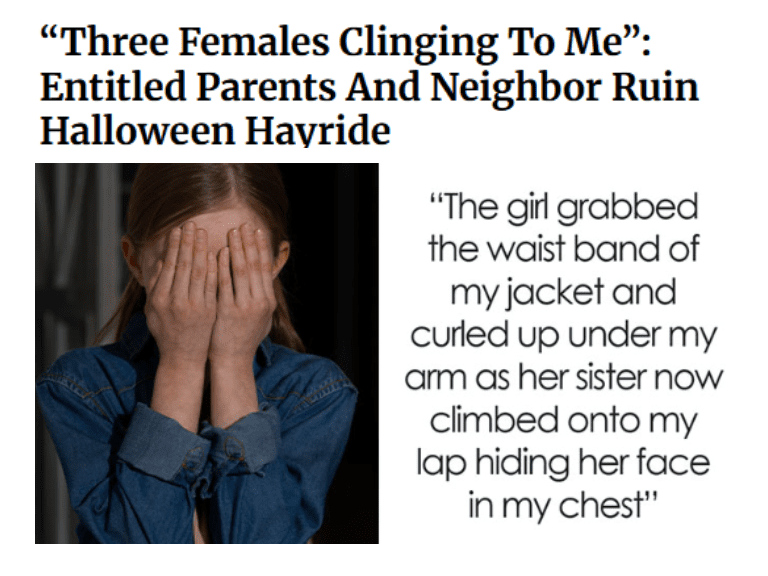
“Three Females Clinging To Me”: Entitled Parents And Neighbor Ruin Halloween Hayride