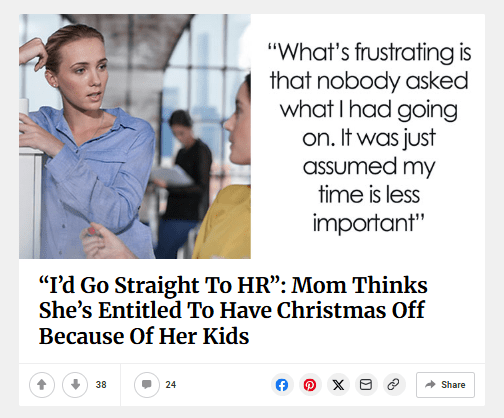
Every December, offices across America quietly simmer with one of the most reliably contentious workplace debates of the entire year: who deserves to have Christmas off, and on what basis should that decision be made? This holiday season, the argument reached a boiling point when a mom declared loudly and without much hesitation that she believed she was entitled to have Christmas off from work simply because she had children at home. Her coworkers, several of whom are childless adults with their own families, traditions, and holiday plans, pushed back immediately. One of them stated plainly that if the schedule was changed to prioritize parents over everyone else without a fair process, they would go straight to HR. The comment spread quickly beyond the breakroom and onto social media, where it ignited a passionate national conversation about fairness, entitlement, and what it truly means to be a considerate colleague during one of the most emotionally loaded times of the year. The responses were sharp, personal, and deeply divided because this particular debate touches something that almost every working adult has felt but few have said out loud.
The mom in question had reportedly made her case to management based on the argument that Christmas is primarily a holiday for children and that parents therefore have a greater need and by extension a greater right to be home on that day. She felt that her coworkers without children could more easily cover the holiday shift since they “did not have as much going on” at home, a characterization that landed about as well as one might expect among colleagues who celebrate Christmas traditions of their own. Many of her coworkers pointed out that they too had aging parents to visit, meaningful rituals to honor, partners and friends to celebrate with, and their own deeply personal reasons for wanting to celebrate Christmas the way Americans do every year fully, warmly, and without being automatically placed at the bottom of the holiday schedule simply because they had not yet had children. The assumption that a childless adult’s Christmas is inherently less significant than a parent’s Christmas is one that many people found not only unfair but quietly insulting. It reflects a broader workplace dynamic that childless employees particularly women have been navigating and pushing back against for years with increasing confidence and clarity.
The “I’d go straight to HR” comment became the most quoted and most debated line in the entire story, not because it was aggressive but because it was direct in a way that workplace conversations about fairness rarely are. The coworker who said it was not being dramatic they were identifying a clear and legitimate avenue for addressing what they perceived as discriminatory scheduling that favored one group of employees over another without objective criteria. Workplace fairness during the holidays is a real and well-documented issue, and understanding the dynamics of what it means to maintain healthy and respectful relationships even professional ones requires acknowledging that every person’s time, plans, and celebrations carry equal weight regardless of their family structure. Many HR professionals who commented on the story confirmed that basing holiday scheduling decisions on parental status alone would indeed be problematic in most workplace environments and could expose a company to legitimate complaints. The conversation shifted quickly from one specific office disagreement into a much wider discussion about the invisible hierarchies that form in workplaces and how they tend to fall along lines that disadvantage the same people over and over again.
What makes this story resonate so broadly is that it captures a tension that millions of working women and men encounter every single year without a clean or comfortable resolution. Parenting is genuinely demanding work, and the desire to be home with your children on Christmas morning is completely understandable and deeply human. But so is the desire of a 28-year-old woman without children to spend Christmas Eve with her grandmother, or a 35-year-old man to fly home for the first time in two years to see his aging parents. The red flags in any relationship or community dynamic including a workplace appear when one group consistently assumes their needs outweigh everyone else’s without dialogue, negotiation, or genuine consideration. Fair scheduling systems exist precisely to prevent this kind of unspoken hierarchy from forming, and many companies that handle it well use rotating holiday schedules, seniority-based systems, or open preference submissions that treat every employee’s request with equal respect. Maintaining personal well-being and boundaries at work especially during the holidays is something every employee, parent or not, deserves to protect without guilt or apology.
The deeper conversation this story sparked is ultimately about empathy in both directions something that is easy to preach and genuinely difficult to practice when your own needs feel urgent and valid. Parents are not wrong to want Christmas with their children. Childless employees are not wrong to want Christmas for their own meaningful reasons. What goes wrong is when either group assumes their version of the holiday is the only one worth accommodating, and stops asking what the person across from them might be carrying. The most meaningful Christmas trends Americans are embracing in 2026 center on honesty, equity, and the radical idea that everyone in the room at home or at work deserves to have their holiday considered with equal care. Women especially are navigating this terrain with growing confidence, driven by a broader cultural shift toward living with intention and refusing to accept arrangements that ask them to consistently sacrifice their own peace for someone else’s convenience. The solution in this case, as in most, was not dramatic it was simply a fair conversation that should have happened from the beginning, with every voice at the table given equal weight.
Picture this: it is the week before Christmas in Portland, Oregon, and the scheduling meeting at a mid-sized healthcare office has just wrapped up in a way no one expected with a fair rotating system that gave every employee, parent and non-parent alike, an equal shot at their preferred holiday days off. The mom got Christmas Day. Her childless coworker got Christmas Eve. Two others swapped New Year’s shifts voluntarily. And everyone walked out of that meeting feeling something that workplaces rarely manage to create during the holiday season: genuinely respected. The coworker who had threatened to go to HR over her mental well-being and fairness at work ended up spending Christmas Eve with her grandmother for the first time in three years and later posted about how much it meant in a way that brought several of her coworkers to tears. The mom came back in January talking about how magical Christmas morning had been with her kids, grateful and noticeably softer. It turned out that what everyone needed was not to win the argument it was simply to feel that their holiday mattered too. And once that was acknowledged, the conflict dissolved almost entirely on its own. That is the real lesson hiding inside every workplace holiday drama: everyone deserves to enjoy their life fully and fairness is always the most generous gift any of us can give.