The invitation went out in early October, as it always does, a cheerful group text filled with turkey emojis and pumpkin icons. This year, however, nestled between the customary details about time and my address, was a new, decidedly un-cheerful line: “To help cover the significant costs of hosting, I’m kindly requesting a minimum contribution of $100 per adult attending.” The silence that followed was louder than any response could have been. My phone eventually buzzed with a private message from my older brother, Mark. “You’ve got to be kidding me,” it read. “Since when do we charge family for Thanksgiving?” And that, right there, was the spark that ignited a family conflict I had been quietly dreading for years, a confrontation that was about so much more than just money. This was not a decision I made lightly, nor was it born from a sudden desire to be petty or create drama during what is supposed to be a season of gratitude. The truth is, the financial and emotional burden of hosting our family’s Thanksgiving had become unsustainable for my small household. For the past five years, my husband and I have been the de facto hosts, a role we initially embraced with joy. We love our home filled with laughter and the smell of roasting turkey. But what started as a labor of love had slowly morphed into a massive, expensive undertaking that everyone else seemed to take for granted. The gentle hints about the cost of the organic, free-range turkey, or the sheer volume of sides required, were met with nods and empty promises of “we’ll bring something next time,” promises that were consistently forgotten by the time the next holiday rolled around.
This annual gathering is not a small, intimate affair; it is a full-scale production for over twenty people, counting aunts, uncles, cousins, and my immediate family. The grocery bill alone for a feast of that magnitude is staggering, easily pushing into the several-hundred-dollar range before you even factor in the drinks, the extra chairs we have to rent, the disposable plates and cutlery for easy cleanup, and the days of unpaid labor my husband and I pour into cleaning, prepping, cooking, and ultimately, exhausting ourselves. The dynamic had become painfully clear: everyone was eager to be a guest, but no one was willing to share the true load of being a host. The underlying family conflict was one of perceived entitlement versus actual effort, a silent resentment building with each passing year as I watched my siblings show up empty-handed, feast with gusto, and leave behind a mountain of dishes and a depleted bank account. The breaking point came last year, when my brother Mark, after his third helping of pie, jokingly asked if we were going to “upgrade to a better brand of champagne” next year. The joke stung because it highlighted how utterly oblivious he was to the real cost of his free meal.
So, this year, I decided to make the invisible, visible. The one-hundred-dollar minimum was not a random figure plucked from the air; it was a carefully calculated estimate of the per-person cost for the high-quality meal I provide, a number I was actually low-balling out of a sense of familial obligation. I knew it would cause a stir, but I was not prepared for the sheer vitriol that would come from my own brother. His protest was not a calm, rational discussion about family traditions; it was an indignant rant about how I was “commercializing a holiday” and “destroying family unity.” He accused me of being greedy, of caring more about money than about family togetherness. This, from a man who has never once offered to host, who contributes a single six-pack of beer to the feast, and who consistently leaves before the cleanup even begins. His reaction was a perfect microcosm of the entire problem a loud defense of his right to enjoy a luxury without acknowledging the labor and capital that creates it. The ensuing argument, which quickly spilled over from private texts into a full-blown family group chat debate, revealed the deep fissures in our family’s approach to reciprocity and shared responsibility.
What amazed me, however, was that the family conflict was not unanimous. While my parents were initially uncomfortable with the idea, my aunts and a few of my cousins actually privately messaged me their support. One cousin confessed she had always felt guilty showing up without contributing meaningfully but never knew how to broach the subject without offending me. Another aunt pointed out that when she hosted years ago, the tradition was for everyone to bring a substantial side dish, a practice that had somehow fallen by the wayside once I took over. This division was enlightening; it showed me that the issue was not that people were universally against contributing, but that a vocal, entitled minority, led by my brother, had set a precedent of passive consumption. My petty side, I will admit, began to emerge during this digital firestorm. Instead of backing down, I decided to lean into the role of the “petty” hostess they were accusing me of being. I crafted a detailed, itemized spreadsheet, breaking down the cost of the entire meal from the twenty-pound turkey and the cornbread for the stuffing to the green beans, the potatoes, the ingredients for multiple pies, the wine, the soft drinks, and even the rental fee for the extra table and chairs.
I did not stop at the financials. I then created a second column, a time log estimating the hours spent. I listed the deep cleaning of the house the weekend before, the hours spent grocery shopping at multiple stores, the day-before prep for pies and sides, the waking up at 5 a.m. on Thanksgiving Day to get the turkey in the oven, the constant cooking and monitoring throughout the day, the serving, and the hours of cleanup afterward while everyone else relaxed. I attached this spreadsheet to the group chat with a simple message: “For transparency, here is what your ‘free’ Thanksgiving actually costs. The $100 is not a fee for attendance; it is a request to share in the cost of the experience you all enjoy. If this is unacceptable, we completely understand, and will miss you this year.” The silence that followed this message was even more profound than the first. This was not just about money anymore; it was about forcing them to acknowledge the immense, often invisible, labor that goes into creating their holiday joy. I was making the economy of our family holiday transparent, and it was making people deeply uncomfortable in a way that was necessary for change.
The fallout was immediate and, in a way, satisfying. My brother declared he and his family would not be attending, a decision he announced with the dramatic flair of a Shakespearean actor exiting the stage. A few others, swayed by his outrage, also dropped out. For a moment, I felt a pang of guilt. Was I really willing to break up the family Thanksgiving over this? But then I thought about the quiet resentment I had been carrying for years, the financial stress, and the exhaustion, and I realized that the tradition was already broken. It was broken the first time I felt more like a caterer than a sister and daughter hosting a joyful gathering. This family conflict, as painful as it was, was the catalyst for a necessary recalibration. The people who did choose to contribute, including my now-supportive parents, did so without complaint, and some even offered to pay more or to come early to help with setup. The dynamic had shifted from one of entitlement to one of partnership.
When Thanksgiving Day arrived, the atmosphere was different, and it was better. The group was smaller, yes, but it was filled with people who had consciously chosen to be there and had invested in making the day a success. There was a tangible sense of shared purpose and genuine appreciation that had been missing in previous years. The conversation was lighter, the laughter was easier, and I was not hovering on the brink of a panic attack in the kitchen. I was actually present, enjoying my family and the meal we had all, in one way or another, contributed to creating. The family conflict had served its purpose; it had cleared the air and established a new, healthier precedent. It proved that boundaries, even those that are initially met with anger and resistance, are not the end of relationships but can be the beginning of more honest and equitable ones. The real thanksgiving I felt that day was not just for the food on the table, but for the liberation that came from finally valuing my own effort and refusing to allow the family conflict over fair contribution to be swept under the rug any longer. I learned that sometimes, what looks like pettiness on the surface is actually the first and most necessary step in advocating for yourself and fostering a more respectful and balanced family dynamic.
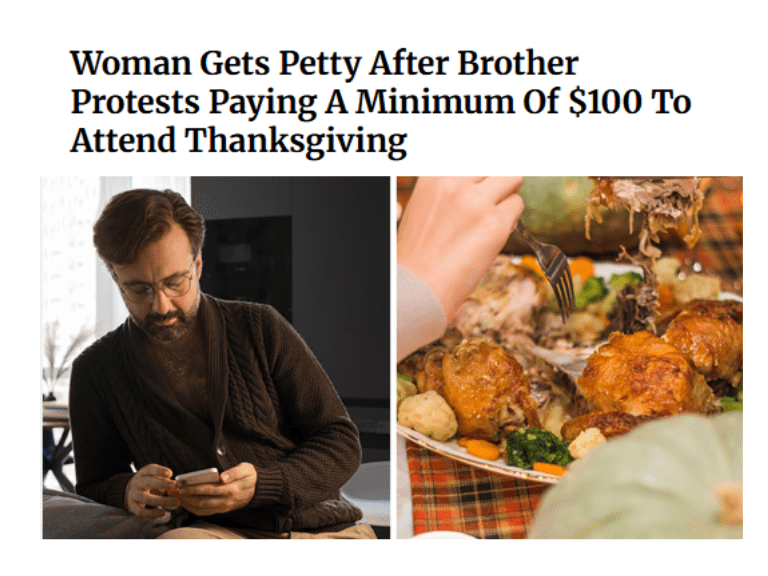
Woman Gets Petty After Brother Protests Paying A Minimum Of $100 To Attend Thanksgiving