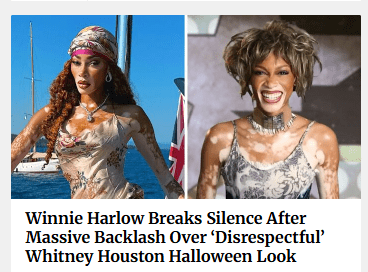
Winnie Harlow has finally broken her silence, addressing the tidal wave of criticism that followed her choice of Halloween costume this past season, a decision that sparked a fierce debate about respect, legacy, and the boundaries of creative expression. The supermodel, known for her pioneering presence in the fashion industry and her advocacy for vitiligo awareness, found herself at the center of a social media storm after images surfaced of her dressed as the late, legendary singer Whitney Houston. The fallout was immediate and severe, with countless voices across platforms like Instagram and Twitter condemning the look as a disrespectful misstep during a time of year that is already fraught with discussions about appropriate and insensitive costumes. This particular Halloween controversy touched a nerve far deeper than the usual seasonal debates about cultural appropriation, striking at the heart of how we honor icons who are no longer with us. Harlow’s decision to publicly address the situation marks a significant moment, offering not just an explanation but a window into the complex interplay between celebrity, fan expectation, and personal intent in the digital age. The incident serves as a potent reminder that Halloween, for all its fun and fantasy, carries a weight of responsibility, especially when the costume involves a beloved figure whose life story was as tumultuous as it was triumphant.
The controversy began, as so many do in our hyper-connected world, with a seemingly innocuous social media post. In the days following Halloween, Winnie Harlow shared a series of photographs and videos from her celebrations, which included a meticulously crafted transformation into Whitney Houston circa her “I Wanna Dance with Somebody” era. The costume was detailed, featuring the singer’s iconic curly hair, bold makeup, and a sequined outfit reminiscent of her late-80s music video looks. To many of Harlow’s followers and fans of Houston alike, however, the homage felt off-key. Criticism quickly crystallized around a few key points: the perceived trivialization of Houston’s profound and complicated legacy, the timing given the singer’s well-documented and tragic struggles, and a sense that the costume reduced her to a mere aesthetic rather than honoring her humanity. For a holiday like Halloween, which walks a fine line between celebration and caricature, the line between tribute and offense can be vanishingly thin. The backlash was not merely about the costume itself but about the context the feeling that Whitney Houston’s memory, for many, is still too raw, her contributions too sacred, to be used as seasonal attire.
In the days of radio silence that followed the initial post, the online discourse only intensified. Comment sections became battlegrounds, with some defending Harlow’s right to pay tribute to an idol and others lambasting the choice as tone-deaf. This period of quiet from the model herself allowed the narrative to be shaped entirely by public perception, fueling headlines and think pieces about celebrity accountability. The core of the criticism often returned to the concept of respect what does it truly mean to respectfully embody someone, especially someone like Whitney Houston, whose voice defined a generation but whose personal life was marked by very public pain? Halloween costumes of celebrities are certainly not new, but the reaction to Harlow’s look underscored a shifting cultural sensibility. There is a growing collective awareness that some figures, particularly those who have passed away under tragic circumstances or who represent monumental cultural touchstones, inhabit a space that perhaps should be off-limits to Halloween reenactment, a space where admiration should manifest in ways other than impersonation.
When Winnie Harlow did choose to speak, she did so through a carefully considered video statement posted to her Instagram stories, a platform that allows for a more direct and unfiltered connection with her audience. Her tone was measured, somber, and reflective, a clear departure from the festive mood of the original Halloween posts. She began by expressing her deep and genuine admiration for Whitney Houston, describing her not just as a musical icon but as a personal inspiration whose strength and talent had been a guiding light. Harlow acknowledged the backlash head-on, stating that it had been a painful but necessary lesson in listening. She clarified that her intention was never to disrespect or make light of Houston’s legacy but to celebrate the joy and powerhouse energy she represented to her as a fan. This distinction between intent and impact became the cornerstone of her response she recognized that despite her pure intentions, the impact of her Halloween costume had caused hurt, and for that, she offered a sincere apology.
The public reception to Harlow’s apology was, predictably, mixed. Some accepted her words as heartfelt and believed that her explanation of intent was sufficient, noting that the world of Halloween and costume parties is inherently rooted in impersonation and fantasy. Others, however, remained unconvinced, arguing that the apology, while a step in the right direction, did not fully engage with the deeper issues at play. Critics pointed out that the problem often lies not in the intent of one individual but in a broader pattern where the tragedies of Black women icons are sometimes aestheticized or divorced from their full context. This Halloween incident, for them, was part of a larger conversation about which figures society deems acceptable to costume and why. The debate expanded beyond Harlow to encompass our collective relationship with celebrity, grief, and memory. It questioned whether an apology can ever truly “resolve” a controversy born from such emotionally charged territory or if it simply marks a point of reflection for both the celebrity and the public.
This event is far from an isolated one in the annals of celebrity Halloween mishaps. Nearly every year, the holiday produces a new crop of controversial costumes that spark conversations about race, culture, gender, and history. What makes the Winnie Harlow situation particularly instructive is her status as a model who has herself been a trailblazer in challenging beauty standards. Her career is built on redefining perception, which adds a layer of complexity to her being at the center of a perceived misperception. The incident forces a comparison: is dressing as a celebrated icon fundamentally different from dressing as a generic or culturally stereotypical figure? Many argued that Harlow’s costume existed in a grayer area—it was a specific, detailed tribute to a specific person she admired. Yet, the vehement backlash suggests that for the fans and protectors of Whitney Houston’s legacy, the specificity was precisely the issue; it felt like an unauthorized use of a cherished image, a borrowing of a soulful identity for a night of entertainment.
The role of social media in amplifying and shaping this controversy cannot be overstated. Platforms designed for sharing turned into arenas for mass public judgment, with the velocity of outrage far outpacing the opportunity for measured discourse. The Winnie Harlow Halloween story is a textbook case of the modern news cycle: a post, a viral reaction, a media frenzy, and then a response. This environment creates immense pressure for public figures to issue statements, sometimes before they have had the full chance to process the situation themselves. It raises questions about whether social media facilitates healthy accountability or simply fuels a punitive culture that allows little room for nuance or private growth. The collective conversation around Halloween has undoubtedly been changed by these platforms; a costume that might have once been seen only by a party crowd is now subject to the scrutiny of millions, turning personal choices into public indictments.
At its heart, this controversy touches on the very purpose of Halloween. Is the holiday a blanket permission slip for transformation, where any figure, real or fictional, is fair game for imitation in the spirit of fun? Or have we, as a society, matured to a point where we understand that some imitations can cause real pain, regardless of the calendar date? The tension between these two viewpoints is what fuels debates like the one surrounding Winnie Harlow. Halloween is uniquely positioned at the intersection of personal expression and social responsibility. Choosing a costume is an act of identity projection, but when that projection involves another person’s identity—especially one laden with cultural significance and personal tragedy—it becomes a communal matter. The backlash against Harlow can be interpreted as a collective pushback against the idea that everything and everyone is available for costume play, a demand for a more empathetic approach to the holiday.
Moving forward, the lasting impact of this episode will likely be more educational than punitive for the wider public. For Winnie Harlow, it is a moment etched in her public narrative, a learning experience that will undoubtedly inform her future choices, both personal and professional. For fans and observers, it serves as a case study in navigating the complicated ethics of admiration and representation. The conversation has illuminated the delicate balance between paying homage and perpetuating harm, a balance that requires continuous sensitivity and self-education. Halloween will continue to be celebrated with gusto, but the discourse suggests that participants are becoming more thoughtful curators of their own disguises, considering not just the visual impact but the historical and emotional weight a costume might carry.
In the end, Winnie Harlow’s decision to address the Halloween backlash directly was a necessary move in an era where silence is often interpreted as indifference. Her response, whether one views it as fully satisfactory or not, engaged with the criticism on its own terms and acknowledged the hurt felt by many. It reinforced the idea that public figures, despite their fame, are still individuals navigating complex social landscapes and are capable of missteps. The controversy surrounding her Whitney Houston Halloween costume is more than just a celebrity gossip item; it is a reflection of our ongoing cultural negotiation about legacy, respect, and the evolving rules of public life. As we look toward future Halloween seasons, this incident will undoubtedly be referenced as a benchmark in the conversation about where the line is drawn, reminding everyone that behind every costume is a real history, and behind every critique is a real emotion. The Halloween season may only come once a year, but the lessons about empathy and consideration it can inspire are timeless.