

There is something special about knowing that someone genuinely misses you.
Maybe it is an unexpected text in the middle of a busy day, a phone call just to hear your voice, or a simple message saying he wishes you were there. These small moments can make a relationship feel meaningful, especially when life gets busy.
But what happens when those moments become less frequent?
Perhaps you are always the first person to text. Maybe your conversations have become predictable, or you find yourself checking your phone more often than you would like, hoping he will reach out.
It is natural to wonder how to make him miss you again.

The good news is that strengthening a romantic connection does not have to involve ignoring messages, pretending to be unavailable, or making someone jealous.
In fact, those strategies can create unnecessary confusion.
A healthier approach focuses on maintaining your individuality, enjoying meaningful time together, communicating openly, and making room for both partners to contribute to the relationship.
The goal is not to make him worry about losing you. It is to build a connection that both of you genuinely value.
Whether you are in a new relationship, have been dating for years, or are navigating a long-distance romance, these ten approaches can help you create a healthier balance between closeness and independence.
Why Do We Want Someone to Miss Us?
Before exploring what to do, it helps to understand why being missed matters in the first place.
When someone says they miss their partner, they may be expressing affection, a desire for companionship, or appreciation for the time they spend together.
Being missed can feel reassuring because it suggests that your presence has meaning beyond the immediate moment.
However, people express affection differently.

One person might send several messages throughout the day. Another might prefer a meaningful evening conversation. Someone else may express care through practical support rather than frequent romantic words.
These differences do not automatically indicate how much someone loves you.
The more important questions are whether your partner treats you with respect, shows consistent interest, and makes an effort to maintain the relationship.
The NHS guidance on maintaining healthy relationships emphasizes open communication, mutual support, and listening to one another as important parts of strong relationships.
With that foundation in mind, here are ten ways to encourage a more meaningful connection without resorting to emotional games.
#1. Make Room for Him to Initiate Contact
Imagine looking through your recent conversations and realizing that almost every exchange began with a message from you.
You send the morning greeting, ask about his day, suggest when to meet, and call whenever you have free time.
There is nothing wrong with showing affection or taking initiative. But when one person consistently manages all communication, the relationship may begin to feel unbalanced.

Instead of assuming you must always keep the conversation going, allow room for your partner to initiate contact too.
You do not need to disappear or deliberately ignore him.
Simply avoid taking responsibility for every interaction.
For example, if you have already suggested meeting over the weekend, give him an opportunity to confirm the plans or offer an alternative.
If you usually call during your lunch break, it is okay to focus on your own activities occasionally.
The purpose is not to test whether he notices your absence. It is to encourage shared participation.
What if he never initiates?
A lack of initiation does not automatically mean he is uninterested. He may have different communication habits or expectations.
Rather than drawing conclusions from one missed call, look at the broader pattern.
Does he respond thoughtfully when you reach out? Does he make plans? Does he follow through on commitments?

If you consistently feel that you are carrying the relationship alone, explain how you feel.
For example, you might say:
“I enjoy talking with you, but lately I feel like I’m usually the one reaching out. I’d love it if we both made more of an effort.”
A conversation like this provides an opportunity for change without turning affection into a competition.
#2. Keep the Parts of Your Life That Make You Happy
One of the easiest changes to overlook in a relationship is how gradually your personal routine can begin to revolve around another person.
Maybe you used to spend Friday evenings with friends, attend a fitness class, paint, volunteer, or enjoy quiet time reading.
Then the relationship became more serious.
Without necessarily intending to, you started changing your plans to match his schedule.
There is nothing inherently wrong with making compromises for someone you love. Healthy relationships involve flexibility.
But it is also important to maintain a sense of identity outside the relationship.
Your friendships, goals, interests, and experiences still matter.

If you love photography, keep exploring it. If you enjoy weekend hikes, continue making time for them. If you are working toward a professional qualification, protect the time you need to study.
These activities are not merely ways to appear more interesting to your boyfriend or husband.
They contribute to your own fulfillment.
They also give you new experiences and perspectives to share when you spend time together again.
According to Love Is Respect’s guidance on respect in healthy relationships, partners should support one another’s interests, personal choices, and independence.
A practical way to start
Think of one activity you enjoyed before the relationship became a major part of your schedule.
Make time for it this week.

Do it because it makes you happy, not because you want him to notice that you are busy.
The healthiest form of independence is genuine, not something performed to attract attention.
#3. Stop Treating Every Text Message Like an Emergency
You are having dinner with friends when your phone lights up.
It is a message from him.
You immediately reach for your phone, even though someone at the table is halfway through telling an important story.
Does that sound familiar?
Modern relationships often involve constant digital communication, which can make it difficult to distinguish between being connected and being permanently available.
But maintaining a relationship does not require you to interrupt everything whenever a notification appears.
If you are working, studying, spending time with family, or simply taking a break from your phone, it is reasonable to reply later.

This does not mean deliberately waiting a certain number of minutes or hours to seem less interested.
It means responding when you have the time and attention to engage properly.
Of course, there may be situations when a message is urgent or you have agreed to communicate at a particular time.
The point is to establish realistic expectations rather than treating instant replies as a measure of love.
Agree on communication expectations
Some couples enjoy regular messages throughout the day. Others prefer checking in during the evening.
Neither approach is automatically better.
What matters is whether both partners understand and respect the arrangement.

The relationship education organization Love Is Respect offers a helpful resource on setting digital boundaries, including how couples can discuss texting expectations and online privacy.
You could agree that work hours are generally reserved for work, while evenings are a good time for longer conversations.
Clear expectations reduce misunderstandings and help both people feel respected.
4. Make Your Time Together Something You Both Enjoy
When people think about being missed, they often focus on what happens during periods of separation.
But the quality of the time you spend together may be just as important.
Consider two different evenings.
During the first, you and your partner sit together while scrolling through separate phones, occasionally exchanging a few words.
During the second, you prepare dinner together, laugh about something that happened during the day, and talk about plans you are both excited about.
Neither evening needs to be extravagant.

Yet the second offers more opportunities for shared attention, meaningful conversation, and emotional connection.
Relationship researchers often refer to small attempts to connect with a partner as bids for connection.
A bid might be a question, a smile, a request for help, or an invitation to share a moment.
The Gottman Institute explains that responding positively to these everyday attempts at connection can help partners build closeness over time.
You can explore this concept in its article on recognizing and responding to bids for connection.
Small moments can matter
You do not need expensive vacations or elaborate dates to create meaningful experiences.
Consider making breakfast together on a Sunday morning, exploring a neighborhood neither of you knows well, or setting aside an evening to talk without digital distractions.

Try asking questions that encourage real conversation rather than relying exclusively on routine exchanges.
- What was the best part of your week?
- Is there something new you would love to try?
- What has been on your mind lately?
- What is one thing we could do together next month?
What matters is not the cost of the activity, but whether both people feel included and appreciated.
When time together is meaningful, those shared experiences may become something you both look forward to repeating.
5. Give Each Other Breathing Room Without Creating Emotional Distance
Being close to someone does not mean spending every available moment together.
Even in loving relationships, people need time for work, friendships, family responsibilities, personal interests, and rest.
But there is an important distinction between healthy personal space and intentional emotional withdrawal.
Healthy space means respecting each other’s individual needs while remaining caring and responsive.
Emotional withdrawal, by contrast, may involve refusing to communicate, withholding affection as punishment, or deliberately making someone uncertain about the relationship.
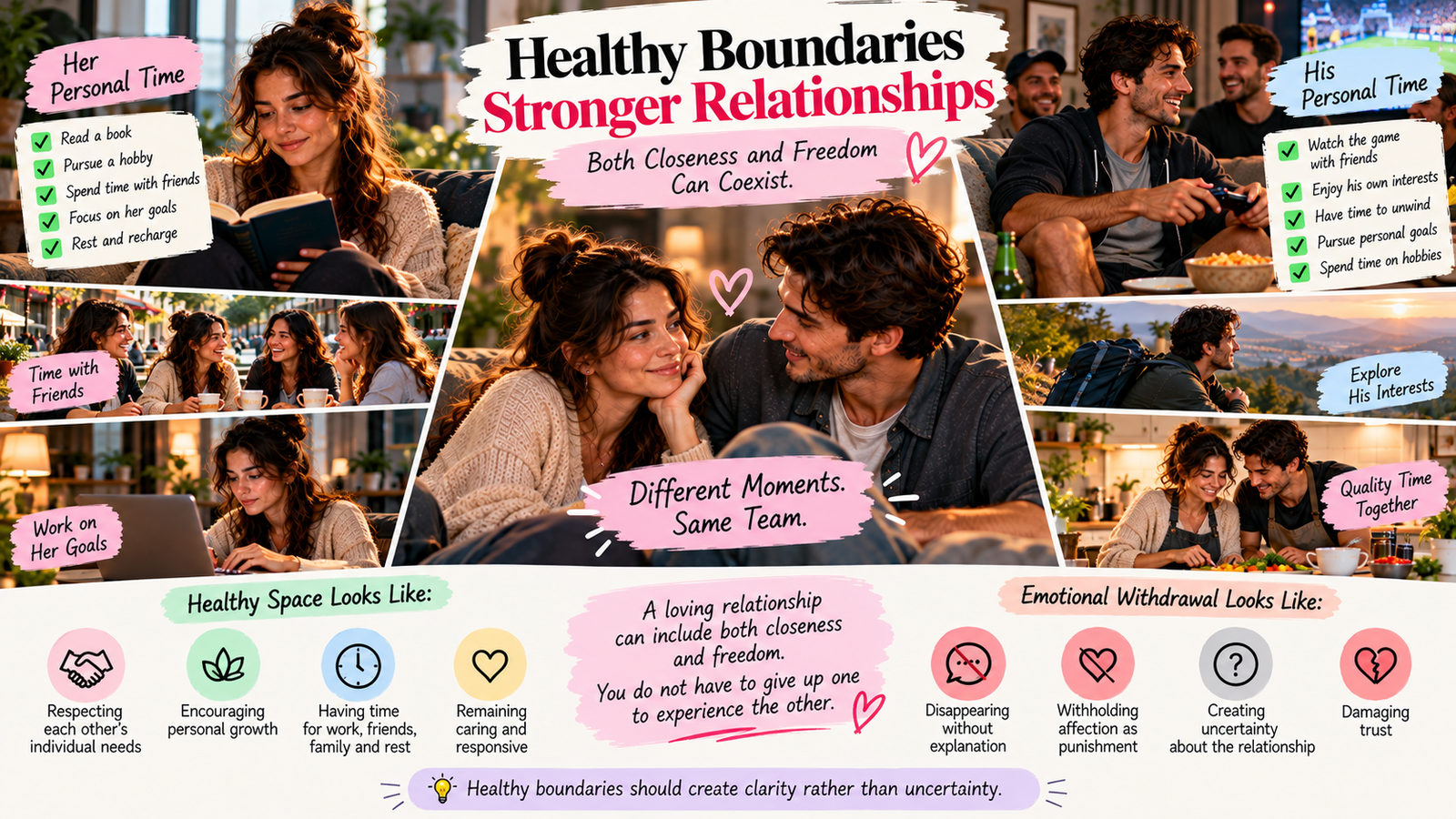
The first can support independence. The second can damage trust.
Imagine that your partner wants to spend Saturday afternoon watching a game with friends.
If you had no conflicting plans, you might use that time to meet someone you have been meaning to see, catch up on a project, or simply enjoy an afternoon alone.
You do not need to interpret his desire for personal time as rejection.
Likewise, he should respect your plans when you want to do something independently.
Space should feel safe, not threatening
The important question is whether personal time exists within a relationship where both people feel secure.
If one partner repeatedly disappears without explanation or uses silence to punish the other, that is a different issue.
Healthy boundaries should create clarity rather than uncertainty.

The Love Is Respect guide to relationship boundaries and expectations explains why discussing individual needs and expectations can help partners build mutual understanding.
A loving relationship can include both closeness and freedom.
You do not have to give up one to experience the other.
6. Break the Habit of Monitoring His Social Media
Social media makes it possible to know a surprising amount about another person’s online activity.
You can see when they were active, which photos they liked, whose posts they commented on, and sometimes where they spent their evening.
That visibility can be convenient, but it can also create unnecessary questions.
- Why was he online but did not reply?
- Who is the woman commenting on his picture?
- Why did he react to someone’s post but not yours?
It is easy to form assumptions based on limited information.
However, a social media interaction rarely tells you everything about the person involved or the context behind it.
Repeatedly checking someone’s activity can also take time away from the things you genuinely enjoy.
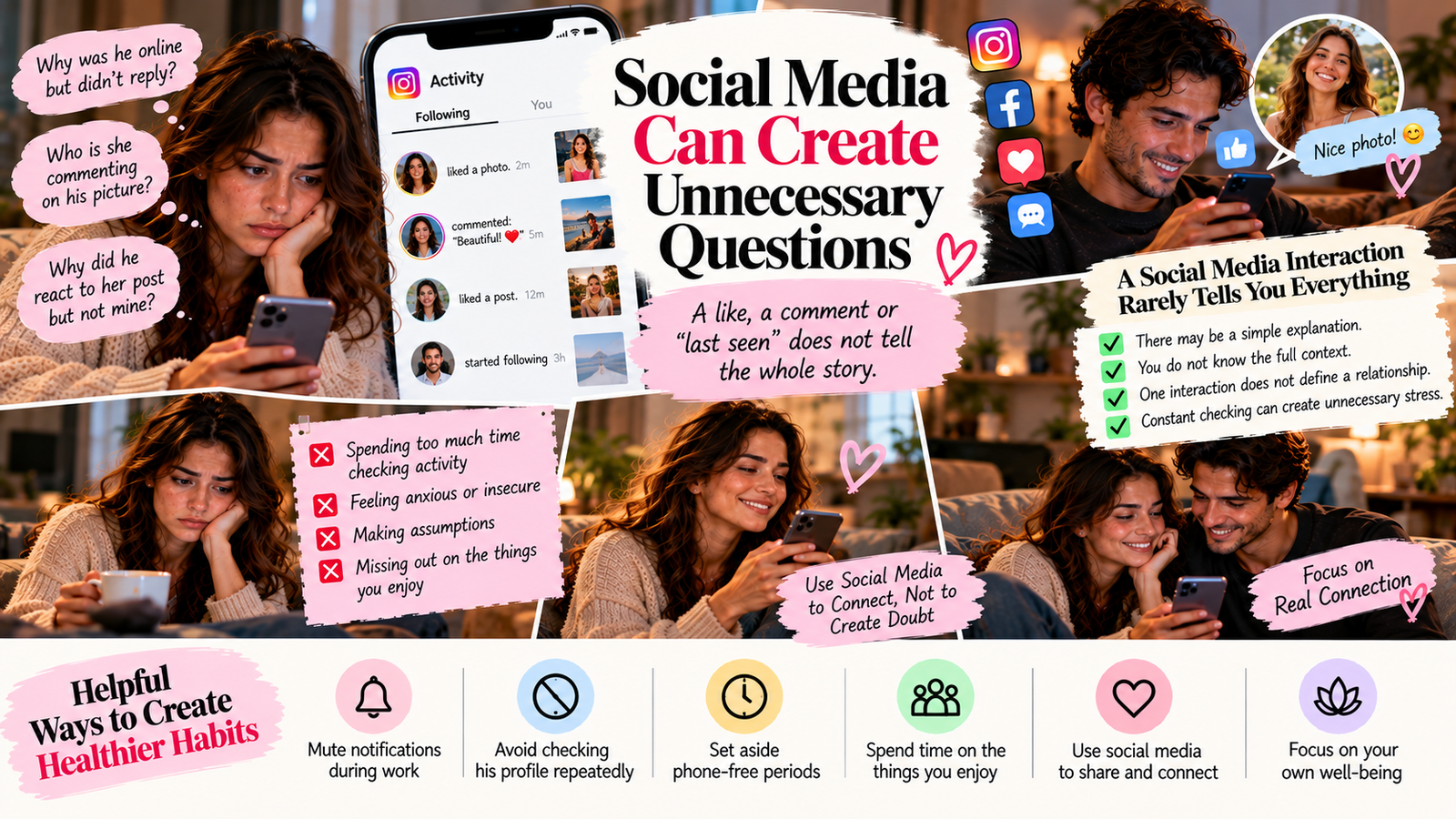
If you recognize this habit in yourself, consider changing your routine.
You could mute notifications during work, avoid checking his profile every time you open an app, or set aside phone-free periods during your day.
Use social media to connect with people and share experiences you enjoy rather than to gather evidence about your relationship.
Choose conversation over investigation
If something specific is bothering you, do not assume you must solve it by searching through online activity.
Where it is safe to do so, ask a respectful question.
You might say:
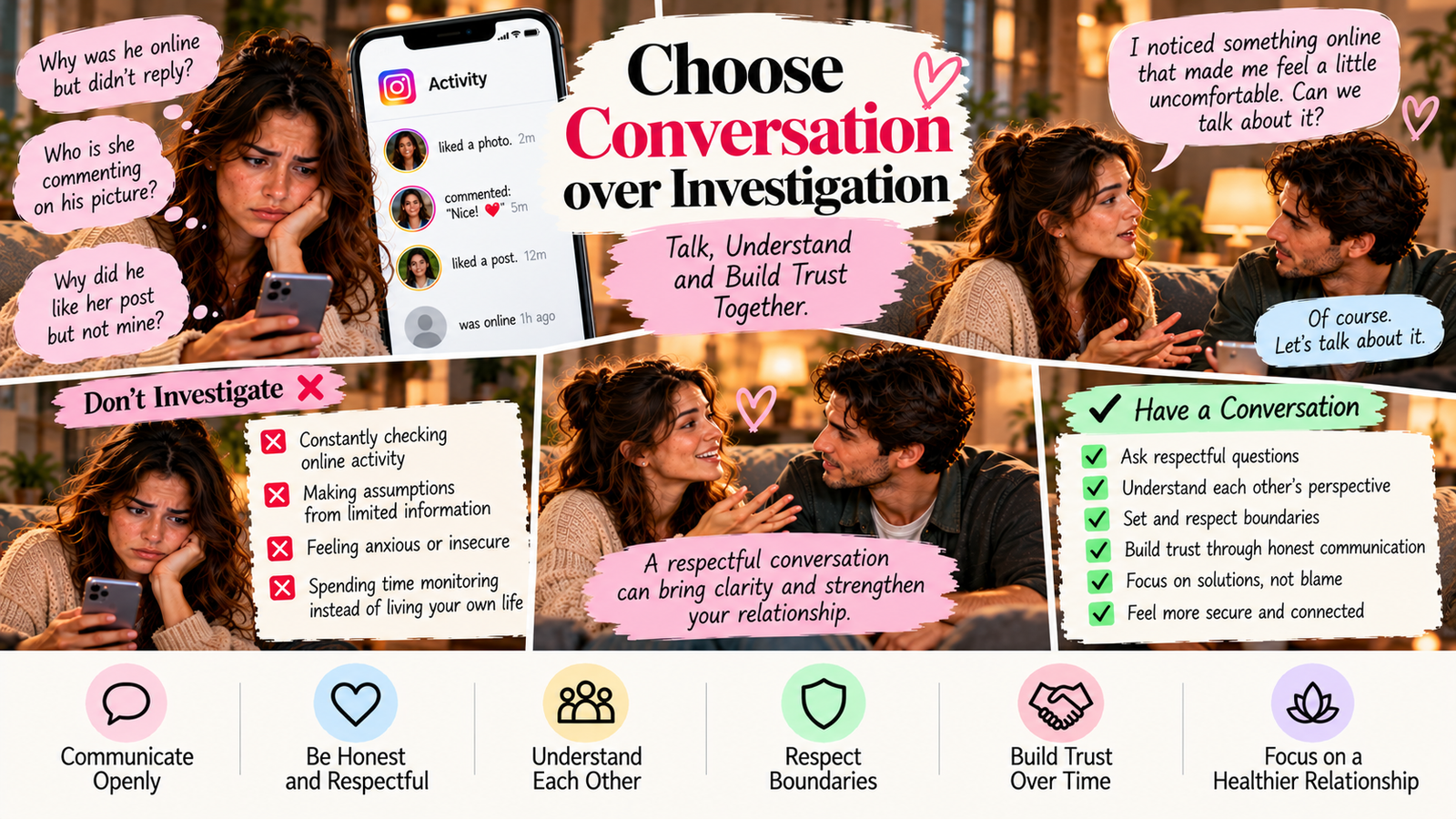
“I noticed something online that made me feel a little uncomfortable. Can we talk about it?”
The goal is not to accuse or control your partner. It is to understand each other.
Trust is not built through constant monitoring.
It develops when people communicate honestly, respect boundaries, and behave consistently over time.
7. Keep Discovering New Things About Each Other
The beginning of a relationship often feels exciting because everything is new.
You are learning about each other’s childhoods, favorite places, ambitions, habits, and unexpected interests.
As time passes, everyday responsibilities can take priority.
Conversations may begin revolving around schedules, bills, work, and household tasks.
These practical discussions are necessary, but relationships also benefit from curiosity.
Instead of trying to appear mysterious by withholding information, focus on continuing to grow as individuals and as a couple.
Learn something new.

Visit a different restaurant.
Start a hobby.
Take a weekend trip if your circumstances allow it.
Ask your partner about a dream he has not pursued yet.
Share a story from your past that he has never heard.
The idea is not to become a completely different person.
It is to remember that neither of you is a finished story.
People’s experiences, preferences, and ambitions can change over time.
Making an effort to stay curious allows you to keep learning about the person you love.
Try a new shared experience
Think of an activity neither of you has tried before.
It could be something simple, such as cooking a dish from another country, visiting a local museum, learning a board game, or exploring a nearby walking trail.
Doing something unfamiliar together can create fresh conversations and memories.

You may discover a shared interest, or you may simply enjoy laughing at how differently you approach the same activity.
Either way, the experience offers something beyond another routine evening.
8. Build Emotional Warmth Instead of Trying to Be Perfect
Nobody can be cheerful, entertaining, and emotionally available every minute of every day.
Relationships include difficult conversations, disappointments, stressful periods, and disagreements.
You should never feel that you have to hide your sadness or suppress legitimate concerns just to make yourself more appealing.
However, the way two people treat each other during everyday interactions can have a significant influence on how their relationship feels.
Kindness, appreciation, patience, and attentive listening all create opportunities for a supportive connection.

If your partner tells you about a difficult day, listening without immediately dismissing the problem may help him feel understood.
If he achieves something important, celebrating his success can show that you care about his goals.
The same consideration should extend to you.
You deserve a partner who takes your concerns seriously, celebrates your achievements, and supports you during difficult periods.
Notice the everyday opportunities for connection
Sometimes small actions communicate affection more clearly than elaborate declarations.
Remembering something your partner mentioned last week, thanking him for a thoughtful gesture, or checking how an important appointment went can demonstrate genuine attention.
The Gottman Institute explores the role of these interactions in its article on making better bids for connection.

It is also important to handle disagreements respectfully.
If a discussion becomes heated, taking time to calm down can be useful, provided you communicate that you intend to return to the issue.
Being a supportive partner does not mean accepting disrespect or pretending everything is fine.
A strong emotional connection allows both people to feel valued even when life is imperfect.
9. Strengthen Your Independence and Self-Confidence
There is a difference between wanting someone in your life and feeling that your entire sense of worth depends on their attention.
If your mood rises and falls according to how quickly he replies, whether he compliments you, or how often he suggests meeting, the relationship may begin to feel emotionally exhausting.
Instead of looking only to your partner for reassurance, consider the areas of your life where you would like to feel more confident.

That might mean building professional skills, improving your financial stability, strengthening friendships, or learning to make decisions independently.
It could also involve becoming more comfortable spending time alone.
Self-confidence does not require a particular salary, job title, appearance, or lifestyle.
It can develop through everyday experiences that remind you of your abilities and values.
Start with goals that matter to you
Choose a realistic personal goal that has nothing to do with impressing your partner.
Perhaps you want to complete an online course, improve your cooking skills, save for a personal purchase, or become more consistent with exercise.
Make a plan that suits your circumstances.
Celebrate the progress you make.
Over time, working toward your own goals can help you feel that your life has direction beyond your romantic relationship.

Your partner can support those ambitions, just as you can support his.
But neither person should have to abandon their individuality to prove their commitment.
A meaningful relationship should make room for both people’s growth.
#10. Stop Trying to Control Whether He Misses You
This may be the most important point of all.
You cannot force another person to miss you.
You can send fewer messages, make plans without him, or spend more time working on yourself.
But none of those actions guarantees a particular emotional reaction.
And when they are performed solely to influence his behavior, they can stop being expressions of independence and become strategies for controlling the relationship.

For example, deliberately ignoring a kind message to create uncertainty may seem like a way to increase his interest.
But he might interpret your silence as disinterest or become confused about what you want.
Posting photographs to provoke jealousy can create similar problems.
Rather than trying to engineer his feelings, pay attention to what naturally happens when you both have room to be yourselves.
- Does he express interest in your day?
- Does he make an effort to spend time with you?
- Does he respect your commitments?
- Does he communicate when something is wrong?
Most importantly, do you feel that your needs and feelings matter?
These questions offer more useful insight than measuring how many hours it takes him to send a message.
Ask for what you need
If you feel disconnected, it is okay to say so.
You might tell him:
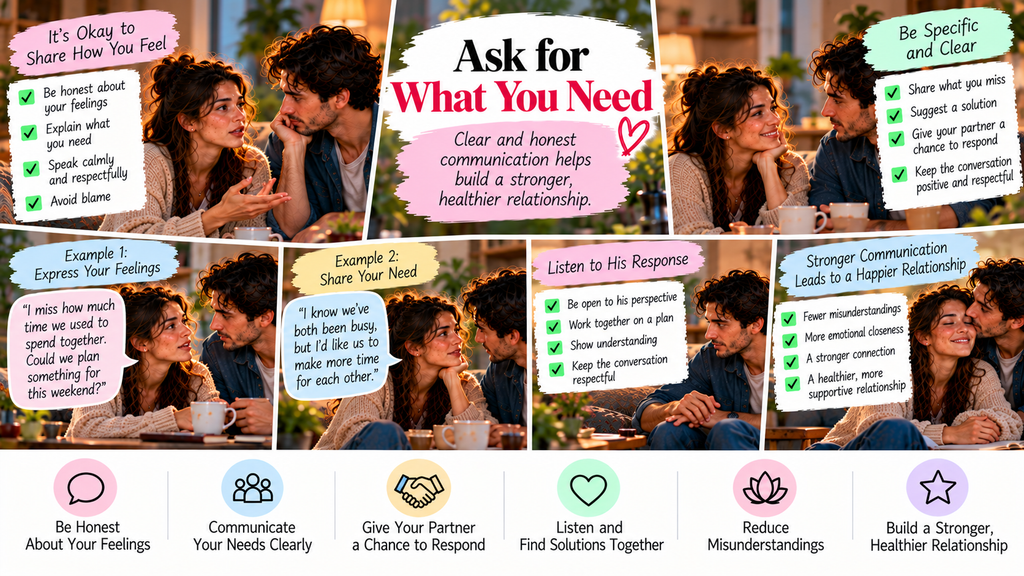
“I miss how much time we used to spend together. Could we plan something for this weekend?”
Or:
“I know we’ve both been busy, but I’d like us to make more time for each other.”
These statements communicate a need without blame.
They also give your partner a clear opportunity to respond.
Healthy communication does not eliminate every disagreement, but it can make misunderstandings easier to address.
How to Know Whether He Truly Values Your Relationship
It can be tempting to measure someone’s feelings by how often they say they miss you.
But words are only one part of a relationship.
A partner who genuinely values the connection will generally show consideration through everyday behavior, even if his communication style differs from yours.

Pay attention to patterns rather than isolated moments.
- Does he make time for you when reasonably possible?
- Does he follow through on promises?
- Does he respect your boundaries?
- Does he listen when something matters to you?
Is he willing to address problems rather than repeatedly dismissing them?
Someone may be quiet, busy, or less expressive without being uncaring.
At the same time, consistently ignoring your needs, refusing to discuss problems, or expecting you to do all the work should not be dismissed simply because you love him.
The National Domestic Violence Hotline’s guide to healthy relationships highlights respect, honesty, equality, trust, and boundaries as important features of healthy partnerships.
Rather than asking only whether he misses you, consider whether the relationship provides consistent care and mutual respect.
Those qualities offer a more meaningful foundation for evaluating the connection.
The Difference Between Healthy Independence and Playing Hard to Get
Many dating discussions blur the line between creating healthy space and deliberately making yourself unavailable.
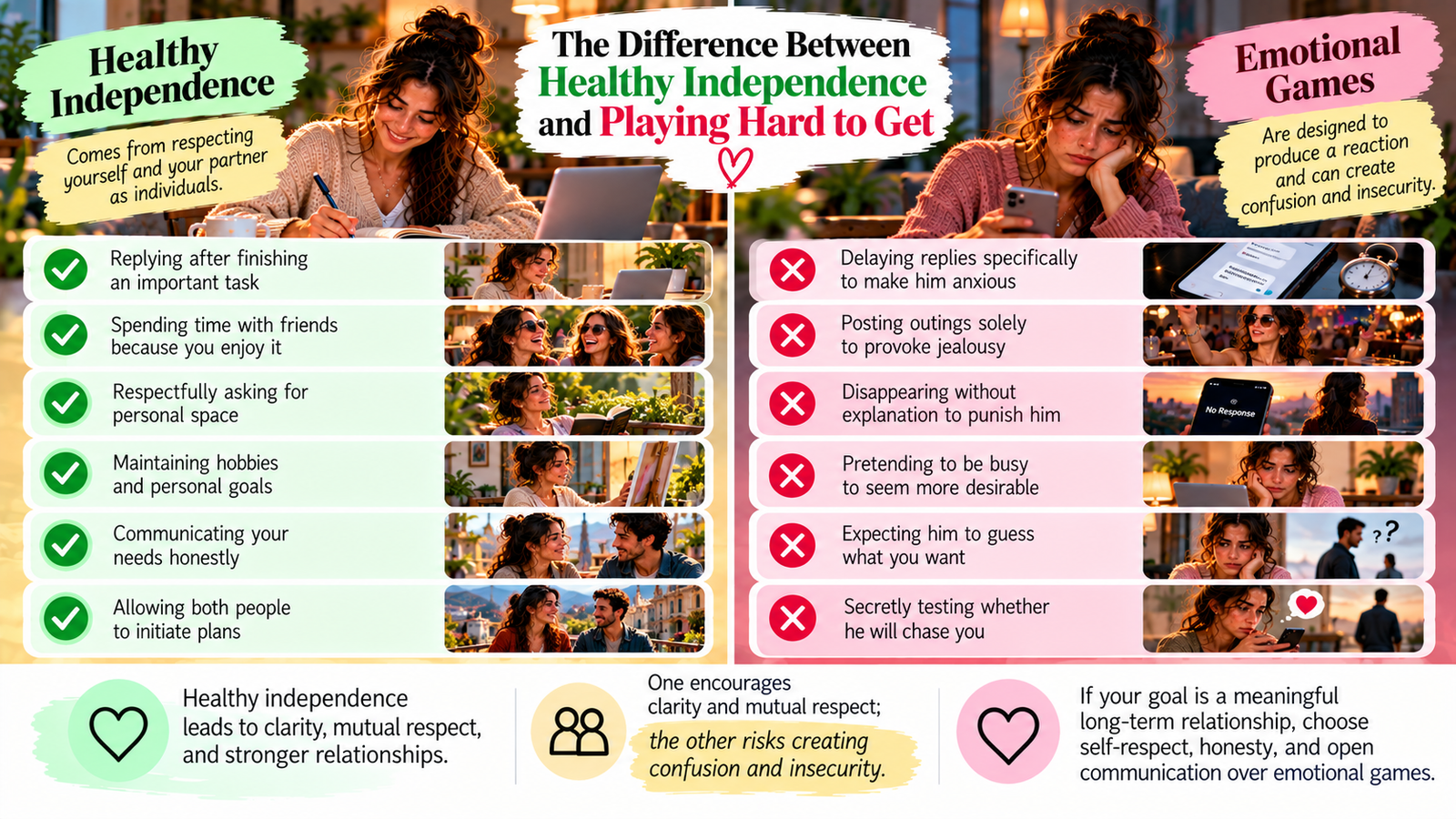
The distinction matters because the same behavior can have very different motivations.
| Healthy independence | Emotional games |
|---|---|
| Replying after finishing an important task | Delaying replies specifically to make him anxious |
| Spending time with friends because you enjoy it | Posting outings solely to provoke jealousy |
| Respectfully asking for personal space | Disappearing without explanation to punish him |
| Maintaining hobbies and personal goals | Pretending to be busy to seem more desirable |
| Communicating your needs honestly | Expecting him to guess what you want |
| Allowing both people to initiate plans | Secretly testing whether he will chase you |
Healthy independence comes from respecting yourself and your partner as individuals.
Emotional games are designed to produce a reaction.
One encourages clarity and mutual respect; the other risks creating confusion and insecurity.
If your goal is a meaningful long-term relationship, authenticity is a more dependable foundation than carefully calculated behavior.
What If You Are in a Long-Distance Relationship?
- Long-distance relationships come with their own challenges.
- When you live in different cities, states, provinces, or countries, missing each other may be a regular part of the experience.
- But physical distance does not automatically guarantee emotional closeness.
- Couples still need realistic expectations, meaningful communication, and opportunities to share experiences.
- A good starting point is discussing how often you would both like to talk.
- For some couples, a short daily call works well. Others prefer a few longer video conversations each week.
- Time zones, working hours, family obligations, and personal routines can all affect what is practical.
- You might also plan activities that give you something to anticipate together.
- Watch the same film and discuss it afterward.
- Cook a similar meal while talking on video.
- Share photographs from an interesting part of your day.
- Make plans for a future visit when possible.
- Most importantly, avoid turning constant online availability into a requirement.
- A delayed response does not automatically mean a lack of commitment.
- Reliable communication and clear expectations matter more than being connected every minute.
What If You Are Always the One Missing Him?
Sometimes the difficult part is not wondering whether he misses you.
It is realizing that you miss him far more often than you feel missed in return.
Perhaps you regularly rearrange your schedule to see him, but he rarely makes similar adjustments.
Maybe you initiate most conversations or feel uncertain about where the relationship is going.

Before deciding what this means, consider whether the two of you have discussed your expectations.
He may believe the amount of contact is working well because you have never told him otherwise.
Choose a calm moment to explain what you have noticed.
Avoid general accusations such as “You never care about me.”
Instead, focus on specific behavior and how it affects you.
“I’ve noticed that I’m usually the one suggesting when we meet. I’d feel more appreciated if you made plans sometimes too.”
Then listen to his perspective.
What matters next is not simply whether he gives a reassuring answer, but whether his actions demonstrate a willingness to work on the issue.
If you repeatedly communicate your needs and nothing changes, it may be time to reconsider whether the relationship is meeting your expectations.
You should not have to carry the entire emotional responsibility for a relationship on your own.
How can I make him miss me without ignoring him?
Focus on having a balanced life, maintaining meaningful conversations, and allowing both partners to make an effort. Continue expressing affection naturally while respecting your own schedule and responsibilities. You do not need to ignore someone to have healthy personal boundaries.
Does giving a man space make him miss you more?
It can create opportunities for someone to reflect on the relationship or look forward to spending time together again, but there is no guarantee. People respond differently to distance. Space works best when it is mutually understood rather than used as a strategy to create insecurity.
Should I stop texting first to see whether he cares?
You can allow more opportunities for him to initiate contact, particularly if you have been doing most of the work. However, silently testing someone is less useful than having an honest conversation about communication expectations. Consider the overall quality of his behavior rather than one texting pattern.
How long does it take for someone to start missing you?
There is no universal timeline. Feelings depend on factors such as relationship history, emotional closeness, personality, daily circumstances, and individual communication preferences. A person might miss their partner quickly without expressing it, while another might communicate affection in a completely different way.
Can making him jealous increase his interest?
Jealousy may attract attention, but attention is not the same as trust or commitment. Deliberately provoking jealousy can create insecurity and conflict. If you want greater affection or reassurance, communicating that need directly is generally a healthier approach.
What if he never says he misses me?
Not everyone expresses affection verbally. Look for consistent care, consideration, and effort in his actions. If hearing affectionate words matters to you, explain that preference instead of assuming he already knows.
Final Thoughts: The Best Way to Be Missed Is to Build a Relationship Worth Valuing
Wanting someone to miss you is understandable.
It feels good to know that your presence matters and that the person you love looks forward to spending time with you.
But genuine affection cannot be manufactured through carefully timed messages, artificial distance, or emotional uncertainty.

The most meaningful connections are built through everyday choices.
Make time for the people and activities that bring you happiness.
Continue developing your own interests and ambitions.
Enjoy your partner’s company without feeling that you must spend every moment together.
Pay attention when he reaches out, and communicate openly when something is missing.
Allow him to contribute to the relationship, but do not turn every interaction into a test.
Above all, remember that your value does not depend on how desperately another person misses you.
A fulfilling relationship is not simply one where someone longs for you when you are gone.
It is one where you both feel respected, supported, and appreciated when you are together.
And that is a connection worth building.
Join the Conversation
Do you believe a little personal space can make a relationship stronger, or do you prefer staying in touch throughout the day?

What has helped you and your partner maintain a healthy connection?
Share your thoughts in the comments. Your experience might offer a useful perspective to someone navigating a similar situation.
Editorial note — W1 Network Stories: This article was inspired by the relationship topic explored in Benjamin Lucas’s “How to Make Him Miss You Like Crazy,” published by Dijbi on April 27, 2026. W1 Network Stories has developed its own editorial discussion, practical examples, relationship guidance, and additional external references. The information is intended for general educational purposes, not individualized relationship counseling. Dijbi is credited as the source of editorial inspiration and has not endorsed this article.