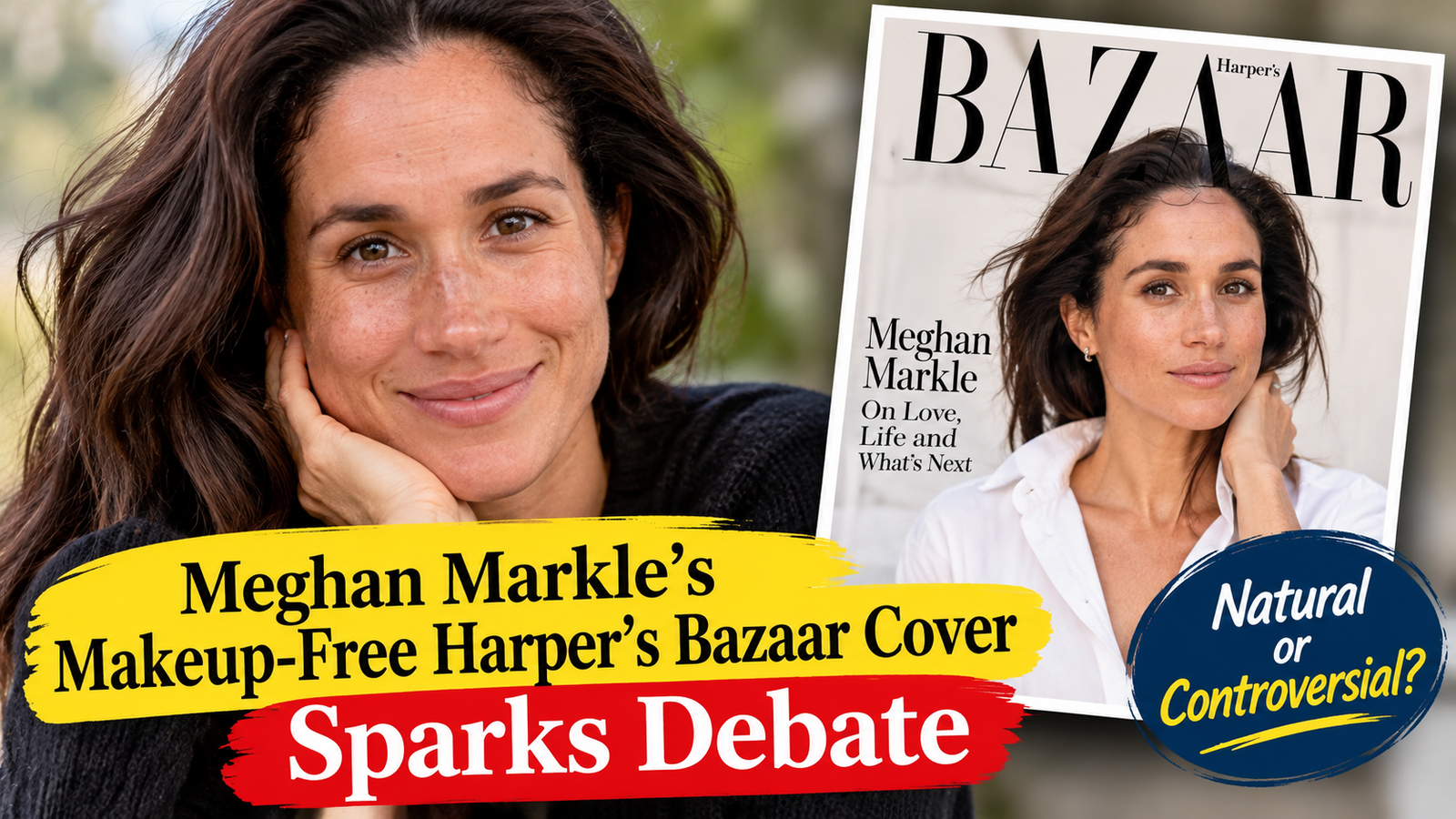
Meghan Markle has once again become a talking point in celebrity culture, but this time the conversation revolves around something surprisingly simple: her appearance on a magazine cover with a remarkably natural look. The Duchess of Sussex appeared in Harper’s Bazaar’s December 2025/January 2026 issue, presenting a different visual style from the glamorous celebrity portraits audiences frequently see.
The photographs quickly attracted attention, with viewers expressing different opinions about the minimalist styling and seemingly makeup-free appearance. Some appreciated the understated presentation, while others questioned the photography and whether a celebrity’s decision to appear without noticeable makeup should be treated as a major statement.
Beyond the photographs, the accompanying interview explored Meghan’s personal development, public scrutiny, family life, and professional ambitions. The combination made the cover more than a conventional celebrity fashion feature, turning it into another discussion about beauty standards, authenticity, and the complicated relationship between public figures and online audiences.
Meghan Markle’s Makeup-Free Harper’s Bazaar Cover Explained
Harper’s Bazaar introduced Meghan as the central figure in its December 2025/January 2026 Art Issue. The accompanying feature, titled Meghan’s Moment, was written by Kaitlyn Greenidge and photographed by Malick Bodian. It was published online on November 19, 2025, with the magazine’s cover attracting widespread attention around the same period.
The editorial presented Meghan in a noticeably understated style. Rather than relying entirely on dramatic beauty styling, the photographs emphasized her facial features, natural-looking skin, and a more relaxed presentation. The overall aesthetic offered a contrast to the highly polished appearance commonly associated with celebrity magazine covers.
An important detail deserves clarification: Harper’s Bazaar officially credited makeup artist Diane Kendal for the photoshoot. Therefore, describing the photographs as a natural or minimal-makeup look is more accurate than claiming that Meghan wore absolutely no makeup.
The creative decision nevertheless became the central talking point. For a celebrity whose public appearances are frequently discussed in terms of fashion, beauty, and presentation, a comparatively understated editorial was enough to generate considerable attention.
Readers can explore the original feature through Harper’s Bazaar’s Meghan Markle cover story.
Why Fans Had Different Reactions to Meghan’s Natural Look
The response to Meghan’s magazine photographs demonstrated how differently audiences can interpret the same celebrity image. Some viewers appreciated the decision to move away from conventional glamour, while others felt the photographs did not deliver the polished visual impact they expected from a major fashion publication.
Supportive reactions focused on the simplicity of the presentation. For these viewers, the photographs offered a refreshing alternative to heavily retouched celebrity imagery and elaborate beauty styling. They appreciated the visible freckles and understated appearance rather than viewing them as imperfections.
Critical reactions focused more on the photographic execution. Some online commenters questioned the angles, expressions, and overall composition, suggesting that the pictures were less flattering than other portraits of the Duchess. Others questioned whether the editorial’s natural aesthetic communicated the message it appeared to suggest.
However, online criticism should not be confused with a representative survey of public opinion. Social media discussions frequently amplify strong reactions, and the comments that attract the most attention do not necessarily reflect what most readers think.
The more interesting aspect of the response is that the same photographs could be interpreted as refreshing, unconventional, awkward, or carefully styled depending on the viewer’s expectations.
The Beauty Debate Behind the Magazine Cover
Meghan’s Harper’s Bazaar appearance also revived a broader conversation about celebrity beauty standards. In recent years, several well-known women have appeared at public events or in editorial photographs with little visible makeup, challenging the expectation that famous women must always present a heavily polished image.
One widely discussed example is Pamela Anderson, whose makeup-free appearances at fashion events attracted significant attention in 2023. Her decision encouraged conversations about beauty, aging, self-confidence, and the pressure placed on women to maintain a particular appearance.
Meghan’s magazine feature entered a similar cultural conversation, although the circumstances and editorial presentation were different.
The debate raises an interesting question: why does a celebrity’s decision to wear less makeup become a headline in the first place?
For ordinary people, choosing whether to wear makeup is generally a personal decision. For celebrities, however, appearance is frequently treated as part of their public identity. Every change in hairstyle, clothing, makeup, or presentation can become material for commentary.
This creates an unusual situation in which women can face criticism for wearing too much makeup and receive equally intense scrutiny when they choose a more natural appearance.
The discussion is not limited to Meghan. It reflects a wider tension between traditional beauty expectations and the growing popularity of more individual approaches to personal style.
What Meghan Said About Perfection and Personal Growth
The cover story was not exclusively about beauty or fashion. Its interview explored Meghan’s perspective on mistakes, authenticity, public expectations, and the experience of building a career under constant attention.
One of the central themes was her belief that perfection should not become the standard by which people judge every decision. She explained that mistakes can provide opportunities to learn and develop rather than simply representing failure.
Meghan also discussed the pressure associated with making personal decisions while knowing that other people may judge them. Her comments connected the idea of authenticity with the freedom to make choices without allowing outside opinions to dictate every aspect of life.
This theme gave the interview a broader meaning beyond its visual presentation. The natural-looking photographs and the discussion about imperfection complemented one another, even though readers were free to interpret the editorial differently.
For some audiences, the combination reinforced the idea of a public figure attempting to present a less formal image. For others, the polished magazine environment made the message more complicated.
That contrast is part of what made the feature interesting.
Public Scrutiny and Meghan’s Changing Relationship With Fame
Meghan’s relationship with public attention has been a major part of her public story since her relationship with Prince Harry became widely known.
Before joining the British royal family, she was recognized for her acting career, particularly her role in the television drama Suits. Her engagement to Prince Harry in 2017 dramatically increased international interest in her personal life.
Their wedding in May 2018 brought additional attention, followed by years of media coverage involving their royal responsibilities, family decisions, and public appearances.
In 2020, Meghan and Harry announced their intention to step back as senior working members of the royal family. They subsequently established their home in California and pursued independent professional and charitable projects.
In the Harper’s Bazaar interview, Meghan reflected on how entering such an intense public environment affected her personal boundaries. She described learning different ways to protect herself, connecting that experience with self-preservation and personal growth.
This background helps explain why discussions about her appearance can become much larger than ordinary fashion commentary.
A magazine photograph may appear to be a simple visual choice, but audiences often interpret it through years of accumulated opinions about the person in the picture.
That does not mean every reaction is necessarily fair or informed. It does explain why Meghan’s editorial photographs attracted attention beyond the fashion industry.
The Interview Also Highlighted Her Life With Prince Harry
Another important part of the feature involved Meghan’s relationship with Prince Harry.
During the interview, she spoke warmly about her husband and described his support as an important part of their relationship. She highlighted his playful personality and the sense of curiosity he brings into their shared life.
The discussion offered readers a more personal perspective on the couple’s relationship, which has frequently been discussed through headlines about their royal history and professional decisions.
Meghan also reflected on balancing family responsibilities with her business interests. She described the advantages of working from home and having opportunities to remain close to her children while managing professional commitments.
These comments added context to the cover story’s broader theme of personal identity. Rather than focusing entirely on her public image, the interview explored how she approaches different parts of her life.
The result was a feature that combined fashion photography with conversations about marriage, motherhood, work, and personal independence.
How Meghan’s Professional Life Has Evolved Beyond Royal Duties
Meghan’s public identity has expanded considerably since her departure from senior royal duties.
Alongside Prince Harry, she has pursued media, business, and charitable initiatives. Their projects have included the Archewell Foundation and professional relationships with major entertainment companies.
Her lifestyle brand, As Ever, has also become part of her independent business identity. The brand is associated with products including preserves, candles, and other lifestyle offerings.
Her Netflix series, With Love, Meghan, brought another dimension to her public presence through cooking, entertaining, gardening, and conversations with guests.
The Harper’s Bazaar feature discussed the challenges of managing professional ambitions while maintaining a family life. Meghan’s comments suggested that she values the creative process and the opportunity to learn through experience.
These details are relevant to understanding the cover’s wider context. The magazine was presenting a public figure whose professional identity now extends beyond acting and her former royal role.
Her appearance was therefore part of a larger editorial portrait of a woman navigating business, family responsibilities, and public expectations.
Why Celebrity Magazine Covers Generate So Much Discussion
Celebrity magazine covers have always played an important role in shaping public conversations about entertainment, fashion, and popular culture. They offer readers a carefully constructed visual introduction to the person featured inside the publication.
In the age of social media, however, that conversation can begin long before someone reads the accompanying interview.
A single photograph can be shared across multiple platforms, separated from its original context, and interpreted through thousands of individual opinions. The resulting discussion may focus on clothing, facial expressions, makeup, photography, or even the perceived intentions behind the editorial.
Meghan’s cover illustrates this process particularly well.
The original feature explored several subjects, including personal growth and public scrutiny. Yet the visible photographs became a major talking point in their own right.
This reflects a broader challenge for public figures and publishers. A magazine can carefully develop a theme, but once its images reach social media, audiences ultimately decide which aspects they want to discuss.
There is also an important distinction between reviewing an editorial photograph and judging someone’s personal appearance. Constructive discussion can examine photography, styling, and creative direction without turning into personal attacks.
What the Mixed Response Says About Modern Beauty Standards
The different reactions to Meghan’s photographs reveal something about the expectations surrounding women in entertainment.
Celebrity beauty standards often create contradictory demands. Women are encouraged to look natural but are also expected to appear flawless. They are praised for showing individuality, yet their choices are frequently compared with earlier appearances and established beauty trends.
A seemingly simple magazine cover can therefore become a discussion about much larger cultural expectations.
Meghan’s photographs also demonstrate that authenticity is difficult to communicate through a highly produced editorial environment. Magazine covers involve professional photography, lighting, styling, creative direction, and careful image selection.
Even when the final appearance is understated, the process behind it remains a professional production.
That does not automatically make the result inauthentic. It simply means that a natural-looking editorial photograph and an ordinary, unplanned photograph are not necessarily the same thing.
For readers, recognizing this distinction makes the conversation more meaningful. The issue is not whether a celebrity has somehow achieved a completely untouched appearance, but how the presentation challenges or reinforces the expectations associated with celebrity beauty.
Conclusion: Meghan Markle’s Cover Became More Than a Beauty Story
Meghan Markle’s Harper’s Bazaar cover generated conversation because it brought together several subjects that continue to attract public interest: celebrity fashion, natural beauty, personal identity, and the pressure of living under constant scrutiny.
The photographs received both praise and criticism, demonstrating that audiences do not always agree on what makes a successful magazine cover. Some appreciated the understated presentation, while others questioned its photographic execution.
The accompanying interview offered a broader perspective, exploring Meghan’s views on mistakes, authenticity, family life, and her evolving professional identity.
Ultimately, the discussion highlights how celebrity images can become cultural talking points far beyond their original purpose. Whether readers liked the photographs or not, the cover encouraged another conversation about how women are expected to look, behave, and present themselves in the public eye.
And perhaps that is the most interesting part of Meghan’s latest magazine appearance: a seemingly simple beauty choice became an opportunity to examine much bigger expectations surrounding fame and modern celebrity culture.
Sources and References
The article is based on the following published sources:
- Harper’s Bazaar — Original Interview and Photoshoot
Meghan’s Moment: Meghan Markle’s Cover Story. Harper’s BAZAAR+1 - People — Meghan’s Harper’s Bazaar Cover Interview
Meghan Markle Discusses Marriage, Personal Growth and Family. - The Independent — Analysis of the Makeup-Free Cover
Can We Please Stop Applauding Celebrities for Posing Makeup-Free?. - British Vogue — Meghan’s Earlier Makeup-Free Appearance
Meghan Goes Make-Up Free, and Her Skin Speaks for Itself. - International Business Times UK — Reactions to the Harper’s Bazaar Cover
Meghan Markle’s Makeup-Free Harper’s Bazaar Cover Ignites Debate