

On the Friday Elena Ruiz almost gave up her Sacramento design business, she had three restaurant menus open on her screen and $640 in her business checking account. A printer needed $780 before he would put a client’s folded brunch menu on the press. Elena had already earned more than the difference. The invoice for the design work was still in her drafts.
She’d been proud of handling everything for her restaurant clients, from the first pencil sketch to the box of menus at the host stand. Somewhere along the way, handling everything had come to include advancing printing costs, chasing three people for approval, and fixing prices over the weekend. She opened an application for a salaried design job. Then she called the restaurant owner and explained exactly what stood between the approved menu and the press.

An original work of fiction. The freelancer, clients, and dollar amounts are illustrative.
The owner agreed to pay the printer directly. That got one job out the door. It also gave this California freelancer a question worth taking into Monday morning. If a ten-minute call could uncover an arrangement that worked better for everyone, what else had she been doing the hard way?
The first habits this California freelancer changed were about money

#1. Check what the business can pay for today
Elena used to open her inbox first. On Monday she opened her bank account, her unpaid bills, and her calendar. She wrote down the cash available, the payments she had already committed to, and the next date money was due in. Against Friday’s numbers, the problem took one line of arithmetic. Even if she had emptied her account, she would still have been $140 short at the printer.

She began doing this before making the day’s first spending decision. On a quiet morning, it took little more than crossing off a payment that had cleared. When a client proposed an ambitious print run, she could look at the figures and discuss who would pay the vendor before she agreed to a pickup date. The U.S. Small Business Administration’s guidance on managing business finances identifies money owed by customers, bills owed by the business, and available cash as distinct items to track. Friday had given Elena a memorable example of all three.
#2. Send the invoice when the agreed milestone arrives
The unsent design invoice had a number, a description, and even a due date. What it lacked was a recipient. Elena had saved it while looking for the restaurant’s billing email, then answered a call and forgotten where she had stopped. The owner, who had approved the menu two days earlier, had every reason to think Elena was still putting the bill together.
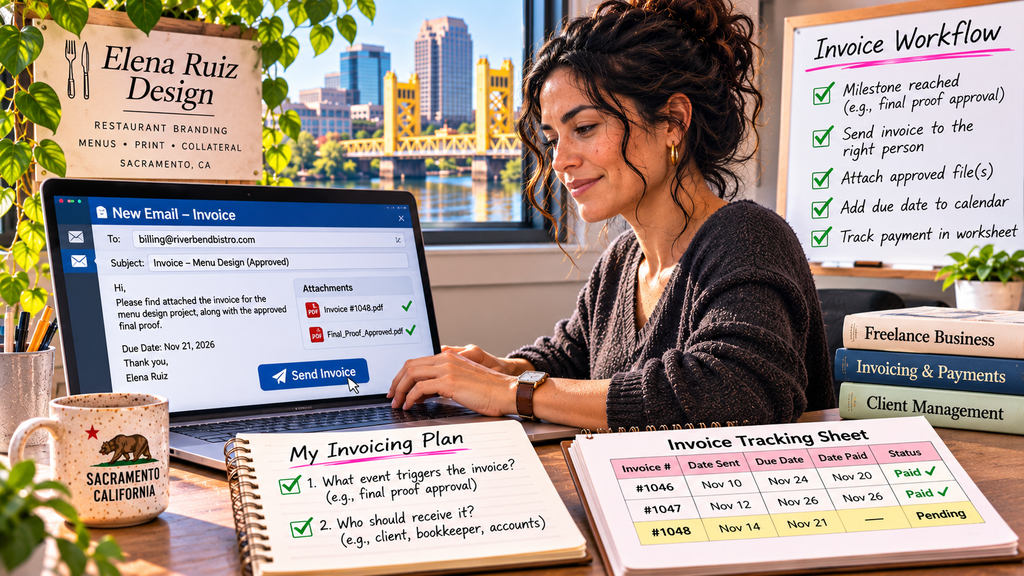
She added two questions to the start of each job. What event made her entitled to invoice under their agreement, and who needed to receive it? For one café, the event was approval of the final proof, and the recipient was an outside bookkeeper who had never met Elena. Once she knew both, she could send the invoice with the approval attached and enter the payment due date in her calendar. On days without a billing milestone, she simply checked for an approved job still waiting to be billed.
She also stopped relying on her sent folder to tell her a job’s status. A sent message could contain a proposal, a draft invoice, or a friendly reminder. Her work sheet had room for the invoice number, date sent, due date, and date paid. That last space stayed blank until payment arrived.
#3. Give every overdue invoice a next action
One restaurant appeared on Elena’s list three mornings in a row. She had marked the invoice “followed up” and assumed the next move belonged to the owner. Reading the exchange again, she realized the owner had asked for the invoice as a PDF. She had resent the same online payment link.
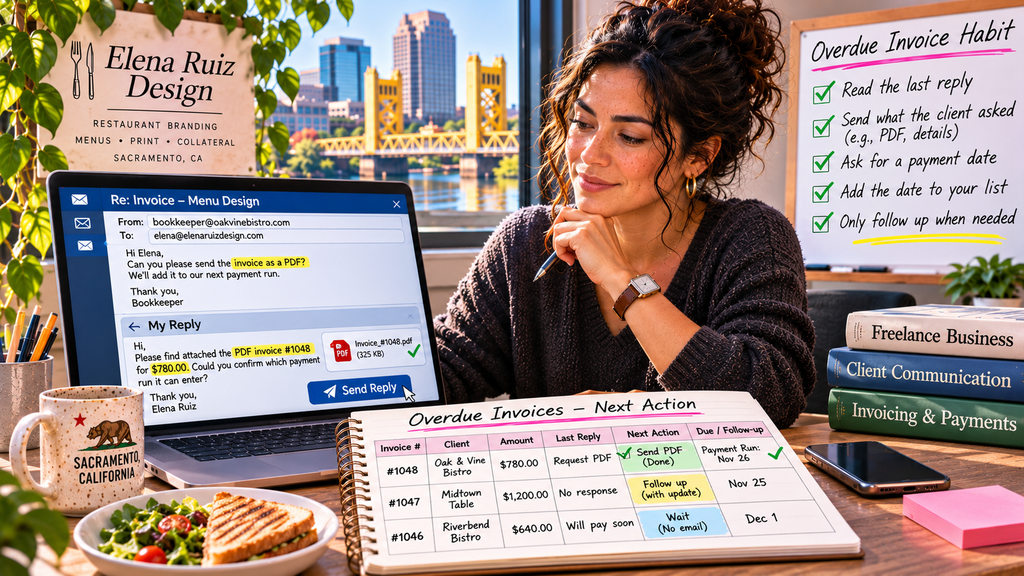
Her new habit was to read the last reply before writing another reminder. For this client, she attached the PDF, included the number and amount, and asked which payment run it could enter. When the bookkeeper gave her a date, Elena put that date beside the invoice. She could leave the client alone until there was a reason to get in touch again.
A daily review didn’t require a daily email. Some mornings the action belonged to Elena, some to the client, and sometimes the sensible entry was a date to wait for. That distinction mattered to a designer who still wanted to walk into the restaurant for lunch after the bill was settled.
Protect the work the client actually bought

#4. Read the scope before agreeing to a small favor
A café owner asked if Elena could send over a square version of the new menu for social media. She could picture the answer she used to give with one hand already on the mouse. But a tall menu turned into a square made the type too small to read on a phone. A usable version needed fewer dishes, larger prices, and a decision about which items to feature.

Elena pulled up the agreement and found one print layout and one round of corrections. She explained the design problem to the owner and offered to price a separate graphic featuring four brunch dishes. The owner chose to photograph the printed menu for that week’s announcement and save the custom graphic for a seasonal launch. Both left the conversation knowing what Friday’s delivery would contain.
She made that quick comparison every time a request changed the work. Correcting a price she herself had mistyped went straight onto her list. Designing a second format prompted a conversation about the fee and the deadline. Being able to tell the difference also made it easier to fix a genuine mistake promptly and graciously.
#5. Put one real decision in front of the client early
Elena once spent an afternoon balancing two columns of entrées before learning that the chef intended to drop the entire lunch section. The most expensive part of the mistake was how good the page already looked. Having polished it, she was tempted to keep rearranging it long after the premise had changed.

Now, before settling in to design, she looked for the unanswered question that could undo the most work. For a neighborhood diner, it was whether breakfast would be available all day. She sent a rough layout showing where the breakfast hours would go and asked the owner to confirm them. While she waited, she prepared the logo and checked the photographs, work that remained useful either way.
Readers who struggle to choose among a dozen plausible morning tasks can also use W1 Network Stories’ guide to choosing a daily priority and making time for focused work. Elena’s practical test was whether an answer would let somebody else move. A sketch with one question often did that better than a finished page.
#6. Record all the time a fixed-fee job takes
Elena liked to think of a $600 menu update as eight hours of design. At that estimate, the fee worked out to $75 an hour before expenses. When she started recording calls, file preparation, and trips to collect proofs, a comparable job came to 12 hours. The same fee then worked out to $50 an hour before expenses and taxes.

The surprise was where the four extra hours went. A 15-minute call with the chef had saved Elena from laying out the wrong dishes. A long drive to collect a proof could have been avoided if she had asked the printer to send it directly to the restaurant. Treating every extra minute as waste would have led her to cut the conversation that had helped her most.
At the end of each work session, she entered the client, the activity, and the elapsed time. The next quote could then include a realistic allowance for design and coordination, with an optional price for an in-person press check. A client who valued that visit could buy it, and Elena could set aside the time to do it properly.
Make room for the next job while finishing this one

#7. Check the calendar before promising a date
A Thursday deadline looked comfortable until Elena worked backward from the printer’s cutoff. A final proof needed approval Wednesday. The restaurant owner spent Wednesdays buying ingredients and preparing for dinner service. The useful deadline for getting a decision was Tuesday afternoon, when Elena had already booked another client’s review.
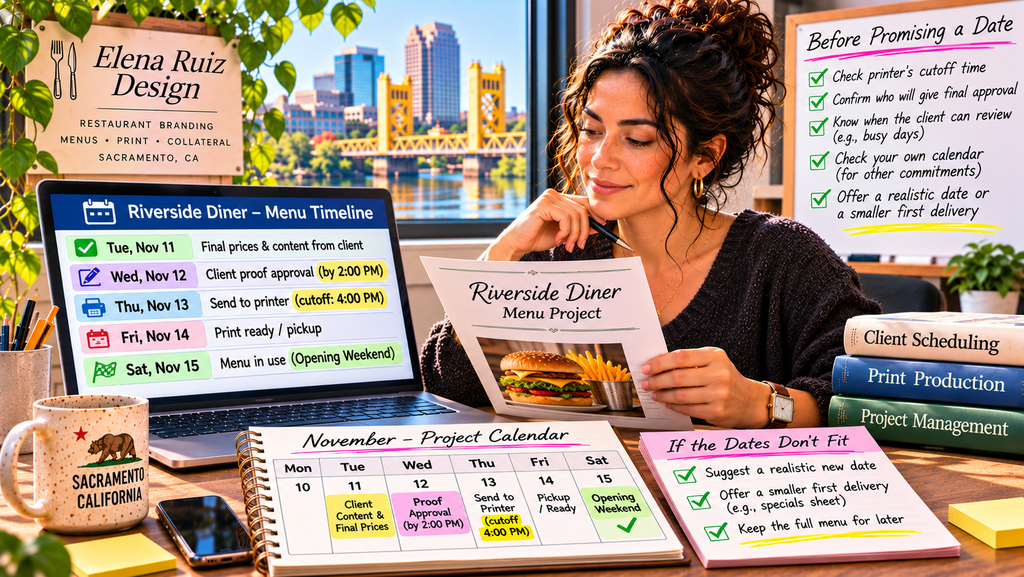
She began pausing over every date she was about to promise. Who would supply the final prices, who could sign off, and when could the printer take the job? When the answers didn’t fit, she offered a date she could reasonably meet or a smaller first delivery. One owner opted for a single-page specials sheet for opening weekend and kept the folded menu for the following week.
This worked best when the client could see the same dates. In her confirmation email, Elena named the person approving the proof and the time she needed their answer. If approval slipped, both sides could identify which part of the schedule needed to move.
#8. Keep one conversation about future work alive
When work was plentiful, Elena could go weeks without talking to anyone about another job. By the time the last menu went to press, reaching out felt urgent and awkward. She would start composing a broad announcement about her availability, then spend the afternoon rewriting her portfolio instead.

She gave herself a smaller daily task. She could answer a prospective client’s question, ask permission to show a finished project, or follow up with someone who had mentioned a specific need. A bakery owner had told her that customers struggled to read the cake sizes on its order sheet. Elena wrote to ask whether he still wanted help with that sheet and offered to discuss it after his holiday rush.
Some conversations ended with a polite decline. That was still enough information to close the entry and spend the next day’s attention elsewhere. When someone asked her to check back in a month, she recorded the invitation and its date. She no longer had to invent an excuse to write or trust herself to remember who had welcomed another conversation.
#9. Put the receipt where the project lives
A charge from the print shop could mean a color proof for one restaurant or sample stock for Elena’s own portfolio. Six weeks later, the merchant name on her bank statement told her little. The person best equipped to explain the purchase was Elena on the day she made it, while the paper was still in her hand.
She started photographing paper receipts and saving digital ones under the relevant project or business expense. She entered the amount and a brief description while she remembered the purpose. When the client paid the printer directly, Elena kept the approved proof with the project and recorded who handled payment. That kept the client’s printing bill out of her own list of outlays.
The IRS guide to supporting business records explains how documents such as receipts, invoices, and paid bills support entries in a business’s books. For California readers, the Franchise Tax Board’s guide to keeping tax records also explains why to keep records of business income and expenses. Elena’s folder names were her own choice. What made the system workable was being able to retrieve the document and explain the transaction.
#10. Leave a handoff note for tomorrow morning
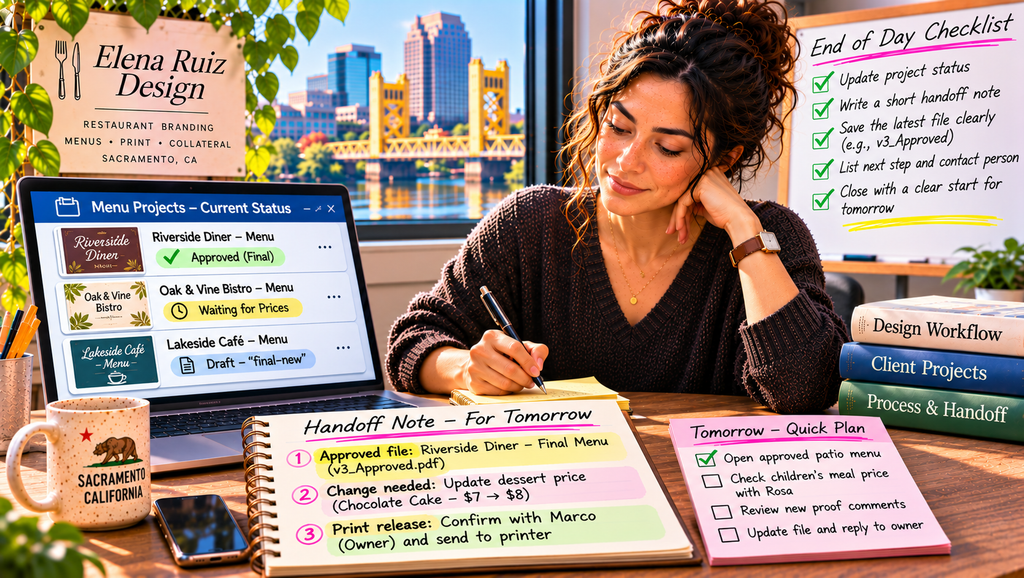
At the end of a working day, Elena often had one menu on-screen, another waiting on prices, and a third saved under a name like “final-new.” Opening them all the next morning felt like work because it was. She was reconstructing decisions she had already made.

Before closing her laptop, she began leaving herself a three-line note. On one Thursday it named the approved file, the single change still needed, and the person authorized to release it to print. Friday morning, when an older proof came back with comments from a second employee, she could identify the mismatch before making edits. The note also gave her enough context to explain the issue to the owner without forwarding an entire email chain.
On a hectic evening, even a single instruction helped. “Open the approved patio menu and check the children’s meal price with Rosa” gave her a place to begin. The habit earned its few minutes on the mornings when she had slept badly, the phone rang early, or a regular client needed an answer before opening the doors.
The next time the printer called
Several weeks later, the Sacramento printer called Elena about another brunch menu. This time he wanted to know whether the restaurant had approved the warm white stock or the bright white. Elena opened the job folder, found the owner’s marked proof, and answered him while he was still on the line. The restaurant had already arranged payment, and her design invoice had gone to the bookkeeper the day before.
She still had a gap in the following month’s calendar. One invoice was overdue, with a call scheduled for Tuesday. Those facts mattered because they told her where to spend the hour before lunch. She closed the finished menu and picked up the bakery’s cake order sheet. For once, the work she had promised for today was the work she actually had time to do.