
A casual house party turned into an unexpected relationship dilemma for one man after he discovered that his girlfriend had previously slept with someone he had just met.
The couple had been together for only a few months, and their relationship appeared to be developing positively. They spent weekends together, shared personal experiences, and were gradually building emotional trust.
But after attending a gathering with his girlfriend’s friends, the man learned something that made him reconsider an otherwise ordinary social occasion.
One of the guests had a romantic history with his girlfriend that she had never mentioned to him.
What bothered him wasn’t simply that she had been intimate with someone before they met. It was the fact that she had introduced him to a social setting without telling him about a connection he believed was relevant.
When he expressed his discomfort, his girlfriend apologized and tried to reassure him. His therapist, however, reportedly suggested that he was making too much of the situation.

Uncertain whether his expectations were reasonable, the man turned to Reddit for outside perspectives.
His experience, originally shared in a Reddit discussion on r/AITAH, raises a question many couples eventually encounter: How much should partners disclose about their past when people from that past remain part of their present lives?
Editor’s note: This article examines an anonymous account published on Reddit in January 2025, including the poster’s subsequent explanations and community responses. The events have not been independently verified, and the girlfriend’s and therapist’s direct perspectives are unavailable.
#1: A New Relationship That Was Becoming Serious
According to the man, he and his girlfriend had been officially dating for approximately two and a half months when the disagreement occurred.
Although their relationship was relatively new, they were already spending substantial time together.
In a later Reddit response, he explained that they had met roughly three and a half months earlier and had spent nearly every weekend together since then, often from Friday evening until Monday morning.

For him, the frequent time together contributed to a growing sense of closeness.
The couple had also discussed personal experiences and previous relationships.
His girlfriend had apparently been open about several people she had dated before meeting him. He appreciated that openness and said he had no problem accepting that she had a romantic history.
He wasn’t expecting his partner to have lived without previous relationships.
Instead, he believed that their willingness to discuss the past was helping create a foundation of trust.
That expectation became central to the disagreement that followed.
#2: An Invitation to a House Party With Her Friends
The situation began when his girlfriend invited him to a house party attended by her friends and acquaintances.
For someone entering a new relationship, meeting a partner’s social circle can be an important step.
It provides an opportunity to learn more about the people who have been part of their life and to become more comfortable in their world.
Among the guests was a man whose name the boyfriend already recognized.

His girlfriend had mentioned this individual several times in previous conversations, usually while recounting unrelated stories.
Because he had heard about him before, the boyfriend was familiar with the name.
What he didn’t know was that his girlfriend and this man had once been sexually involved.
The party passed without the boyfriend discovering that detail.
Only afterward would he learn something that changed how he remembered the gathering.
#3: The Conversation That Changed Everything
The man later clarified that he learned about the former hookup the day after the party, while he and his girlfriend were spending time together at an Airbnb.
He became curious about the man he had met and asked his girlfriend whether that person had ever shown romantic interest in her.
She acknowledged that he had.

The boyfriend then asked whether their relationship had ever become physical.
His girlfriend responded that they had slept together once in the past.
The revelation surprised him.
He had heard stories involving this person, knew he was connected to her social circle, and had now attended the same gathering.
Yet until that conversation, he hadn’t known about their former intimacy.
For the boyfriend, the unexpected discovery created discomfort that was difficult to explain.
He didn’t accuse his girlfriend of cheating.
He didn’t claim that her previous relationship had taken place while they were dating.
Instead, he questioned why he hadn’t received a simple warning before meeting someone with whom she had once shared that kind of history.
#4: Why He Felt a Heads-Up Would Have Been Appropriate
The boyfriend explained that he would have handled a similar situation differently if their roles had been reversed.
If he were taking his girlfriend to a party where someone he had previously slept with would be present, he believed he would tell her beforehand.
He saw this as a consideration for his partner rather than a requirement to disclose every detail of his personal life.
In his view, advance knowledge could help someone feel more comfortable in a potentially awkward social situation.
It could also prevent them from discovering an intimate connection unexpectedly through another person’s comments.

However, he admitted that he struggled to explain exactly why the disclosure felt so important.
He didn’t believe his girlfriend had violated a clearly established relationship rule.
Rather, he had assumed that sharing this kind of information was a common courtesy.
This distinction matters because expectations that seem obvious to one person may never have occurred to another.
As the relationship education organization love is respect explains in its discussion of boundaries and expectations, couples can experience hurt when they assume their partner understands a personal expectation that has never actually been discussed.
The boyfriend’s reaction illustrated precisely that challenge.
#5: He Shared His Feelings Without Starting a Public Argument
Some Reddit commenters initially wondered whether the boyfriend had confronted his girlfriend in front of other party guests or created an embarrassing public scene.
He clarified that neither had happened.
Because he learned about the previous hookup the following day, there was no confrontation at the gathering.
Instead, he spoke privately with his girlfriend.

He told her that finding out about the connection afterward made him uncomfortable.
According to his account, he wasn’t aggressive or excessively loud, and he allowed her to explain her perspective.
His concern was primarily about the absence of advance communication.
This is an important difference.
Expressing discomfort about an unexpected situation is not necessarily the same as accusing someone of wrongdoing or demanding control over their friendships.
How that discomfort is communicated can strongly influence whether a disagreement leads to understanding or further conflict.
#6: His Girlfriend Apologized and Tried to Understand
The girlfriend’s reported response was one of the most constructive aspects of the situation.
Rather than dismissing his concern, she listened.
She explained that it had not occurred to her to mention the previous encounter beforehand.
When she understood how much it affected him, she apologized.
The boyfriend later shared additional details about their conversation.
At one point, he felt so emotionally unsettled that he got out of bed to make tea.

His girlfriend called him back and encouraged him to sit beside her so they could continue talking.
According to his description, she spoke openly and directly about the misunderstanding.
Both became emotional, and the conversation ended with them crying.
He said she acknowledged how deeply the situation had affected him and reassured him that she would try to prevent a similar misunderstanding in the future.
Her willingness to listen gave him hope.
Still, even after receiving an apology, he found himself returning to the incident in his thoughts.
That lingering discomfort would become another source of frustration.
#7: A Therapist’s Response Left Him Questioning Himself
The boyfriend had been working with the same therapist for approximately four years.
He generally valued the therapeutic relationship and described his experience with her positively.
Naturally, he decided to discuss the party incident during a session.
According to his Reddit account, the therapist suggested that he had made too much of the situation.
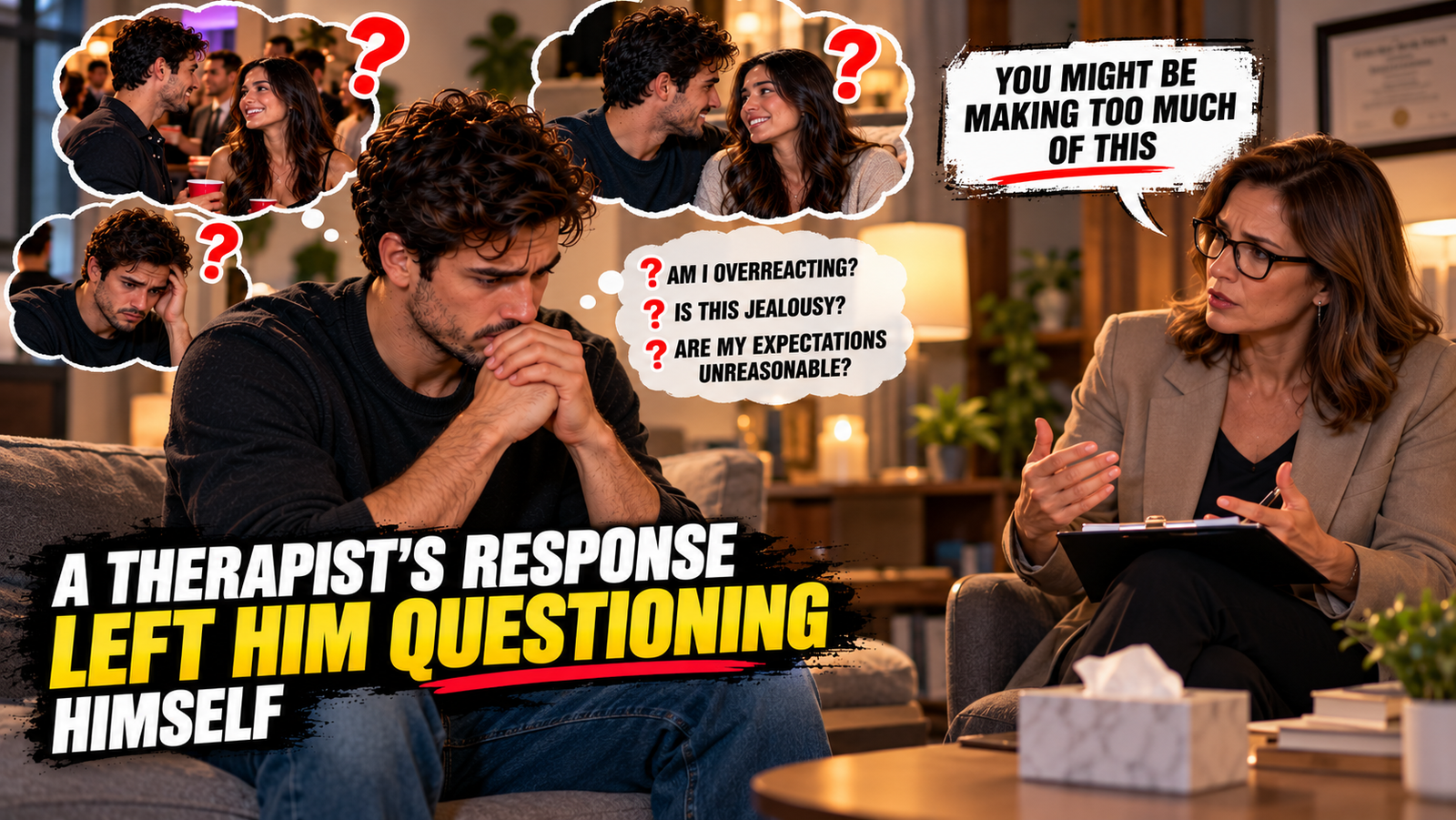
He interpreted her response as criticism and began questioning whether his feelings were unreasonable.
- Was he holding his girlfriend to an unfair standard?
- Was his discomfort rooted in jealousy?
- Or was there something about the unexpected social situation that he hadn’t fully understood?
He couldn’t settle on a clear explanation.
The therapist’s comments, as he understood them, left him feeling judged rather than reassured.
However, the Reddit discussion contains only the boyfriend’s description of their exchange. Without the therapist’s exact words or broader context, it is impossible to determine precisely what she intended.
In a subsequent comment, he acknowledged that his interpretation might not fully reflect her intention.
He also said he hoped to discuss the issue with her again rather than immediately end a professional relationship he had valued for years.
#8: One Reddit Comment Helped Him Identify the Feeling
Among the responses he received, one particular explanation appeared to resonate with him.
A commenter suggested that the uncomfortable part of the situation might have been the unequal information among the three people involved.
His girlfriend knew about her history with the other man.
The other man knew about it too.
But the boyfriend, despite being the person currently dating her, had entered the social gathering without that knowledge.
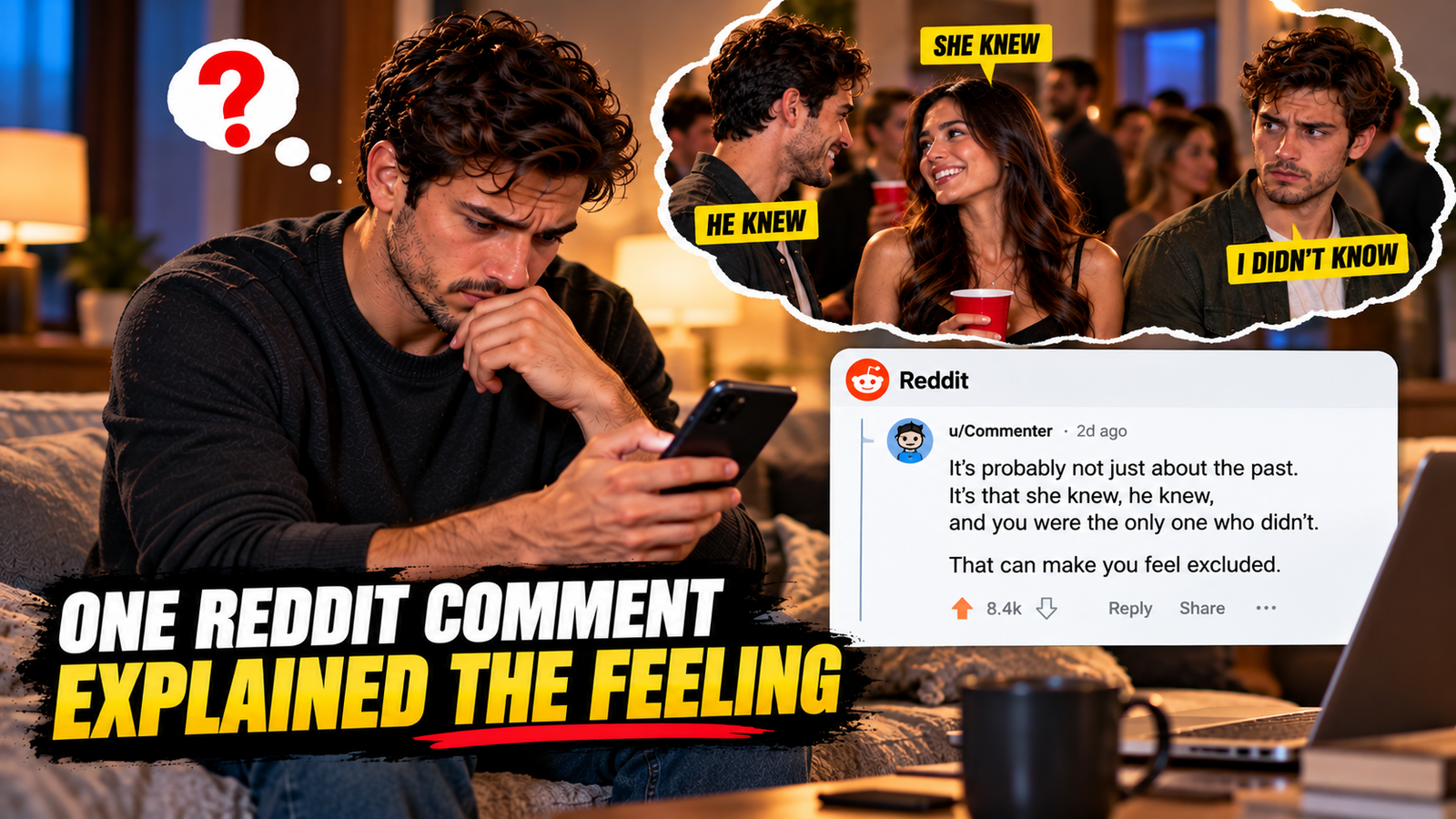
The commenter suggested that this imbalance could make someone feel excluded.
The boyfriend responded that this interpretation closely matched his experience.
He had struggled to describe why the situation bothered him, and the explanation helped him identify the feeling of being the only person unaware of something relevant.
He emphasized that he didn’t believe his reaction came primarily from possessiveness, jealousy, or a desire to control his girlfriend.
Whether those emotions played any role cannot be established from the account alone.
Nevertheless, the distinction between feeling excluded and suspecting infidelity helps explain why he remained upset even though his girlfriend had apologized.
The central question was no longer merely what had happened before their relationship.
It was why he had felt unprepared for a situation involving people who already shared a personal history.
#9: Another Detail Made the Situation More Complicated
As the Reddit discussion continued, the boyfriend revealed another surprising detail.
The man his girlfriend had previously slept with had also been involved with her aunt.
According to the boyfriend, he already knew about that connection before attending the party.
His girlfriend had discussed the man’s involvement with her aunt, along with other details about him.

What she hadn’t told him was that she herself had also slept with the same person.
That difference made the omission particularly confusing to him.
He had understood that this individual was connected to her wider social circle and family acquaintances.
He simply hadn’t realized that the personal history extended to his girlfriend.
Some Reddit commenters considered this detail especially unusual, while others believed it had little bearing on the present relationship.
What mattered to the boyfriend was the apparent inconsistency.
His girlfriend had previously been comfortable discussing other past relationships, including people who were no longer involved in her life.
Yet the man who remained connected to her social environment had not been discussed in the same way.
He began wondering why.
#10: The Instagram Connection Raised New Questions
The boyfriend’s concern eventually expanded beyond the party itself.
He said his girlfriend had described the former hookup as self-interested and not a particularly good friend.
According to his account, she also indicated that she no longer regularly spent time with him.
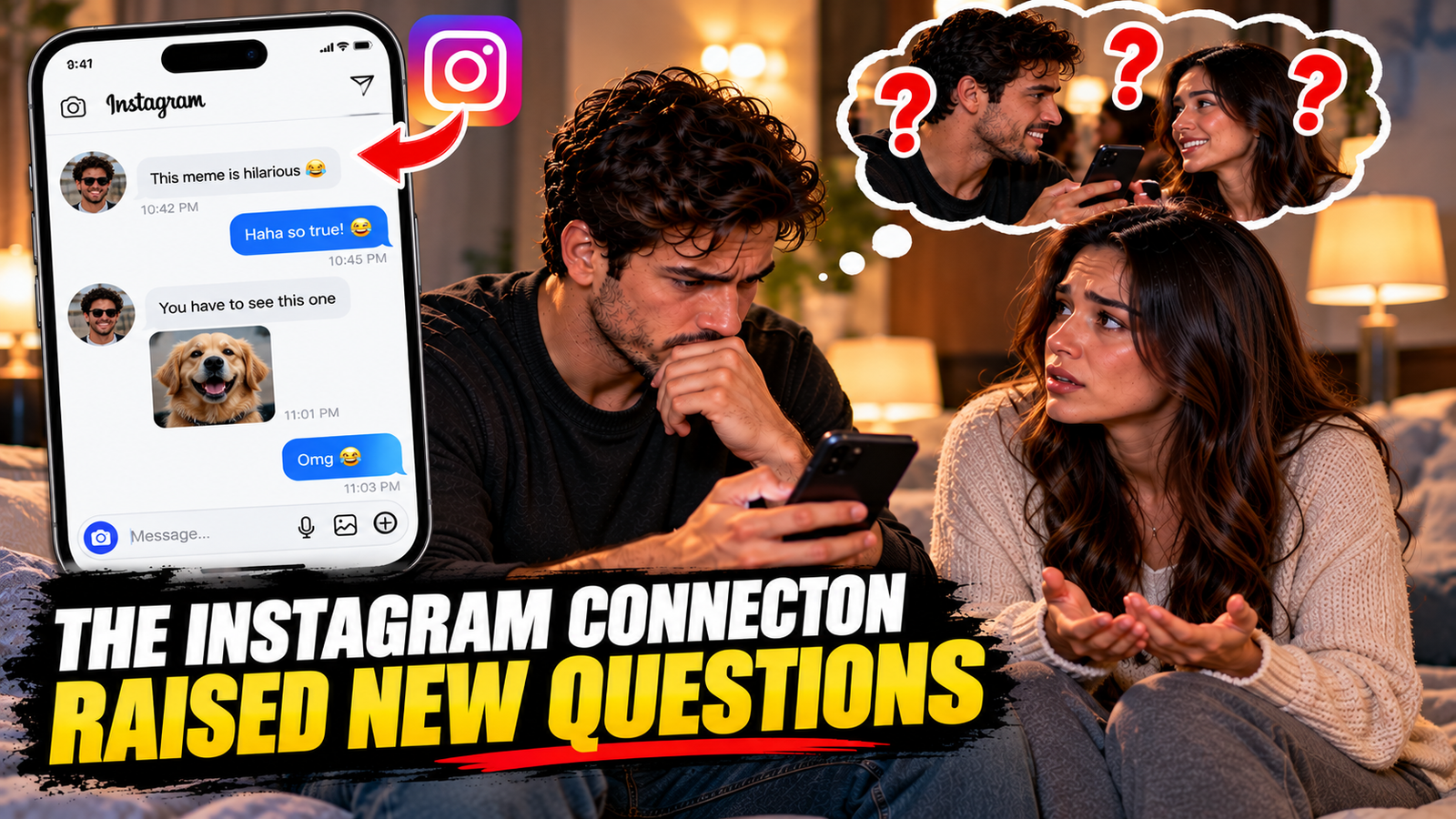
But the two still maintained some contact through Instagram.
They occasionally exchanged memes and humorous posts.
This puzzled the boyfriend.
If she didn’t consider the man a meaningful or trustworthy friend, why keep communicating with him?
He didn’t claim that the Instagram exchanges proved infidelity.
His concern was that the explanation of their current relationship didn’t entirely make sense to him.
He wondered whether there was information he hadn’t understood.
At the same time, there are numerous reasons people remain casually connected to individuals from their past.
They may share friends, participate in overlapping social groups, or maintain occasional contact without any romantic intention.
The love is respect guidance on digital boundaries emphasizes that expectations about online friendships and communication should be discussed rather than automatically assumed.
In this case, the boyfriend’s uncertainty involved both the contact itself and the fact that he did not fully understand why it continued.
Neither issue, on its own, established that his girlfriend had acted unfaithfully.
#11: Some Commenters Wanted Him to Demand No Contact
Not everyone on Reddit encouraged the boyfriend to accept the explanation and move on.
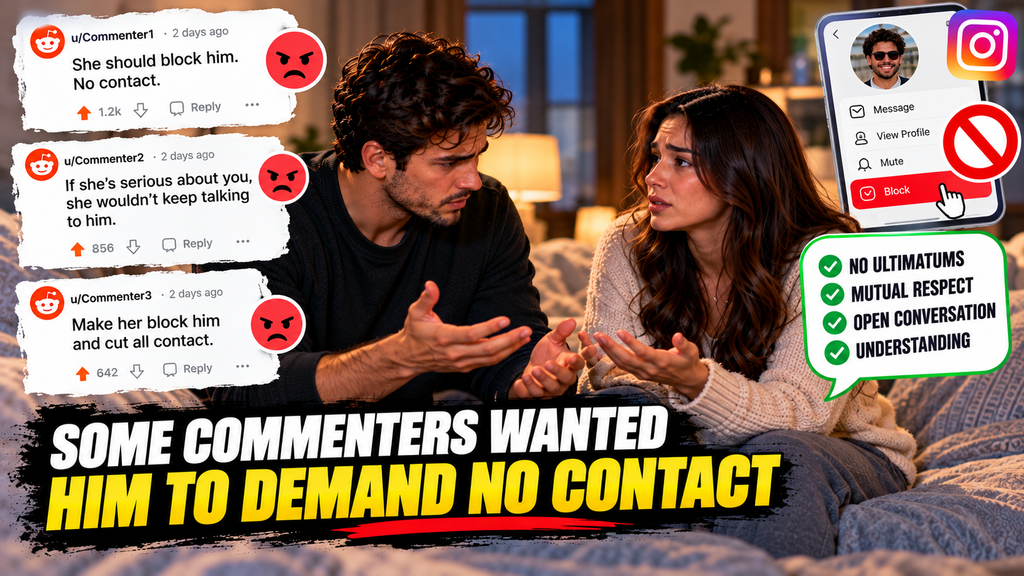
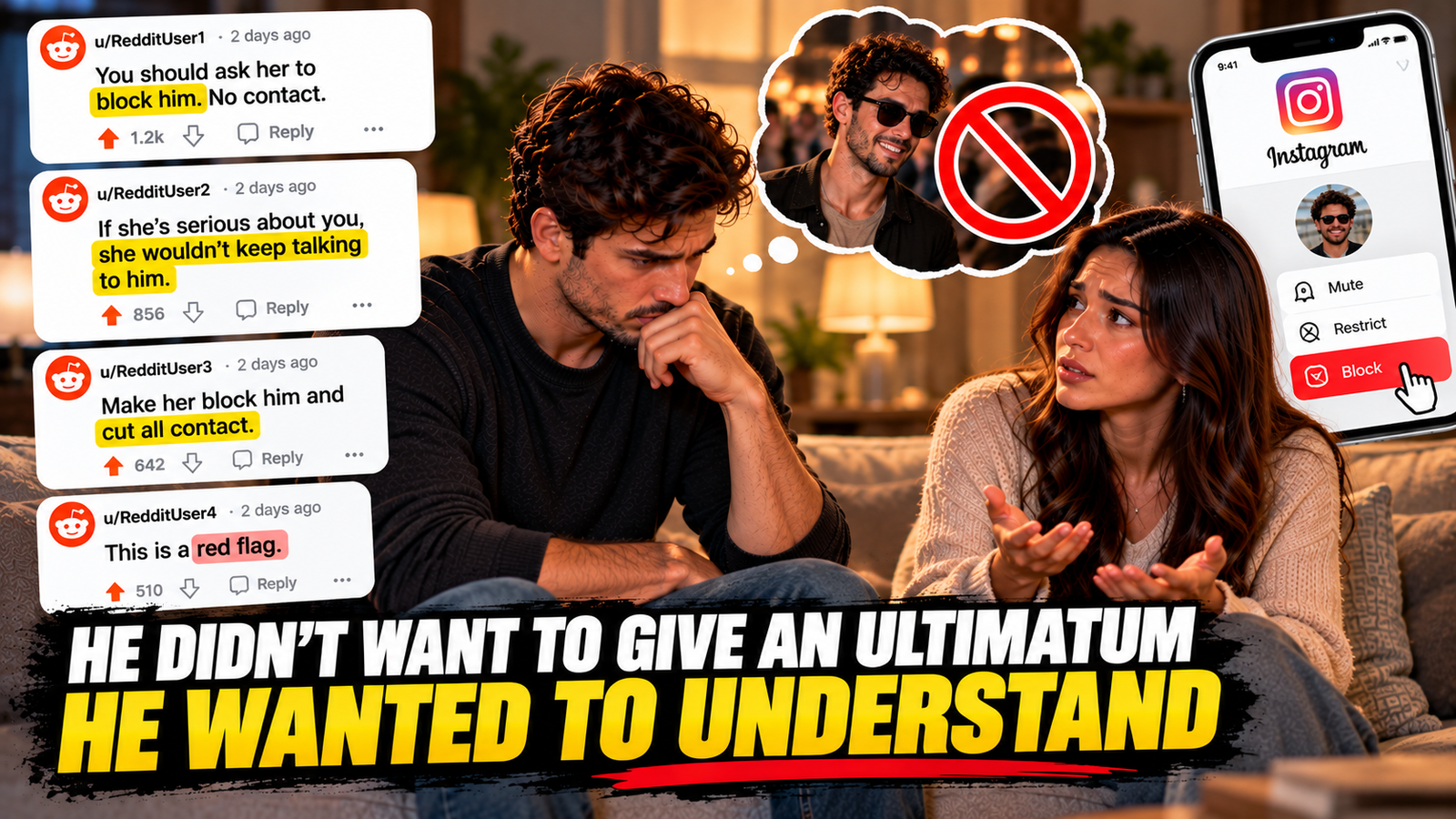
Certain commenters argued that his girlfriend should stop communicating with the former hookup entirely.
Some suggested that asking her to block him would demonstrate whether she was serious about her current relationship.
Others went further, speculating about the nature of the previous connection.
However, those suggestions and suspicions were not supported by independent evidence.
The boyfriend himself rejected the idea of issuing an ultimatum.
He said he didn’t want a relationship in which his girlfriend had to continually prove her loyalty through demands he imposed.
Even if she agreed to block the other man, he wasn’t convinced that would resolve his discomfort.
His goal was not simply to eliminate a social media connection.
He wanted to understand the situation well enough that he could make sense of it.
This reaction introduced another important dimension to the story: the difference between asking for reassurance and attempting to control someone else’s decisions.
A healthy relationship may involve negotiated expectations about former partners, but those expectations need to respect both individuals’ autonomy.
#12: They Discussed the Incident Again the Following Weekend
Although the first conversation ended with an apology and emotional reassurance, the issue wasn’t completely settled.
The following weekend, the couple began discussing the importance of not keeping difficult emotions bottled up.
During that conversation, the boyfriend brought up the party incident again.
He explained that he had discussed it with his therapist and was still having difficulty processing what had happened.
He also admitted that attending future parties involving the same social circle might make him uncomfortable.
According to his account, his girlfriend didn’t respond by forbidding further discussion.
Instead, she asked whether he had made a final decision about avoiding those gatherings.
She also offered to continue talking through the issue until he felt more comfortable.
The boyfriend appreciated that willingness.
He interpreted her response as evidence that she cared about his emotional well-being and wanted their relationship to succeed.
Yet he remained uncertain about whether another conversation would help.
He worried that repeatedly raising the same issue might become exhausting for both of them.
At the same time, simply suppressing his concerns did not seem like a satisfying solution.
#13: The Reddit Community Was Divided
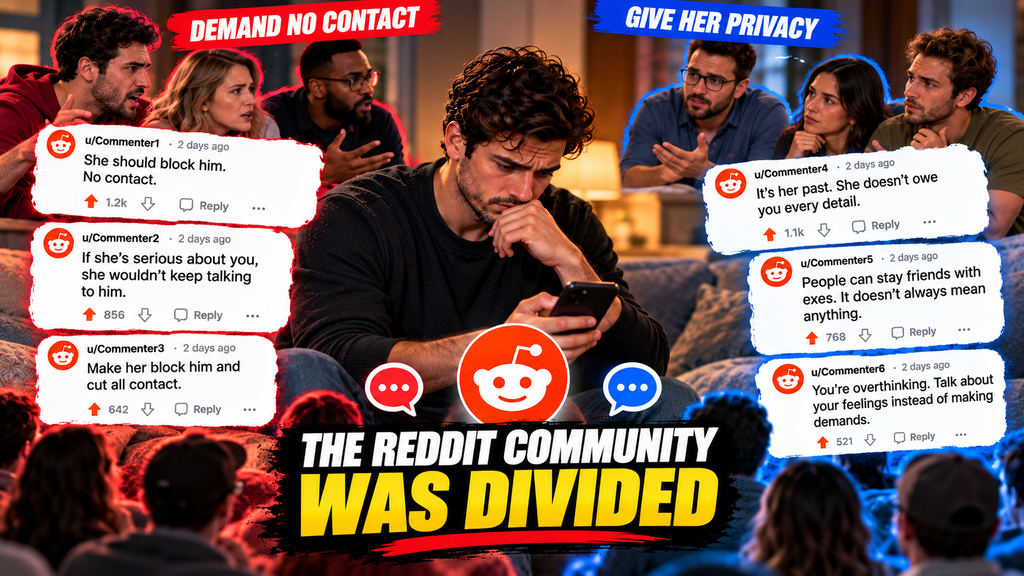
The discussion attracted responses from people with sharply different beliefs about privacy, disclosure, and respect in relationships.
Their disagreement was not only about the girlfriend’s decision.
It also reflected different assumptions about what individuals owe each other during the early stages of dating.
Some Believed He Deserved Advance Notice
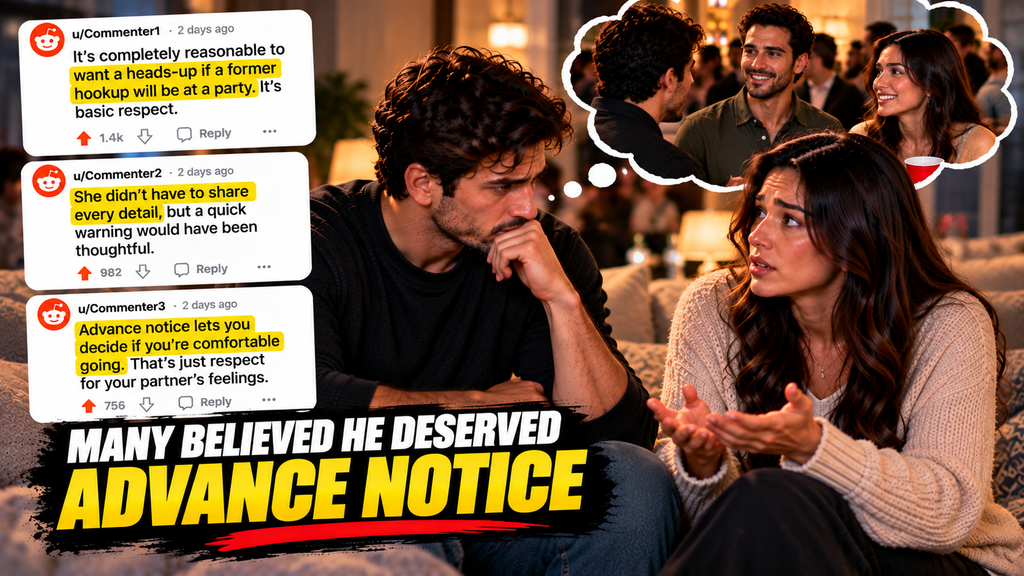
Several commenters argued that the boyfriend’s expectation was reasonable.
They drew a distinction between knowing every detail of a partner’s romantic history and being informed that a former sexual partner would be present at a gathering.
For these commenters, a brief warning was a gesture of respect.
They believed it could prevent unnecessary discomfort, particularly if other attendees already knew about the past connection.
Some acknowledged that the girlfriend might not have acted with bad intentions, while still considering her decision thoughtless.
Their main argument was that advance communication could have allowed the boyfriend to decide how comfortable he felt about attending.
Others Believed the Relationship Was Too New for Such Expectations
A different group emphasized that the couple had been officially dating for only two and a half months.
They argued that someone entering a new relationship should not automatically be expected to disclose everyone they have previously been intimate with.
From this perspective, the girlfriend had not lied when questioned.
She had answered honestly, acknowledged the boyfriend’s feelings, and apologized.
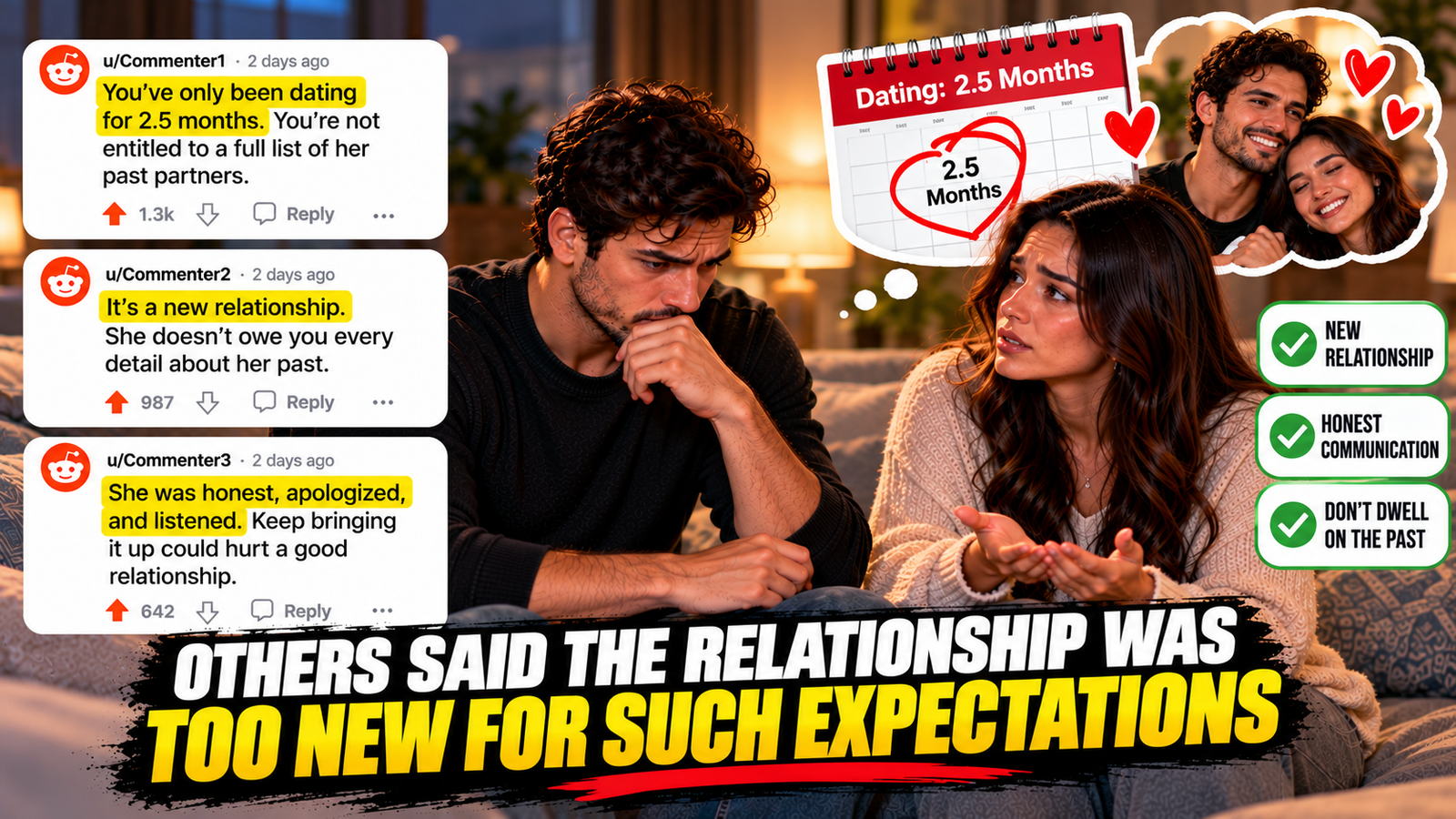
Some commenters felt that repeatedly revisiting the issue after receiving that response risked damaging an otherwise promising relationship.
Their position was that a partner’s past should not become a recurring source of conflict unless it genuinely affects the present.
Some Focused on the Ongoing Friendship Instead
Other users believed the Instagram contact and shared social circle were more relevant than the original disclosure.
They questioned whether a former hookup should remain connected to someone’s current life, especially when the person was described as a poor friend.
For these commenters, the boyfriend’s unease reflected a possible mismatch in relationship boundaries.
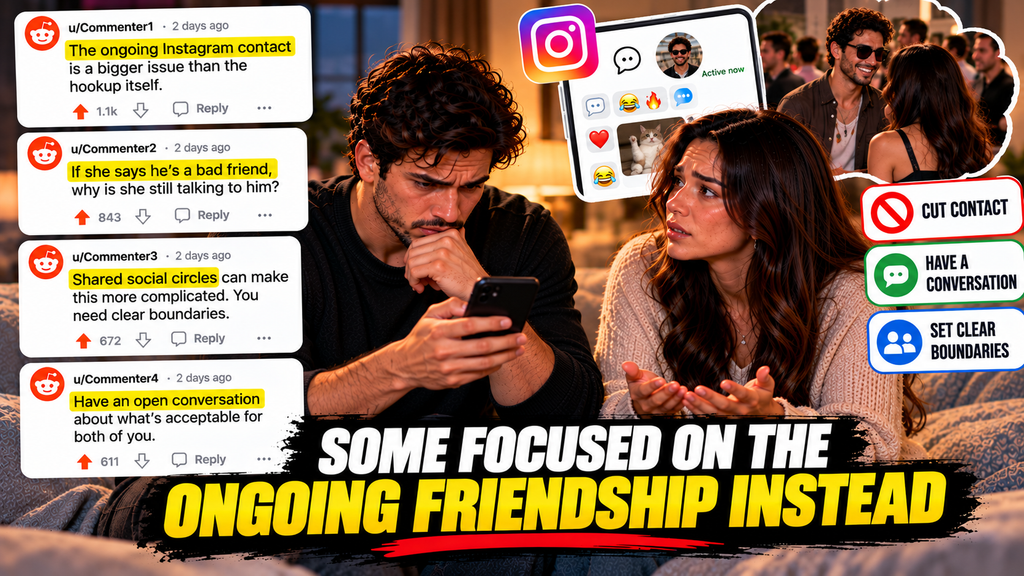
However, their recommendations varied.
Some favored cutting contact, while others suggested a straightforward conversation to establish what each partner considered acceptable.
Importantly, the strongest accusations against the girlfriend were speculative.
The available information did not establish that she was secretly continuing a romantic relationship with the other man.
#14: Does Someone Have to Reveal Every Past Relationship?
One of the broader issues raised by the story concerns the difference between privacy and transparency.
Most adults enter relationships with experiences that occurred before meeting their current partner.
Those experiences might include casual dating, long-term relationships, emotional attachments, and previous sexual encounters.
Being in a relationship does not automatically mean another person becomes entitled to every intimate detail of that history.
However, people may reasonably wish to discuss certain past connections when they continue to overlap with present-day friendships, workplaces, or social events.
The challenge lies in deciding what information is relevant to the current relationship.
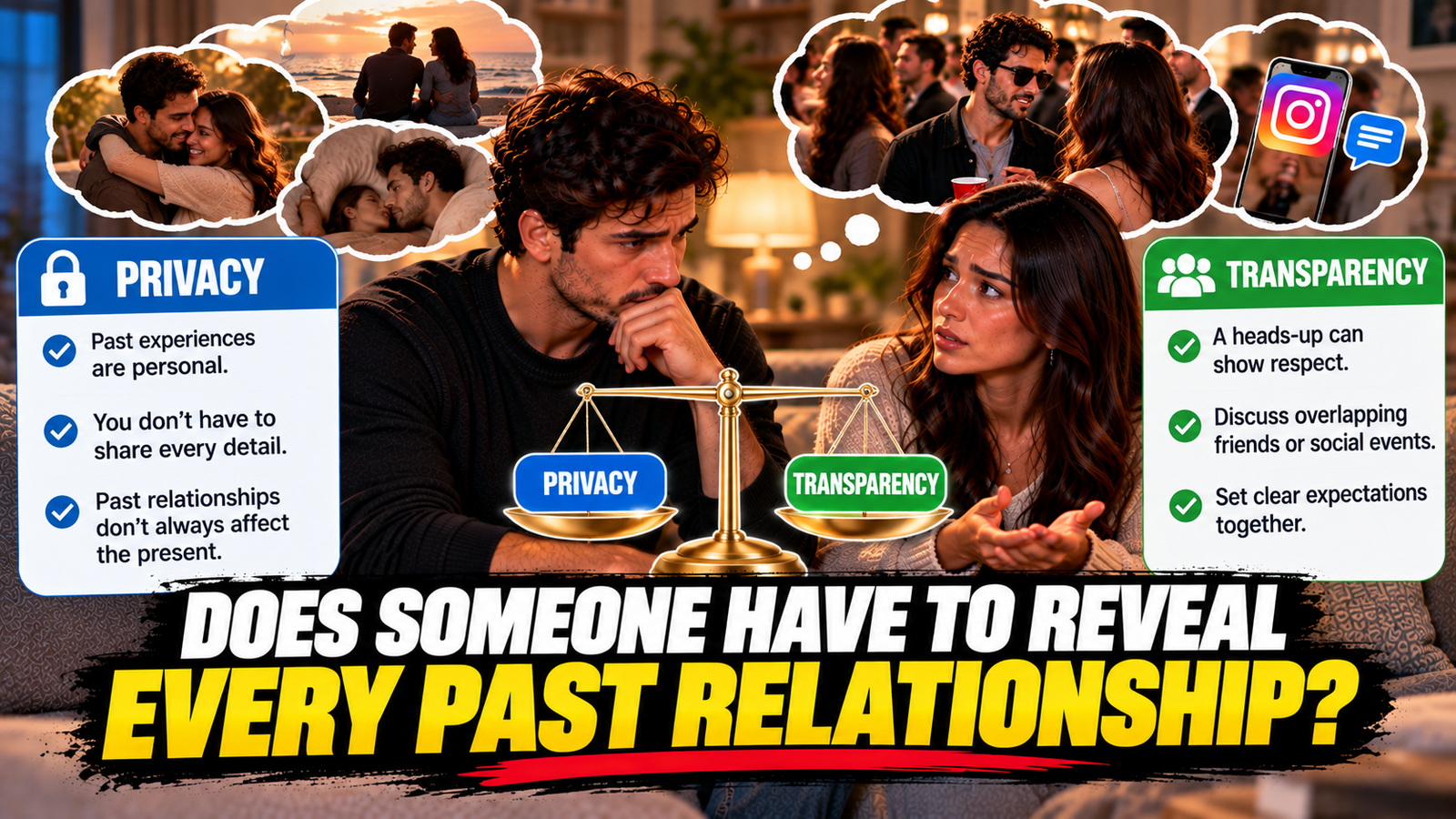
A former partner who has no ongoing involvement in someone’s life may create different considerations from a former partner who regularly attends the same gatherings.
But even in the second situation, a conversation about disclosure does not have to involve extensive personal details.
Partners may agree that a simple heads-up is enough.
Others may prefer not to discuss past sexual relationships unless there is a specific present concern.
Neither arrangement can succeed through assumptions alone.
What matters is whether the people involved understand and voluntarily accept the expectations they establish together.
#15: Privacy and Honesty Are Not Necessarily Opposites
A person can maintain privacy about their past without being dishonest.
Likewise, someone can respect their partner’s privacy while still expressing discomfort about unexpected interactions involving former partners.
The important question is whether relevant information is being deliberately misrepresented, or whether two people simply have different expectations.
The distinction is especially important here because the girlfriend reportedly answered truthfully when asked.
There is no verified evidence that she intentionally arranged the party to embarrass her boyfriend or conceal ongoing romantic involvement.
At the same time, his desire for more context was not necessarily unreasonable.
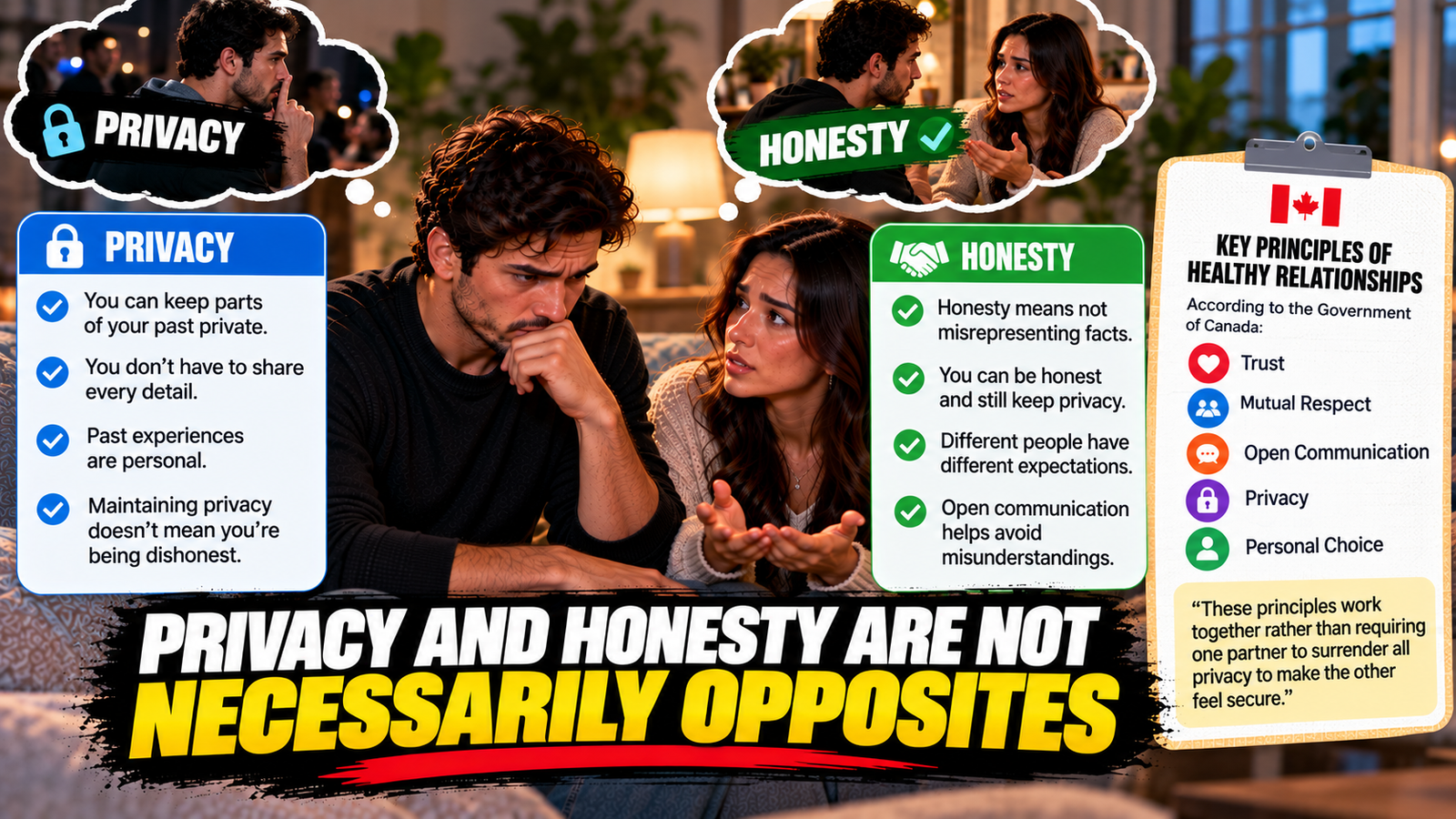
The Government of Canada’s guidance on safe dating and healthy relationships identifies trust, mutual respect, open communication, privacy, and personal choice as important features of healthy relationships.
These principles work together rather than requiring one partner to surrender all privacy to make the other feel secure.
In this case, the challenge was finding a balance between the girlfriend’s freedom to manage her own past and the boyfriend’s wish to feel informed about situations that involved him directly.
#16: Feeling Uncomfortable Does Not Automatically Mean Someone Did Something Wrong
The boyfriend’s experience illustrates an important distinction between emotions and conclusions.
A person might genuinely feel embarrassed, excluded, or unsettled after discovering unexpected information.
Those feelings can deserve attention without necessarily proving that another person acted maliciously.
For example, someone may feel uncomfortable learning that their partner remains friends with a former romantic interest.
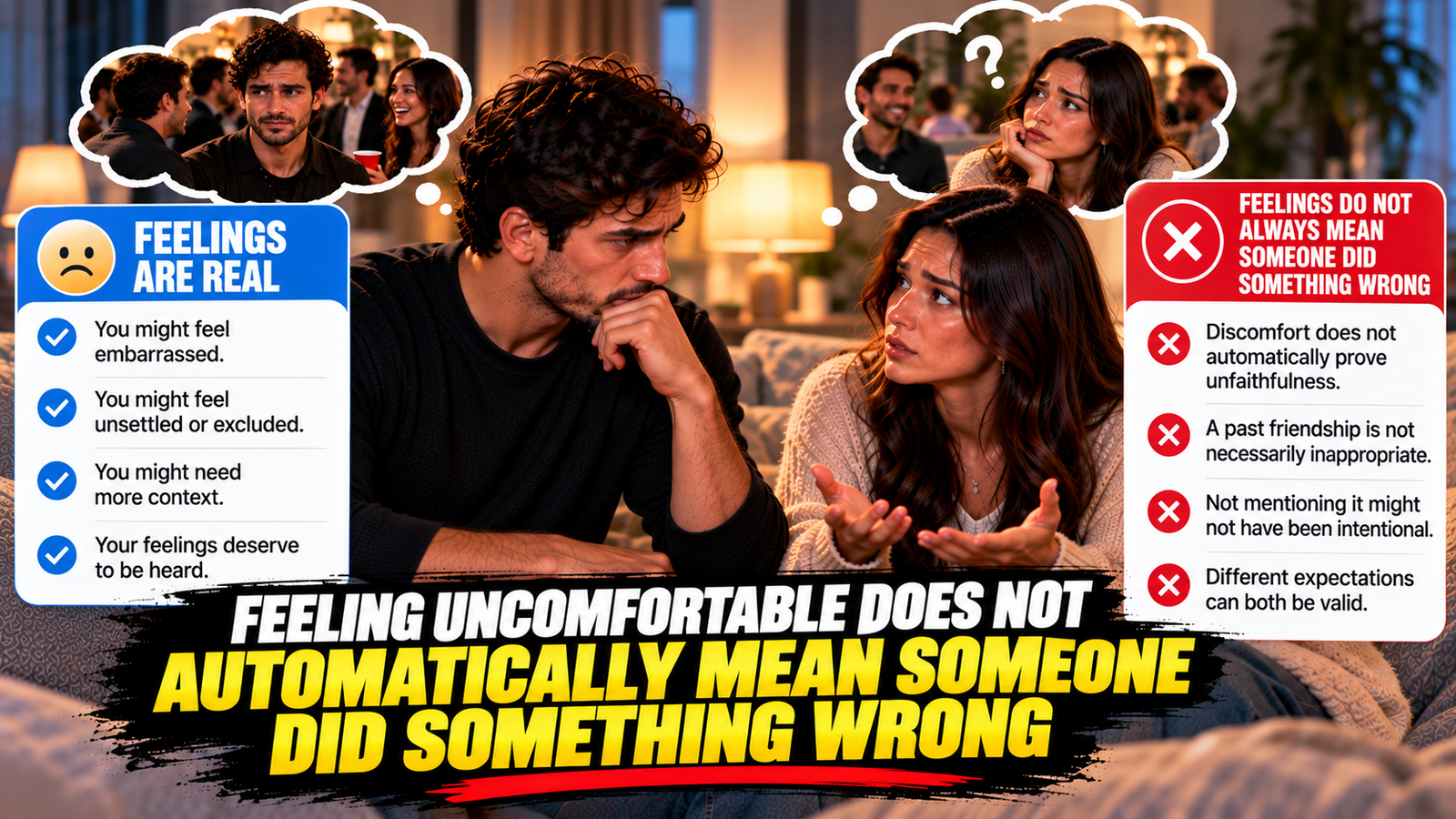
That discomfort can lead to an honest discussion about expectations.
But it does not automatically establish that the friendship is inappropriate.
Similarly, the girlfriend in this story might have considered the former hookup so insignificant that she didn’t think to mention it.
The boyfriend, meanwhile, considered advance disclosure an important courtesy.
Both interpretations could exist without either person deliberately trying to hurt the other.
The difficulty arises when an unspoken expectation is treated as though it had already been agreed upon.
Understanding that difference can help couples discuss what they need without automatically turning a misunderstanding into a moral judgment.
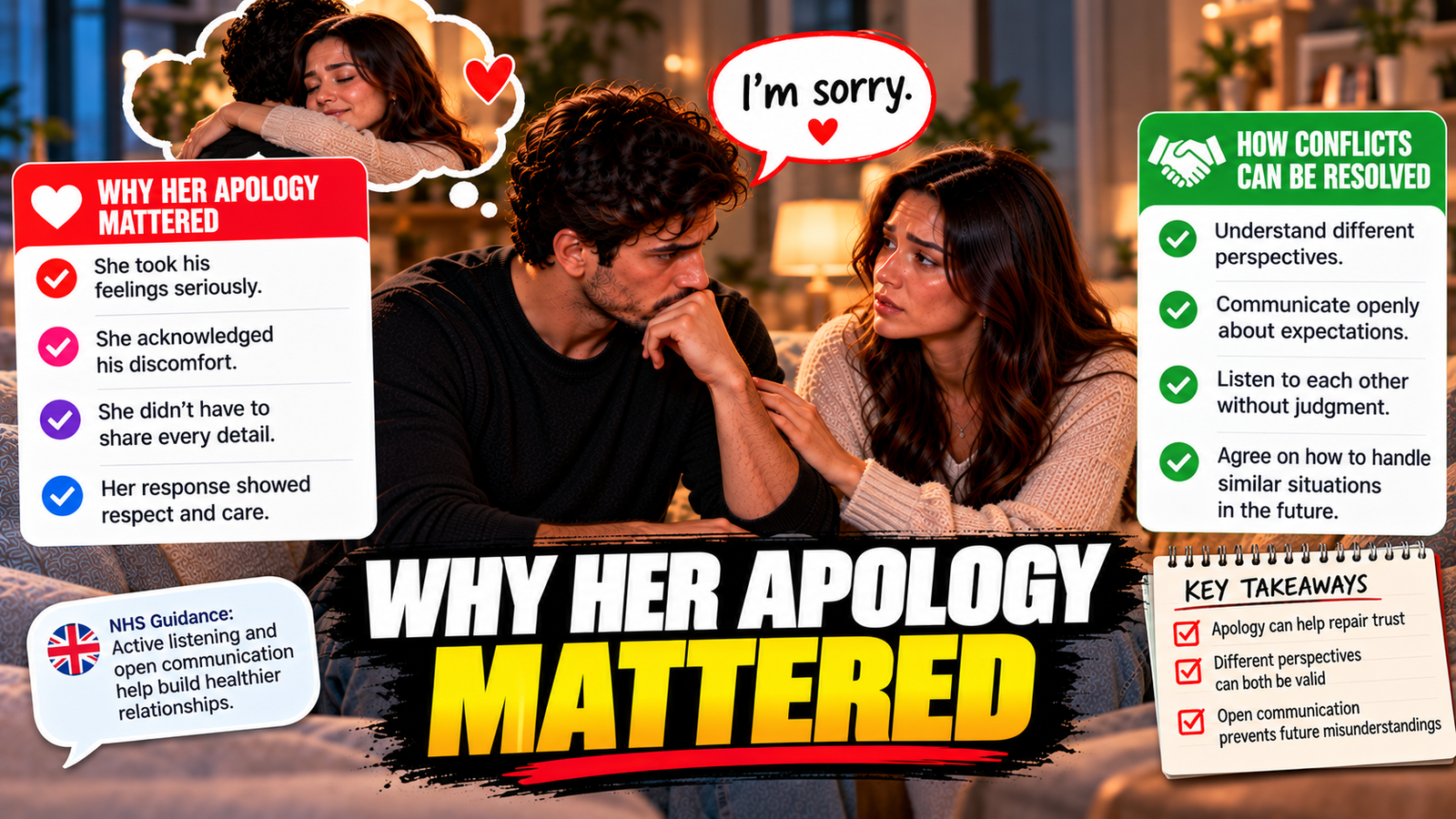
#17: Why Her Apology Mattered
The girlfriend’s reported willingness to apologize was significant because it suggested that she took the boyfriend’s feelings seriously.
She didn’t have to agree that every previous intimate connection should always be disclosed.
Instead, she could recognize that this specific experience had affected him differently from what she expected.
Her response appeared to communicate that his discomfort mattered to her.
The boyfriend also seemed to recognize this.
Even when he was questioning the relationship, he repeatedly acknowledged her willingness to talk and her efforts to reassure him.
This aspect of their disagreement deserves attention because relationship conflicts are not always resolved by determining who was objectively correct.
Sometimes resolution involves understanding why two people interpreted the same situation differently and agreeing on how they want to handle similar situations in the future.
The UK’s NHS guidance on maintaining healthy relationships recommends active listening, checking that a partner’s meaning has been understood, and creating opportunities for regular communication.
Those approaches can be particularly valuable when couples are discussing sensitive expectations that have never previously been addressed.
#18: Could Repeatedly Reopening the Discussion Create Another Problem?
The boyfriend’s uncertainty about bringing up the subject for a third time was understandable.
On one hand, avoiding a conversation simply because it is uncomfortable may leave important questions unresolved.
On the other, discussing the same event repeatedly without identifying what would help can become frustrating.
The distinction is between a conversation that seeks new understanding and one that continually revisits an already acknowledged mistake.
In the Reddit account, the boyfriend identified a specific unanswered question: why his girlfriend maintained contact with a man she did not consider a particularly good friend.
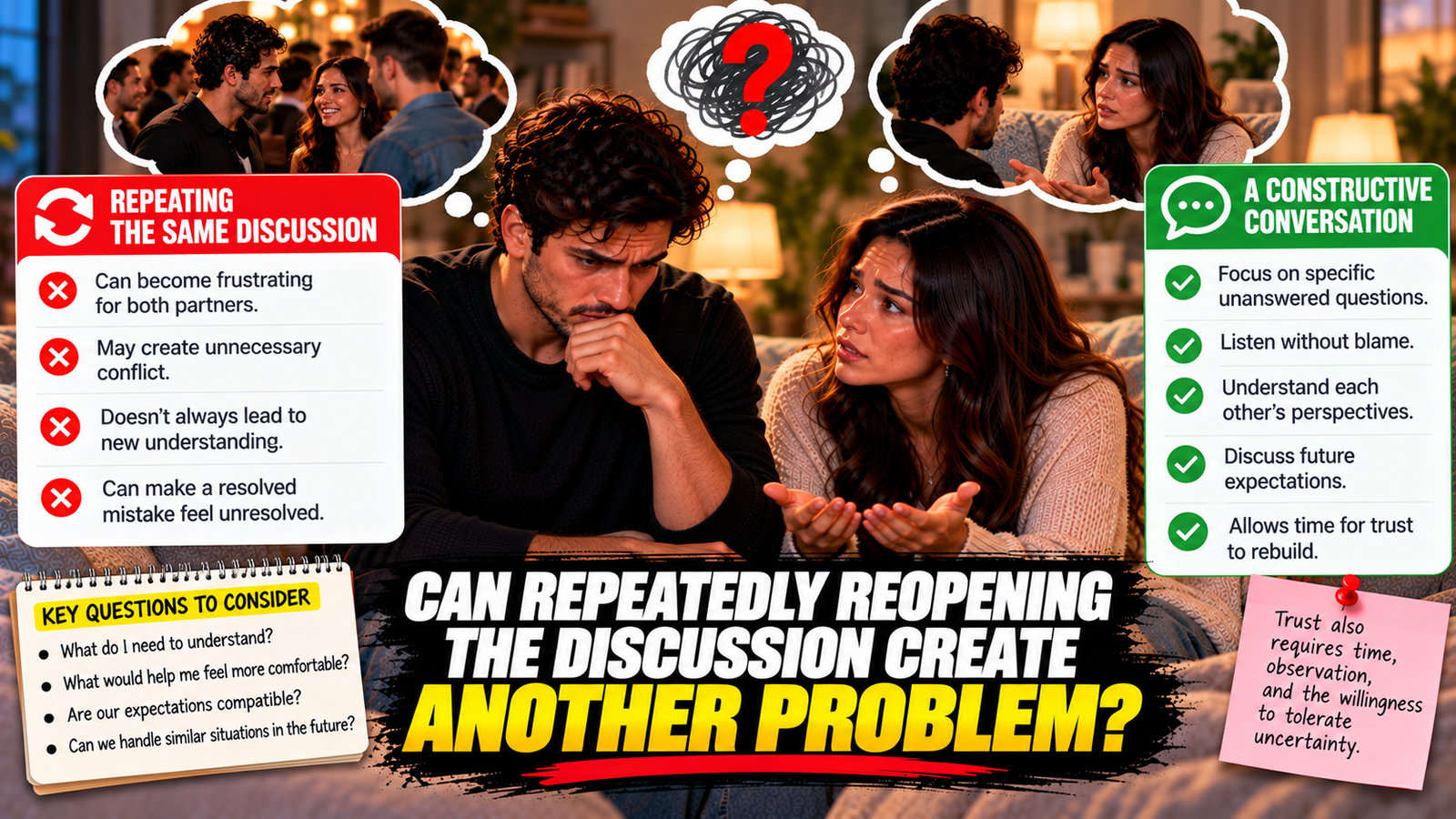
That is more concrete than repeatedly asking why she failed to mention their history.
If he wanted to understand the ongoing connection, focusing on that question might have been more useful than reopening every detail of the party.
The UK relationship support organization Relate offers communication guidance that encourages couples to speak about feelings without blame and make room for each partner to explain their perspective.
A constructive discussion might help both people understand whether their differences are manageable or reflect a deeper incompatibility.
But no discussion can guarantee that a person will feel immediately reassured.
Sometimes trust also requires time, observation, and the willingness to tolerate uncertainty.
#19: What About the Other Guest’s Father?
Another unusual detail appeared in the boyfriend’s later Reddit comments.
He said the former hookup’s father had also been present at the party.
After learning about the previous connection, the boyfriend reconsidered parts of the gathering and felt that the father might have made subtle remarks or gestures directed at him.
However, he provided no independently verifiable evidence that the father knew about the situation or intentionally behaved disrespectfully.
This distinction matters.
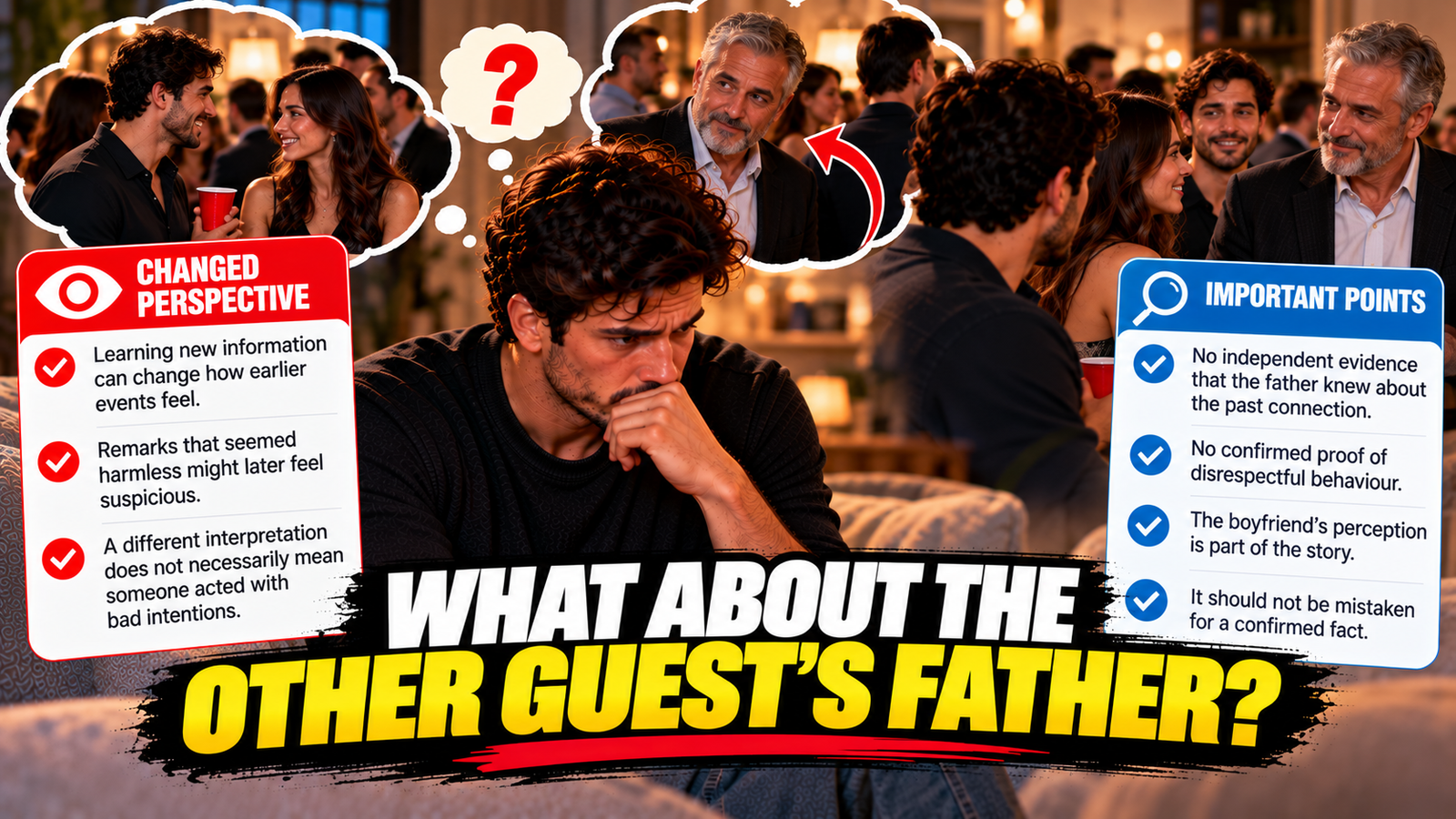
Learning something surprising after an event can change the way earlier interactions are remembered.
A remark that initially seemed harmless might begin to feel suspicious.
But a later interpretation is not necessarily proof of another person’s intentions.
In this case, the available account does not establish that anyone at the party was mocking the boyfriend or deliberately keeping him uninformed.
His perception is part of the story, but it should not be mistaken for a confirmed fact.
#20: Would Cutting Contact With the Former Hookup Solve Everything?
One of the strongest divisions among Reddit commenters involved whether the girlfriend should block the other man.
For some people, maintaining friendships with former romantic or sexual partners is incompatible with their preferred relationship boundaries.
Others are comfortable with those friendships, especially when they are longstanding or connected to mutual social circles.
Neither preference is universal.
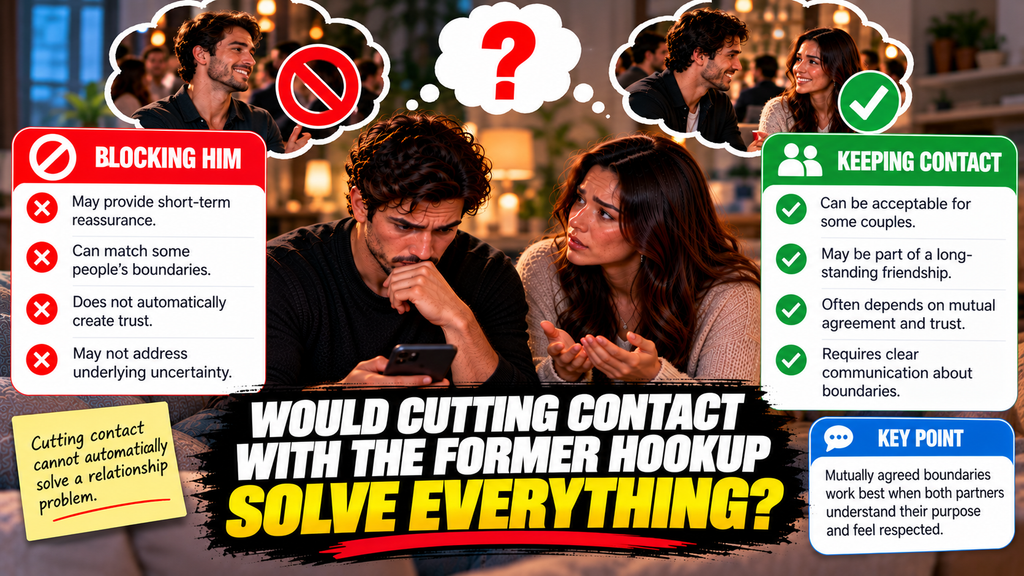
What becomes problematic is attempting to impose a rule unilaterally instead of discussing compatibility.
The boyfriend appeared aware of this difficulty.
He said he didn’t want his girlfriend to stop communicating with someone merely because he issued an ultimatum.
He was concerned that a forced decision would not resolve his underlying uncertainty.
That distinction reflects a broader lesson: removing a person from a contact list cannot automatically create trust.
If the real problem is uncertainty about a partner’s intentions, the couple still needs to address that uncertainty directly.
Mutually agreed boundaries may help, but they work best when both partners understand their purpose and feel respected.
#21: How Couples Can Avoid Similar Misunderstandings
Situations like this often become easier to navigate when partners discuss expectations before a specific conflict arises.
For example, a couple might agree that they don’t need detailed accounts of past romantic experiences but would appreciate knowing when a former partner is likely to be present at an event.
Another couple might decide that occasional contact with former partners is acceptable, provided both people are comfortable discussing the nature of those friendships.
Some may prefer greater separation from previous relationships.
The goal isn’t to establish a universal dating rule.
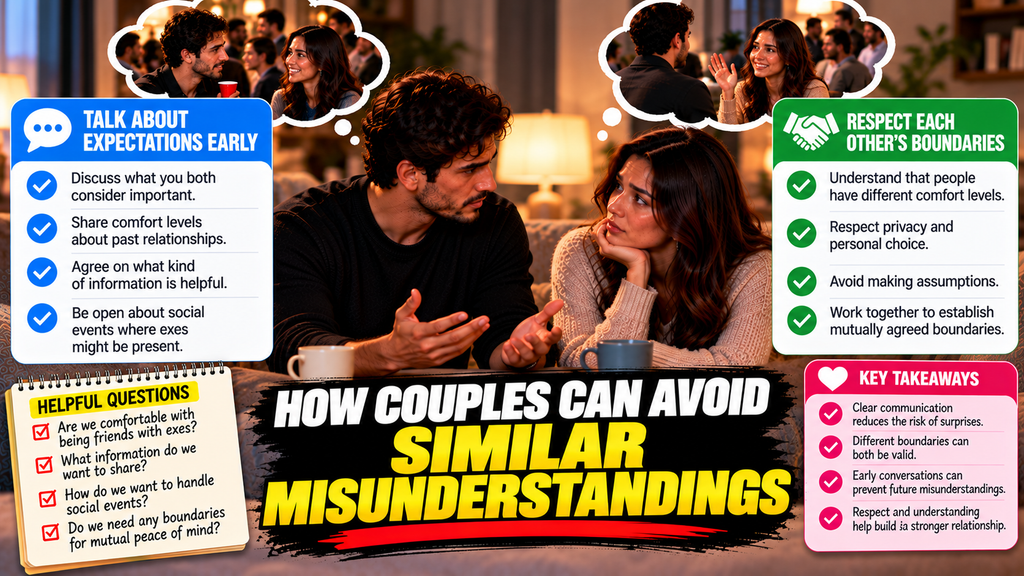
It is to make expectations understandable instead of leaving each person to guess.
The love is respect resource on respecting a partner’s boundaries emphasizes asking questions, recognizing different comfort levels, and respecting privacy rather than assuming both partners have identical expectations.
Those principles are particularly relevant when a relationship is still developing.
Having a sensitive conversation early does not guarantee that every disagreement will disappear.
But it can reduce the chances of someone feeling blindsided by a situation the other person considered ordinary.
#22: Was His Therapist Wrong to Question His Reaction?
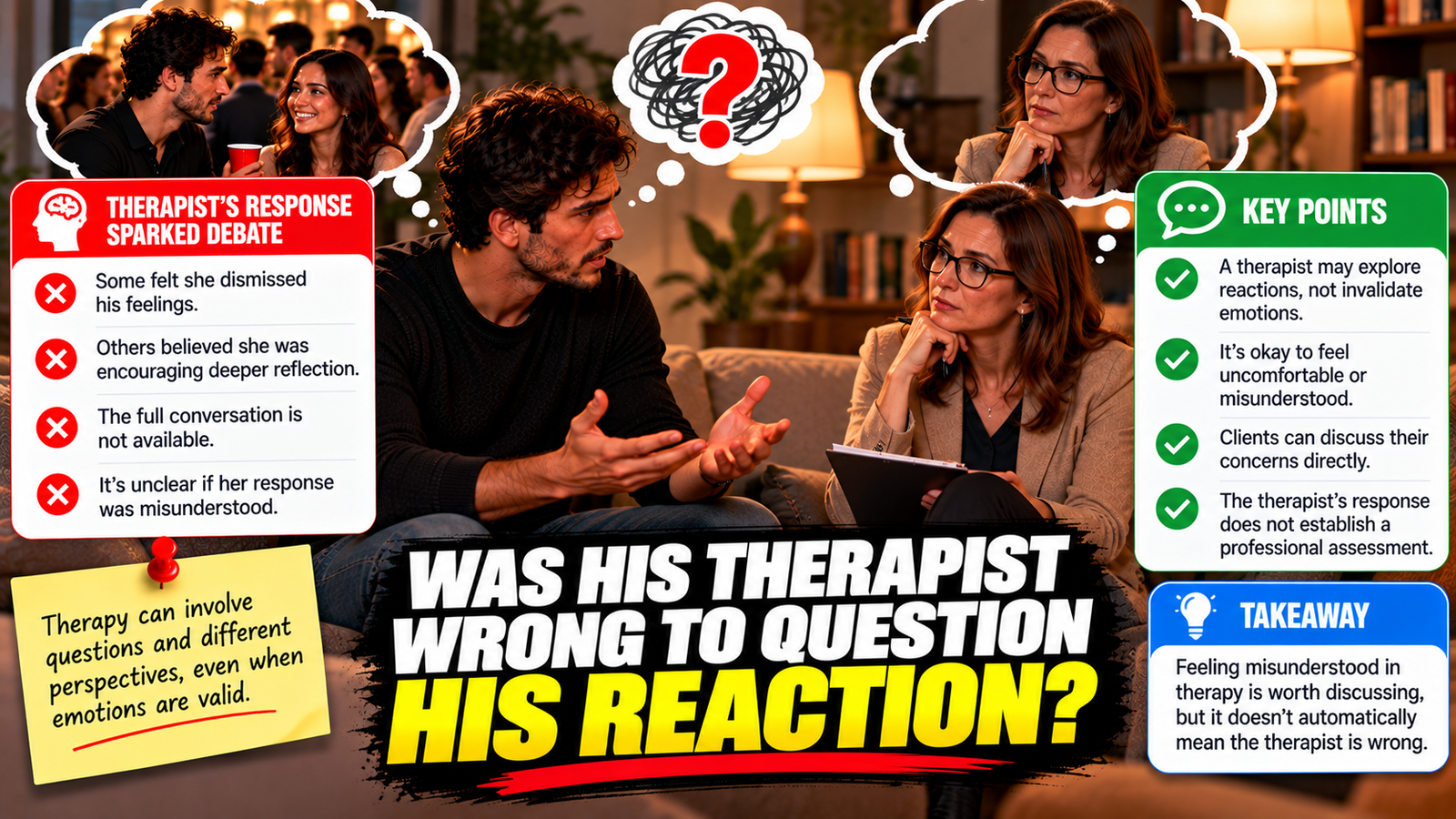
The therapist’s reported response became an unexpected secondary controversy in the Reddit discussion.
Some commenters strongly criticized the therapist and urged the boyfriend to find someone else.
Others suggested that she might have been challenging him to examine why the incident had become so emotionally significant.
The actual conversation between the therapist and boyfriend is not available, making it impossible to determine whether her response was dismissive, misunderstood, or part of a broader therapeutic discussion.
The boyfriend himself acknowledged this uncertainty.
He said he had appreciated working with his therapist for years and intended to revisit the issue rather than immediately assume she was wrong.
That distinction is important because a therapist can sometimes invite someone to examine a reaction without necessarily invalidating the underlying emotion.
At the same time, a person who feels misunderstood in therapy can raise that concern directly.
The disagreement illustrates how strongly people may respond when they feel that an uncomfortable emotion has been judged rather than explored.
It does not establish a professional assessment of either the boyfriend or his therapist.
#23: Did the Couple Eventually Break Up?
Despite the intense discussion, the available Reddit account does not establish that the couple ended their relationship.
The boyfriend acknowledged feeling torn between leaving and moving forward.
He had difficulty understanding why the former hookup remained in his girlfriend’s social circle.
He also worried that the incident might continue affecting his confidence in the relationship.
However, he repeatedly mentioned positive aspects of their connection.
He believed that his girlfriend loved him, appreciated their time together, and valued her openness to further conversations.
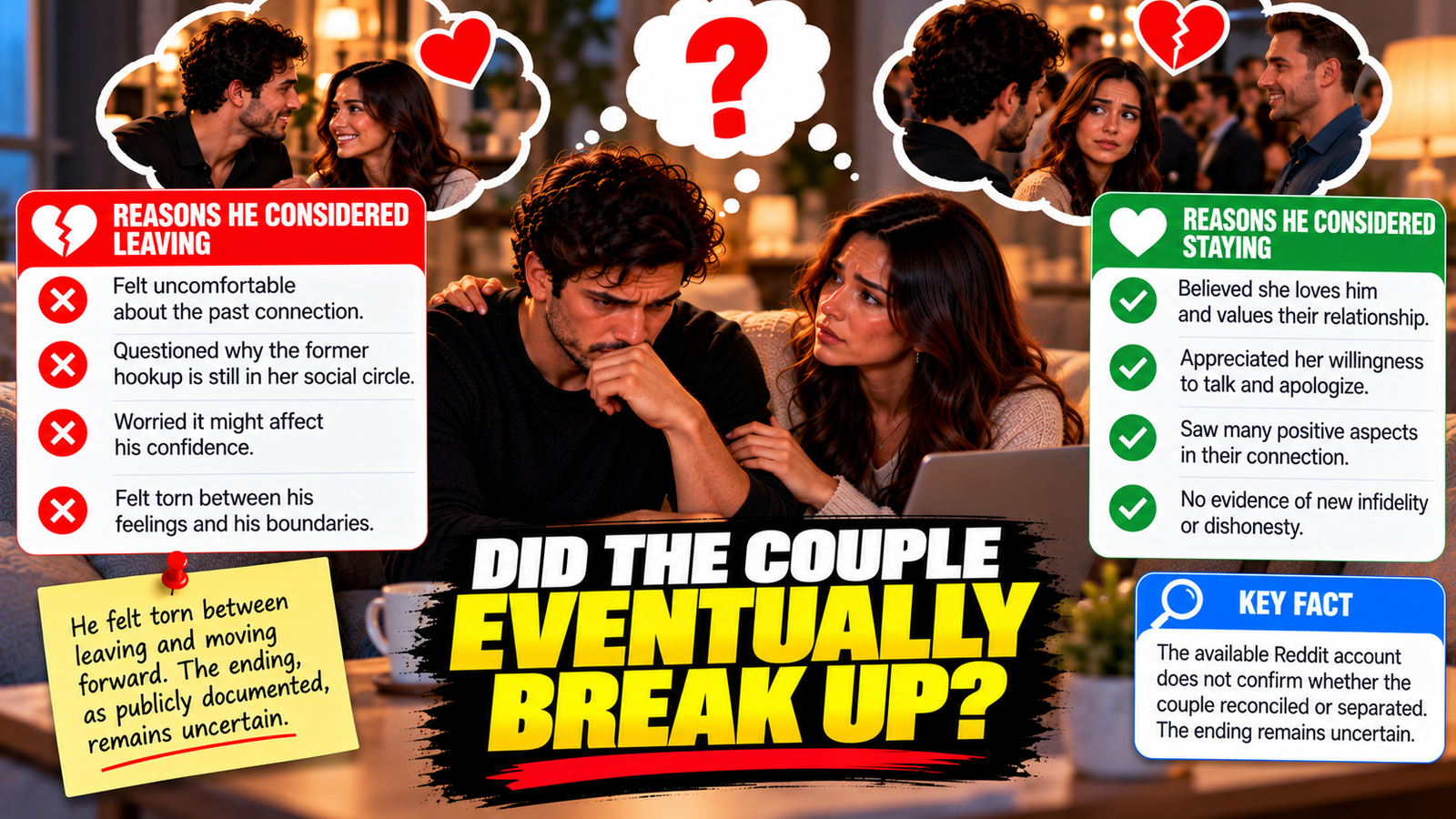
He didn’t describe discovering a new act of infidelity.
Nor did he report a confirmed revelation that her description of the previous hookup had been false.
The unresolved question was whether he could accept her explanation and rebuild his sense of comfort.
Without a verified later update, there is no basis to claim that the couple reconciled completely or separated.
The ending, as publicly documented in the material reviewed, remains uncertain.
#24: The Bigger Lesson: Trust Is More Than Knowing Someone’s Past
At first glance, the disagreement might appear to concern a single past sexual encounter.
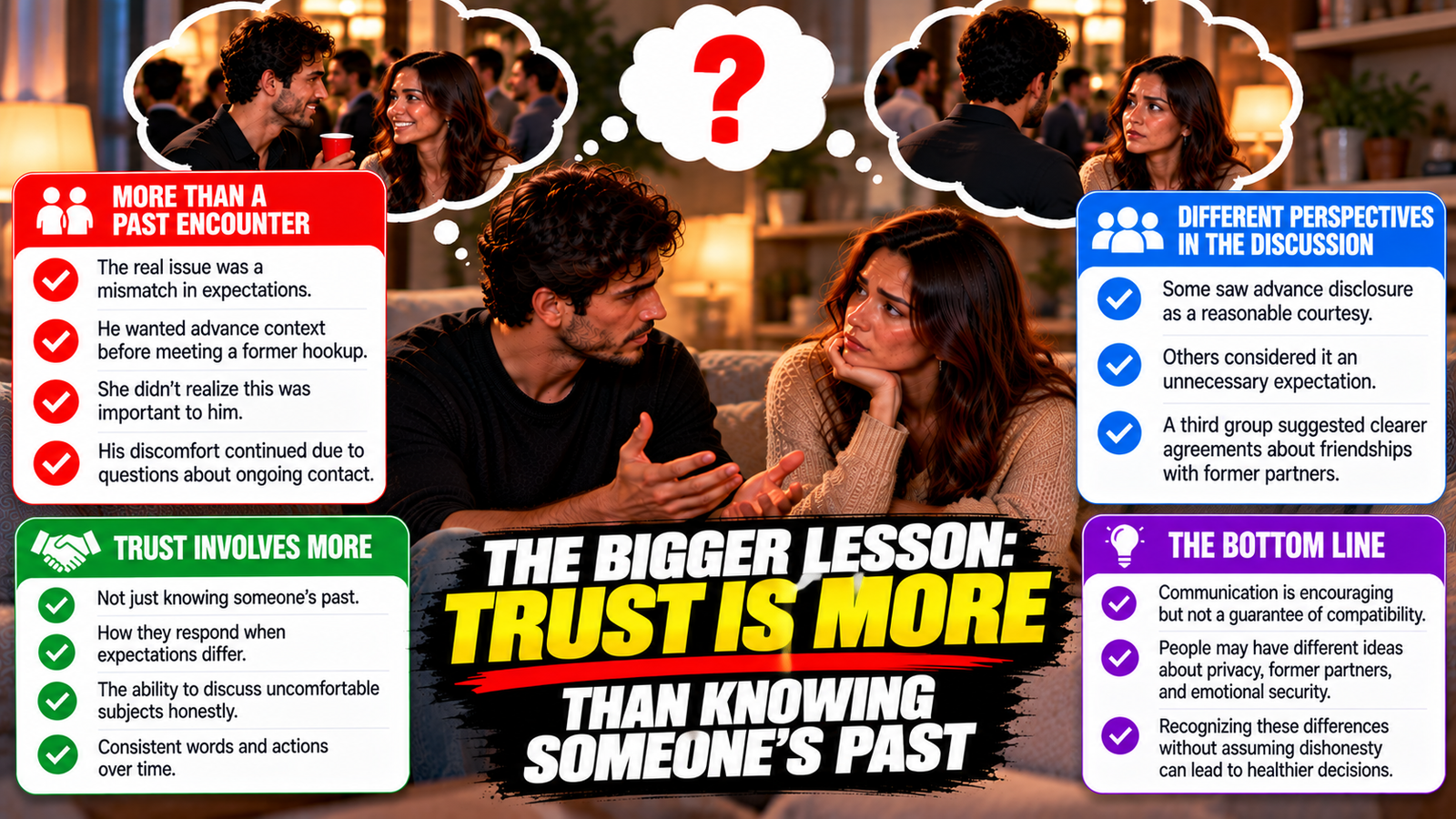
But the boyfriend’s reaction suggests that the deeper issue was a mismatch in expectations.
He believed that a partner should provide advance context before introducing someone to a former hookup.
His girlfriend apparently did not recognize that expectation until he explained it.
She responded with empathy, but his discomfort continued because he had additional questions about the man’s ongoing place in her life.
The Reddit community reflected the same disagreement.
Some readers viewed advance disclosure as a reasonable courtesy.
Others considered it an unnecessary expectation in a relationship that was only a few months old.
A third group believed that the couple needed a clearer agreement about friendships with people from their romantic past.
The situation demonstrates why trust cannot be reduced to the amount of personal information someone shares.
Trust also involves how people respond when expectations differ, whether they can discuss uncomfortable subjects honestly, and whether their words and actions become consistent over time.
The couple’s willingness to communicate was encouraging.
But communication alone does not guarantee compatibility.
Sometimes people discover that they simply have different ideas about privacy, former partners, and emotional security.
Recognizing those differences without automatically treating either person as dishonest can make it easier to decide what a healthy relationship should look like.
#25: Final Thoughts: Was He Asking Too Much?
The boyfriend was not necessarily wrong to feel uncomfortable.
His girlfriend was not necessarily wrong to have a past relationship or maintain casual social connections.
The most important question was whether the two could agree on reasonable expectations moving forward.
His wish for a heads-up could be understood as a request for consideration.
Her initial silence could reflect a genuinely different view of what was worth mentioning.
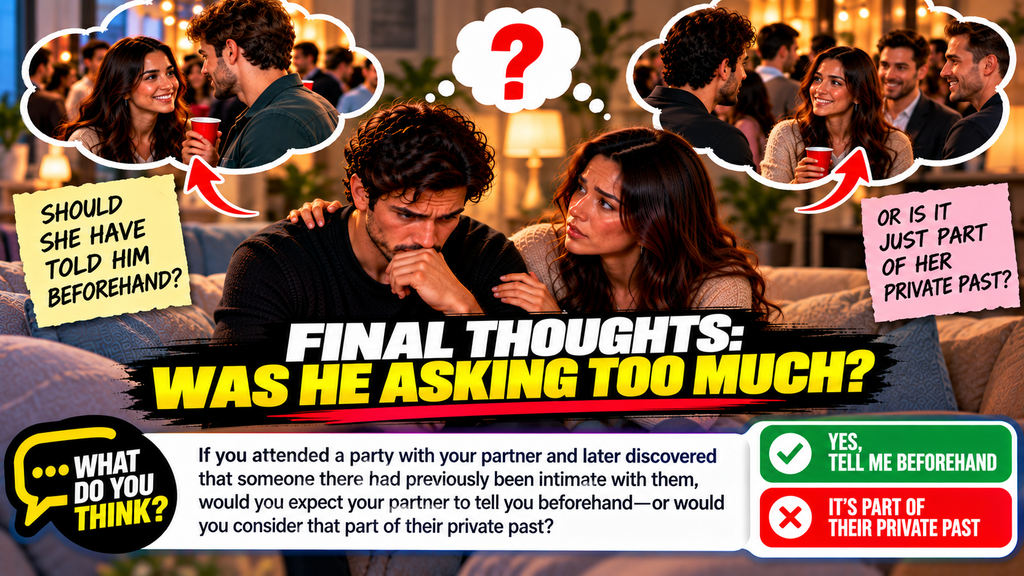
Her apology suggested a willingness to understand him.
His refusal to demand that she block someone suggested that he did not want to rely on control as a substitute for trust.
Ultimately, the situation was less about choosing a villain and more about confronting a difficult truth of modern relationships: people can care deeply about each other while interpreting privacy, honesty, and respect differently.
What do you think? If you attended a party with your partner and later discovered that someone there had previously been intimate with them, would you expect your partner to tell you beforehand—or would you consider that part of their private past?
Sources and Editorial Disclosure
Original account: This article is based primarily on a personal story shared in the Reddit community r/AITAH on January 23, 2025, including the original poster’s subsequent comments and clarifications. Readers can review the original Reddit discussion here.
Related coverage: The story was also discussed in a Dijbi article titled “Asked About Her Past Hookup… Now I’m the Problem?”.
Additional context: W1 Network Stories has incorporated editorial analysis and contextual information from established relationship education and support resources, including love is respect, the UK’s NHS, Relate, and the Government of Canada. Relevant references are linked throughout the article.

Editorial disclaimer: The story reflects the Reddit poster’s personal account. His claims, interpretations, and descriptions of private conversations have not been independently verified. The girlfriend, therapist, and other individuals mentioned have not provided direct responses in the reviewed material. Reader comments represent individual opinions rather than established facts.
This article is an independent editorial retelling and analysis for W1 Network Stories. It is not affiliated with, endorsed by, or officially sponsored by Reddit or Dijbi. No original screenshots, illustrations, or copyrighted images from those sources are reproduced here.