

Sometimes the hardest part of an ordinary day is the accumulation of small frustrations. You search for your keys, open your phone for one message, lose track of time, and remember an unfinished task just as you sit down to rest. A small change in your life can help when it addresses one of these recurring problems. The useful question is which adjustment would make tomorrow a little easier.
That does not mean a better routine can solve every difficulty. An unpredictable work schedule, financial pressure, illness, or caregiving responsibility may require support beyond anything on a personal checklist. Still, where you have some control, a modest adjustment can give you a more workable starting point. You can try it without committing to an entirely new lifestyle.
The following ideas focus on specific moments: starting your day, handling interruptions, making plans, and ending the evening. Each includes something concrete to try and a way to adapt it when life gets complicated. Choose the one that addresses a problem you actually experience. There is no requirement to complete all twelve.
#1. Prepare One Thing Tonight That Tomorrow Will Need
Identify the decision or search that most often delays your morning. It might be finding your work badge, choosing clothing, gathering school supplies, or remembering a document. Before bed, prepare that one item and place it where you will use it. Keep the task narrow enough that it does not become a second evening chore list.

For example, put your badge inside the bag you will carry, rather than beside a pile of unrelated belongings. If you need to take something refrigerated, leave a written reminder on the bag instead of leaving food out overnight. After several mornings, notice whether you still forget the item or spend time searching. A useful preparation habit has a visible result: one less avoidable problem during a busy transition.
#2. Define What Finishing One Task Actually Means
A task such as “get organized” has no obvious endpoint, which makes it difficult to begin or complete. Replace it with an action you could explain to another person in one sentence. “Put the appointment on my calendar” or “write the opening paragraph” gives you something specific to do. Choose one such action before the day’s competing demands gather momentum.

Make the finish line fit the time you have available. If you have fifteen minutes, the goal might be collecting the documents for an application, rather than submitting the entire application. When you finish, acknowledge that the planned step is complete, even if the larger project remains. This approach gives you a clearer record of progress than repeatedly carrying the same oversized task into tomorrow.
You can also use this method when someone else controls the deadline. Separate the next action you can take from the response you are waiting to receive. Sending a question to a colleague is a completed action; receiving an answer is a dependency. Keeping that distinction visible helps you decide what to work on while you wait.
#3. Remove One Unnecessary Digital Interruption
Start with the app that most often pulls you away from something you intended to do. Disable its promotional notifications, remove an unnecessary badge, or move it off your first home screen. Preserve the alerts you need for work, caregiving, accessibility, or urgent communication. The adjustment should give your attention more direction without making you harder to reach when it matters.

Try the change during one predictable period, such as breakfast or the first few minutes of a work session. Notice whether you finish what you started before opening the app again. If nothing improves, choose a different interruption instead of adding more restrictions automatically. You are testing whether a particular setting serves your day, and the useful setting may differ from someone else’s.
#4. Attach a Short Movement Break to an Existing Routine
Choose a moment that already occurs, such as finishing lunch or ending a long call, and use it as a reminder to move. That could mean a brief walk, an accessible seated activity, or another movement suited to your abilities and surroundings. On a busy day, begin with a duration you can realistically manage. Avoid making special equipment or a trip across town a condition for starting.

The CDC’s guidance on adding physical activity explains that some activity is better than none and that weekly activity can be divided into smaller sessions. Its general adult recommendation includes 150 minutes of moderate-intensity activity and two days of muscle-strengthening activity each week. A short movement break can be a starting point toward a broader routine, though it does not automatically meet that full recommendation. If you have a chronic health condition, discuss suitable activities and amounts with your healthcare professional.
Choose a fallback for the conditions that usually interrupt your plans. If outdoor walking is impractical because of weather or an unsafe route, decide on an appropriate indoor option beforehand. If lunchtime is unpredictable, try a different recurring moment. A routine becomes more usable when its design reflects the day you actually have.
#5. Give Frequently Misplaced Items a Permanent Home
Choose one object you repeatedly misplace and assign it a practical storage spot. Keys might belong on an existing hook near the door, while headphones might belong in a particular pocket of your bag. Pick a location close to where you naturally put the item down. You do not need to buy an organizer before testing whether the location works.
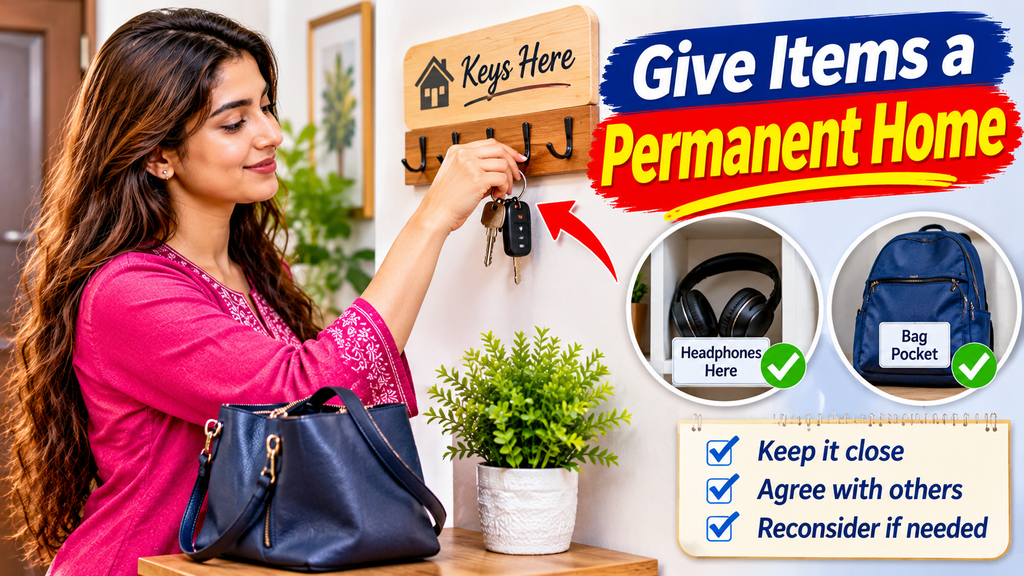
If you share the space, agree on the arrangement with the people who use it. Avoid turning someone else’s belongings into an organization project without asking. When the object keeps appearing elsewhere, reconsider the location rather than treating the problem as a failure of discipline. The best place is one people can remember and reach during the ordinary flow of the day.
#6. Make One Everyday Meal Easier to Put Together
Look for the meal that regularly becomes a last-minute scramble. Choose a simple option made from foods you enjoy and can realistically keep available, such as eggs and toast, beans with rice, or a sandwich with a convenient side. Write down the ingredients so you do not have to reconstruct the plan while shopping. Having a fallback gives you an answer for the evening when your original plan falls apart.

This is an exercise in reducing decisions, so choose something that fits your budget, dietary needs, kitchen access, and preferences. Check what you already have before adding more food to your shopping list. If leftovers are part of the plan, follow appropriate storage and reheating practices. Start with one dependable meal and expand your options only when doing so makes everyday life easier.
#7. Send One Specific Message to Someone You Value
“We should catch up sometime” leaves the next step unclear. Try a more concrete invitation, such as asking whether a friend has time for a short call on Sunday. Alternatively, follow up on something they mentioned: an interview, a difficult week, or a project they care about. Specific attention gives the other person a natural place to begin the conversation.

Keep the invitation easy to decline or reschedule. Someone’s delayed reply may reflect their workload or circumstances, and you do not need to interpret every silence immediately. If making plans repeatedly becomes difficult, suggest a simpler format or a different time. The aim is to create an opportunity for contact that respects both people’s capacity.
For a broader look at choosing priorities and making room for relationships, explore W1 Network Stories’ practical ways to live a happy, meaningful life. Use that reflection to decide which connections you want to maintain more deliberately. A message sent with care is a manageable action within that larger intention. It does not require planning an expensive outing or finding a completely free afternoon.
#8. Pause Before Accepting an Optional Commitment
When a request arrives, give yourself time to check what saying yes would involve. A straightforward response might be, “Let me check my schedule and get back to you this afternoon.” Then consider the preparation, travel, and recovery time as well as the event itself. An activity that lasts an hour may occupy a much larger part of your day.

If the full request does not fit, consider whether a smaller offer would be useful. You might help for thirty minutes, contribute one item, or suggest another date. At work, where simply declining may not be realistic, ask which existing task should move to accommodate the new assignment. Making the trade-off explicit gives everyone a clearer understanding of what is possible.
#9. Record Small Obligations in One Trusted Place
Scattered reminders are easy to overlook when they live in messages, scraps of paper, and half-remembered conversations. Choose one practical place for tasks that do not require immediate action, such as a notebook or a simple digital list. Record the next step in plain language as soon as you notice it. Include a date when there is a real deadline, rather than marking everything urgent.

For example, write “return library books by Friday” instead of “library,” or “ask the office about the missing form” instead of “paperwork.” Review the list at a time that already makes sense, perhaps when checking tomorrow’s schedule. Move appointments into a calendar if they require you to be somewhere at a particular time. The system should help you retrieve information, so use the simplest format you will reliably check.
#10. Create a Clear Transition Toward Sleep
Choose a modest signal that the evening is winding down, such as putting away work materials or starting a quiet activity. Allow enough time for your ordinary bedtime needs instead of expecting an instant switch from chores to sleep. The National Heart, Lung, and Blood Institute’s healthy sleep guidance recommends consistent sleep and wake times and quiet time before bed. It also advises limiting bright artificial light during that period.

Adapt the transition to your actual schedule, especially if you work shifts or care for someone overnight. A useful first adjustment might be protecting a quieter period before your available sleep window, even when that window is during the day. Avoid turning bedtime into a demanding routine that creates more pressure. Persistent sleep difficulties deserve a conversation with a healthcare professional, rather than another round of self-blame.
#11. Leave a Restart Note When You Stop Working
Before closing a task, write a short note that tells you exactly where to resume. Include the next action, the location of the relevant material, and any question that remains unanswered. For example, “Open the draft in the shared folder and check the delivery date before sending” is more useful than “finish email.” This takes a little preparation now to make the next starting point clearer.
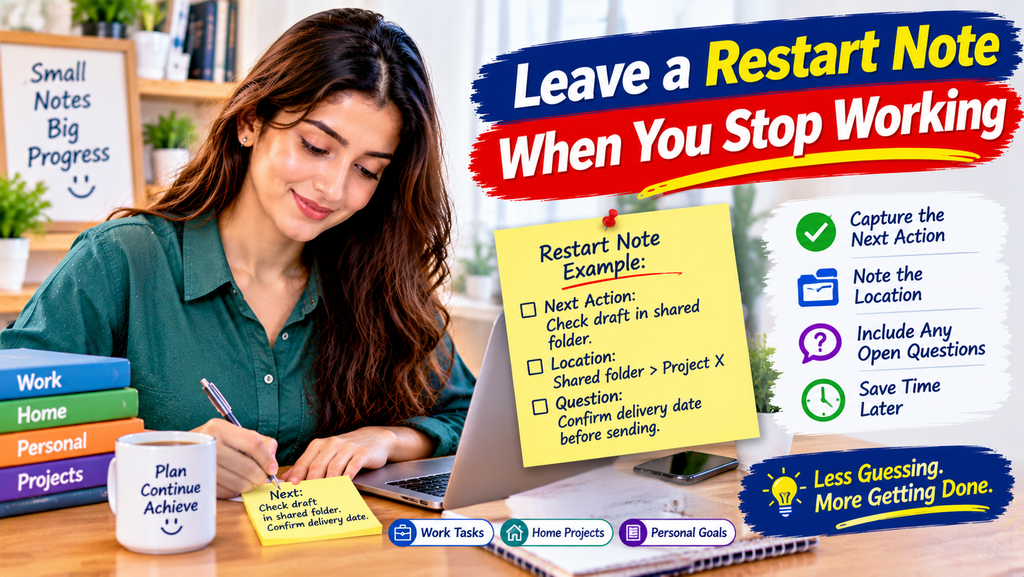
The method can work for household projects as well as paid work. If you are comparing repair options, record which estimate is outstanding and what you need to ask. If you stop reading instructions halfway through, mark the next step instead of trusting yourself to remember it later. When you return, you can spend less effort reconstructing the situation and more effort deciding what to do.
#12. Review What Helped Before Adding Another Habit
At the end of the week, look back at the adjustment you tried. Ask whether it solved the intended problem, how much effort it required, and what repeatedly got in the way. A prepared bag that saved a morning search is useful evidence; an unused reminder suggests the timing or location needs work. Judge the arrangement by its effect on your day, rather than by how impressive it sounds.
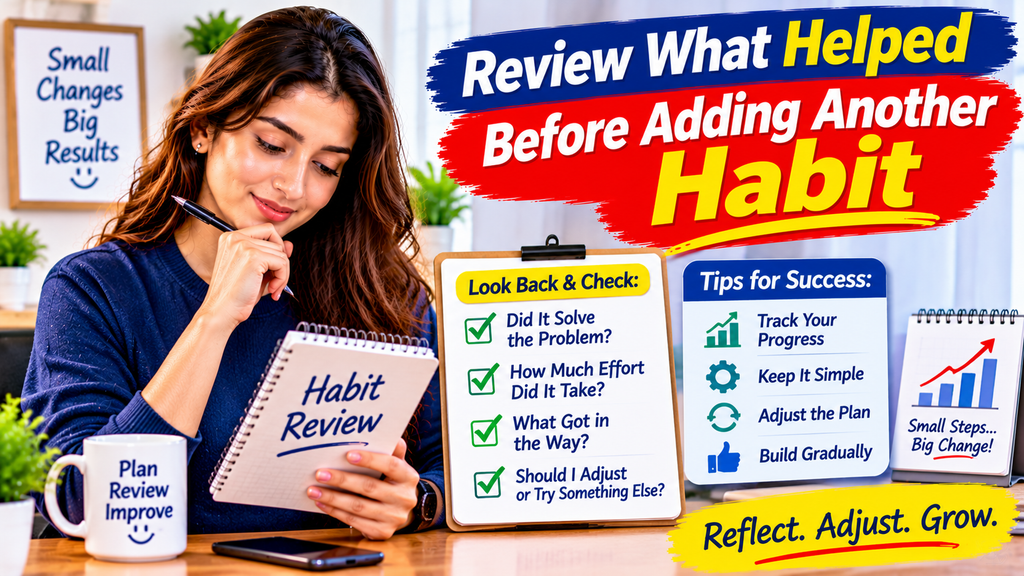
The National Institute of Diabetes and Digestive and Kidney Diseases’ guidance on changing habits recommends starting with small changes, planning for obstacles, and tracking progress. It also recognizes that setbacks occur during behavior change. Apply that idea by changing the plan when you learn something about your circumstances. A missed attempt can show you where a routine needs to be simpler or better timed.
How to Make One Small Change Fit Your Life
Begin with a recurring inconvenience you can describe clearly. “Mornings feel chaotic” is a useful observation, but “I spend time looking for my work badge” points toward a specific experiment. Choose a manageable action, connect it to an existing moment, and decide how you will recognize improvement. In this example, putting the badge in your bag after arriving home provides both a cue and a clear result to look for.
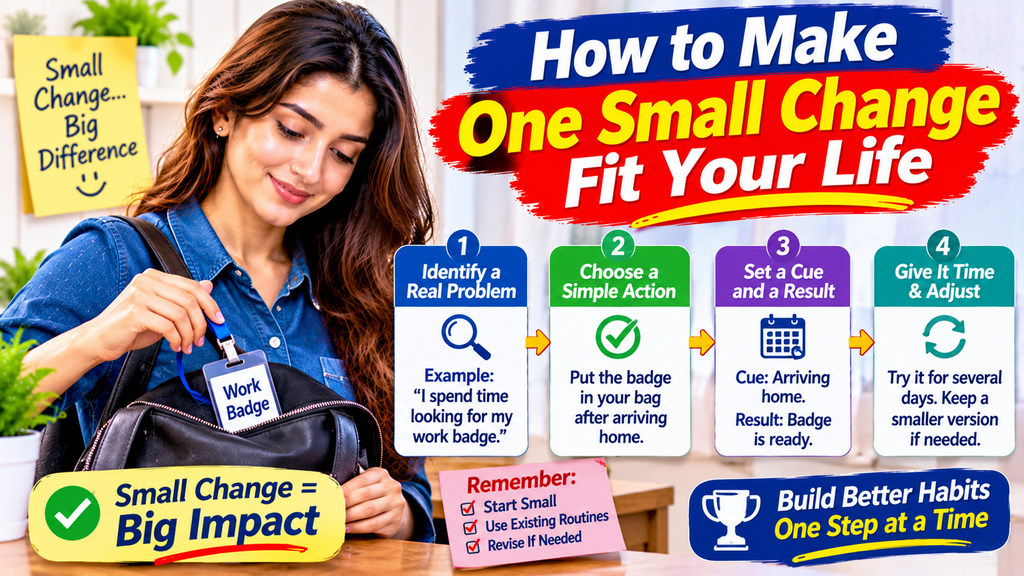
Give the experiment several ordinary opportunities before judging it, while recognizing that there is no universal deadline for a habit to become automatic. Keep a smaller version available for difficult days, such as preparing only the essential item rather than the entire bag. If the change creates more work than it removes, revise it or choose another. You are allowed to stop using an approach that does not fit.
Build a Day That Is Easier to Return To
A small change in your life becomes worthwhile when it helps with something that matters to you. That might mean leaving home with less rushing, finishing one useful task, or making contact with someone you miss. The result can be modest and still deserve a place in your routine. You do not need to turn every improvement into a larger challenge.

Choose one adjustment you can try at its next natural opportunity. Pay attention to what happens, keep what helps, and change what gets in the way. Over time, these decisions can give ordinary days a little more clarity and breathing room. Start with the moment you would most like to make easier tomorrow.
Sources and References
- Centers for Disease Control and Prevention: Adding Physical Activity as an Adult.
- National Heart, Lung, and Blood Institute: Healthy Sleep Habits.
- National Institute of Diabetes and Digestive and Kidney Diseases: Changing Your Habits for Better Health.
- W1 Network Stories, related reading: 15 Practical Ways to Live a Happy, Meaningful Life.