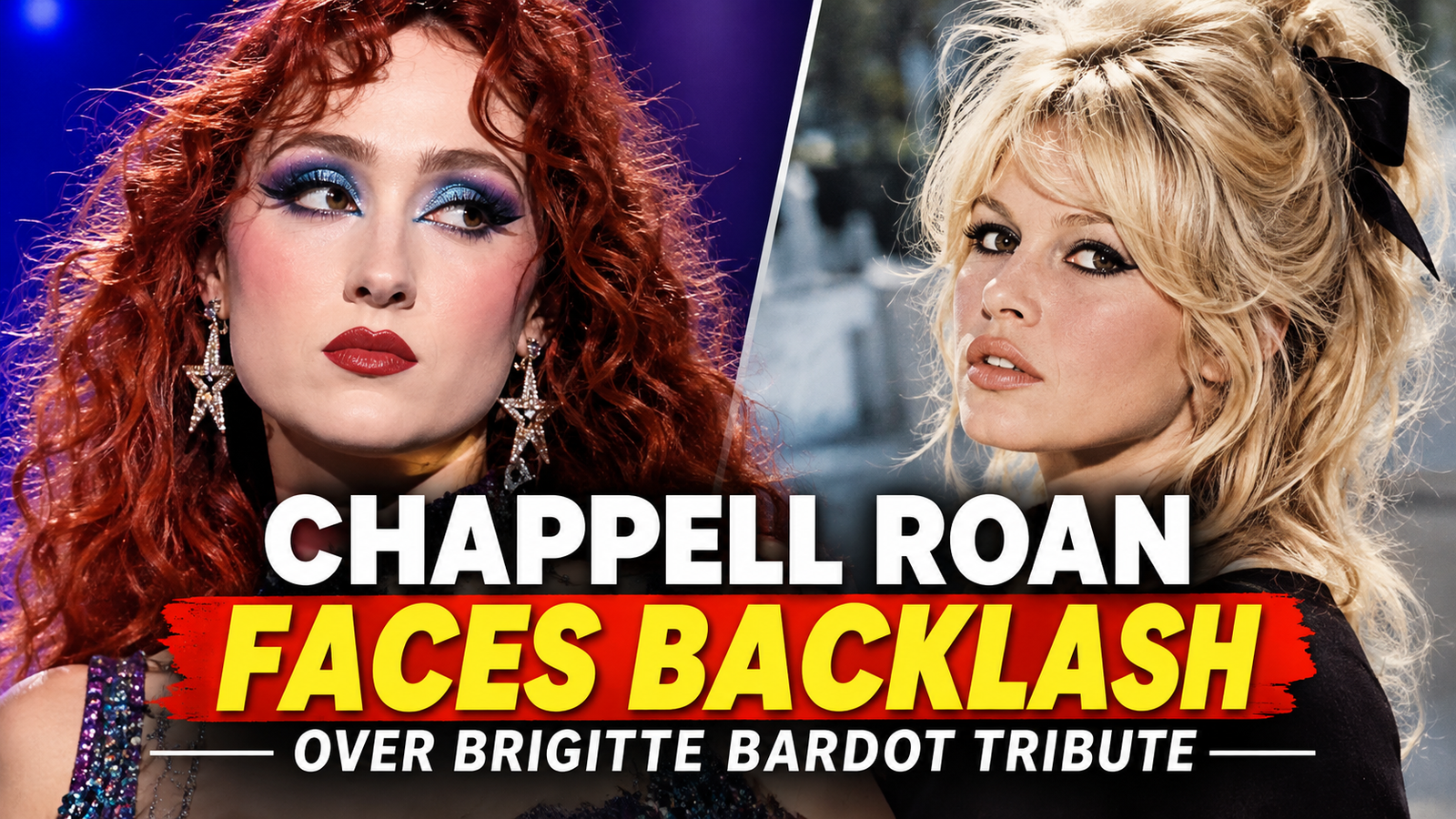
Chappell Roan found herself at the center of an unexpected online controversy after paying tribute to legendary French actress Brigitte Bardot. What initially appeared to be a simple acknowledgment of an artistic influence quickly became a wider conversation about celebrity legacies, historical controversies, and the responsibility that comes with publicly celebrating influential figures.
The Grammy-winning singer referenced Bardot following news of the actress’s death in December 2025, explaining that the French star had inspired her hit song “Red Wine Supernova.” However, the tribute attracted criticism after fans highlighted Bardot’s controversial political positions and history of offensive public statements. Roan subsequently removed her original message and clarified that she did not support the views associated with the late actress.
The incident sparked different reactions across social media. Some fans questioned why Roan had publicly celebrated someone whose later-life reputation was so controversial, while others believed the singer’s response demonstrated that artistic inspiration and personal beliefs do not necessarily have to be connected. Here’s what happened and why the Chappell Roan Brigitte Bardot backlash became a significant pop culture discussion.
What Happened Between Chappell Roan and Brigitte Bardot?
The controversy began on December 28, 2025, following the announcement of Brigitte Bardot’s death at age 91. Bardot was internationally recognized for her work in French cinema, particularly during the 1950s and 1960s. Her influence extended beyond acting into fashion, popular culture, music, and discussions about changing attitudes toward female sexuality.
Following the news, Chappell Roan shared an Instagram Story featuring a tribute to the late actress. The singer acknowledged Bardot as an inspiration behind her 2023 song “Red Wine Supernova” and offered a brief message of remembrance.
Although the post was relatively short, it attracted attention because Bardot’s public reputation had become increasingly complicated over the decades. While she remained an influential figure in film history and animal welfare activism, her political associations and repeated controversial statements had generated considerable criticism.
Some fans were surprised that Roan had publicly honored Bardot without acknowledging this part of her history. Their reactions quickly turned the tribute into a wider discussion about the difference between appreciating someone’s artistic influence and endorsing their personal beliefs.
According to reporting by Rolling Stone, Roan subsequently removed her original tribute and addressed the controversy in another Instagram Story on December 29.
Why Chappell Roan’s Brigitte Bardot Tribute Sparked Backlash
The reaction was not simply about an old Hollywood-style celebrity tribute. It reflected the substantial differences between Bardot’s cultural influence and the political positions she expressed later in life.
For many contemporary music fans, especially those who appreciate Roan’s music and her public support for LGBTQ+ communities, Bardot’s record presented an uncomfortable contradiction. They questioned how an artist associated with themes of individuality, self-expression, and acceptance could celebrate a figure whose later public statements had been widely condemned.
Bardot had faced multiple convictions in France for inciting racial hatred. Her public comments about immigrants, Muslims, and LGBTQ+ people also attracted significant criticism. These controversies became an important part of how her legacy was discussed, particularly following her death.
The issue became especially relevant because Roan’s music has developed a strong connection with queer audiences. Her songs frequently explore attraction, identity, emotional freedom, and experiences that resonate with listeners who value self-expression.
For critics, the tribute seemed to overlook an important part of Bardot’s history. They believed that recognizing an influential cultural figure without acknowledging their harmful statements could unintentionally minimize the impact those statements had on affected communities.
However, the situation also raised a separate question: Should an artist’s admiration for a particular aesthetic or creative influence automatically be interpreted as support for everything that person believed?
That distinction became central to the discussion.
Chappell Roan Responds and Clarifies Her Position
As criticism developed, Roan addressed the situation through a follow-up Instagram Story. Rather than defending her original tribute, she acknowledged that she had not been aware of the extent of Bardot’s controversial views.
In her response, Roan wrote:
“Holy shit I did not know all that insane shit Ms. Bardot stood for. Obvs I do not condone this. Very disappointing to learn.”
The statement was reported by multiple entertainment publications, including The Independent.
Her clarification communicated two important points. First, she expressed disappointment after learning more about Bardot’s public record. Second, she explicitly separated her appreciation for the actress’s influence on a particular song from any endorsement of her political and social positions.
Roan’s response also changed the direction of the conversation. Instead of focusing exclusively on the original tribute, people began discussing whether her willingness to acknowledge the controversy should be viewed positively.
Some critics still questioned why the singer had referenced Bardot as an inspiration without knowing more about her background. Others argued that people can appreciate a specific creative influence without being familiar with every aspect of that person’s life.
The distinction is important because Roan’s statement did not attempt to erase Bardot’s history. Instead, it clarified that the singer did not support the positions that had caused concern.
Why Brigitte Bardot’s Legacy Remains Controversial
E Dio creò la donna: BB, innocenza e provocazione. La diva libera (e ribelle) che non ha mai avuto paura delle sue idee, quotidiano.net
To understand the reaction to Roan’s tribute, it is necessary to understand why Bardot remains such a complicated figure in entertainment history.
Born in Paris in 1934, Bardot became one of the most recognizable actresses of her generation. Her international breakthrough came with the 1956 film And God Created Woman, directed by Roger Vadim. Her performance attracted widespread attention and helped establish her as an influential symbol of changing attitudes toward female sexuality in postwar European cinema.
Her appearance, screen presence, and distinctive fashion helped shape popular culture. The hairstyle and clothing associated with her image became recognizable references in fashion and entertainment for decades.
However, Bardot’s public identity changed considerably after she stepped away from acting in 1973. She increasingly devoted her time to animal welfare activism and became associated with political causes that generated substantial controversy.
Her Animal Rights Activism
One important part of Bardot’s legacy was her commitment to protecting animals. After leaving the film industry, she became a prominent animal welfare campaigner and established the Brigitte Bardot Foundation in 1986.
The organization continued her animal protection work, making it an important part of her public identity outside cinema.
Her commitment to animal welfare earned recognition from people who supported her campaigns. However, this work existed alongside political statements and public positions that attracted strong criticism.
This contrast is one reason discussions about Bardot’s legacy became particularly complicated after her death. Her contributions to animal protection cannot simply be treated as identical to her political views, but neither can those views be ignored.
Her Political Statements and Legal Controversies
Bardot’s political positions became increasingly controversial during the later decades of her life. She made repeated inflammatory statements concerning immigration, Islam, and minority communities in France.
According to The Guardian’s examination of her legacy, French courts convicted her five times for inciting racial hatred.
These convictions became a significant part of her public record and influenced how journalists, cultural commentators, and members of the public evaluated her legacy.
Her comments about LGBTQ+ people also attracted condemnation. Additionally, she criticized the #MeToo movement in a 2018 interview, making remarks that many people considered dismissive of women who had spoken about harassment and abuse.
For younger audiences encountering Bardot primarily through music, fashion references, or vintage photographs, these later controversies may not have been immediately familiar.
That difference in historical awareness helps explain why Roan’s initial tribute generated such a strong reaction.
How Red Wine Supernova Connects Chappell Roan to Brigitte Bardot
Chappell Roan Controversy: PR Experts on How She Can Protect Mental Health – Business Insider, businessinsider.com
The connection between the two women was not created by the December 2025 tribute. Bardot had already been referenced in Roan’s music years earlier.
Released in 2023, “Red Wine Supernova” became one of the defining songs associated with Roan’s rise in popularity. The track references Bardot by name in its opening lyrics, connecting the French actress’s recognizable cultural image with the song’s playful romantic storytelling.
Bardot’s influence in this context is particularly interesting because her image represented a particular period of European cinema and fashion. Her glamorous appearance, confident screen persona, and reputation as a cultural trendsetter made her a recognizable reference for artists interested in vintage aesthetics.
For Roan, the reference became part of a contemporary pop song that attracted a different generation of listeners. Many younger fans discovered Bardot’s name through the track rather than through her original films.
However, a reference in a song does not necessarily mean that an artist supports every political or personal position associated with the person being referenced.
Artistic inspiration can come from different sources, including an individual’s appearance, a particular performance, a historical image, or an element of popular culture. That does not automatically establish agreement with the person’s broader worldview.
The controversy highlighted why context matters when discussing artistic influences. It also demonstrated how a reference that once seemed relatively straightforward can take on a different meaning when audiences examine the complete history of the person being celebrated.
Why Fans Had Different Reactions to the Controversy
The Chappell Roan Brigitte Bardot backlash did not produce one universal response. Instead, it exposed different expectations that audiences have of modern celebrities.
Some fans believed Roan should have researched Bardot more thoroughly before identifying her as an inspiration. From this perspective, public recognition carries a degree of responsibility, particularly when the individual being honored has a documented history of controversial statements.
Others focused on the singer’s follow-up response. They argued that discovering new information and publicly correcting an earlier statement is a reasonable reaction. In their view, expecting celebrities to know every detail about every historical figure they reference is unrealistic.
A separate discussion concerned the difference between appreciating an artistic contribution and endorsing someone’s personal beliefs.
This distinction matters because historical figures rarely have simple legacies. An actor may have influenced cinema while holding political positions that are deeply objectionable. A musician may create influential work while making public statements that damage their reputation.
Audiences can recognize artistic contributions without dismissing the harm associated with other parts of a person’s history.
For Roan’s supporters, her clarification was important because she did not continue defending the tribute after learning more about Bardot. For critics, however, the incident raised questions about the research behind public references and the expectations placed on artists with large, diverse audiences.
Both perspectives contributed to the wider conversation.
What the Incident Reveals About Celebrity Tributes and Social Media
The controversy also demonstrates how quickly social media can transform a brief celebrity statement into a major entertainment discussion.
Instagram Stories, in particular, allow celebrities to communicate directly with followers without publishing a permanent traditional post. This format can make public responses immediate, but it also means that short statements can receive widespread attention before additional context is available.
In Roan’s case, the initial tribute was followed by a clarification within approximately one day. The sequence illustrates how audiences can respond to a celebrity’s message, introduce historical information, and influence the direction of an online conversation.
It also raises an important issue about the permanence of public records. Even after a post is deleted, screenshots, news reports, and discussions can preserve its content.
For celebrities, this means that a short tribute can attract scrutiny beyond its original intention. For audiences, it provides an opportunity to examine historical context that might otherwise receive less attention.
However, social media discussions are not always balanced. Some reactions can become overly personal, while others may overlook legitimate concerns simply because they support a particular celebrity.
A more useful approach is to distinguish between criticism of a public statement and personal attacks against the individual who made it.
Roan’s experience illustrates why that distinction matters. Her original message could be questioned, her clarification could be evaluated, and Bardot’s historical record could be discussed without turning the situation into an excuse for harassment.
Brigitte Bardot’s Cultural Influence and the Problem of a Complicated Legacy
The controversy also brings attention to a broader question about how society remembers influential entertainers.
Bardot’s contribution to French cinema remains historically significant. Her performance in And God Created Woman helped challenge conventional representations of women in popular film, and her image influenced fashion, photography, and entertainment culture.
At the same time, her later political statements and legal convictions cannot be separated from a complete account of her public life.
The Guardian’s retrospective reporting explores this contradiction, noting how Bardot’s cultural significance existed alongside a record of racist and anti-LGBTQ+ remarks. The article also examines how her image was understood differently across generations and countries.
This is an important distinction for modern audiences. Historical recognition does not require unquestioning admiration, and criticism of someone’s political beliefs does not require pretending their artistic influence never existed.
The same principle applies to the music industry. Artists frequently draw inspiration from historical performers, cultural movements, fashion eras, and public figures. But those influences can be reconsidered when new information changes how a person or movement is understood.
Roan’s situation became an example of that process. Her connection to Bardot through “Red Wine Supernova” remained part of the song’s history, but her subsequent statement made clear that she did not want the reference interpreted as support for Bardot’s controversial views.
Why the Chappell Roan Brigitte Bardot Backlash Matters
The Chappell Roan Brigitte Bardot backlash developed from a brief tribute into a wider discussion about artistic inspiration, historical responsibility, and the complicated legacies of famous people.
Roan initially honored Bardot because of the French actress’s influence on “Red Wine Supernova.” After fans highlighted Bardot’s controversial political positions and repeated offensive statements, the singer removed her tribute and publicly clarified that she did not support those views.
The incident demonstrated that cultural influence and personal beliefs are not necessarily the same thing. Bardot’s place in French cinema history can be acknowledged while her harmful public statements are also examined honestly.
Ultimately, the discussion offers a useful reminder that appreciating art does not require overlooking the history of the person who created it. For modern celebrities, it also shows why public tributes deserve thoughtful context, particularly when they involve figures whose legacies remain deeply divisive.
As conversations about entertainment history continue to evolve, audiences will likely keep asking how artistic contributions should be remembered alongside the personal and political positions of the people behind them.Sources and References
- The following published sources were used to verify the article’s central facts and historical context.
- Rolling Stone — Chappell Roan Removes Brigitte Bardot Tribute After Learning About Her Controversial Views. Rolling Stone Australia
- The Independent — Chappell Roan Says She Doesn’t Condone Brigitte Bardot’s Views. The Independent
- The Guardian — Sex Object, Animal Rights Activist, Racist: The Paradox That Was Brigitte Bardot. The Guardian
- Variety — Chappell Roan Backtracks on Brigitte Bardot Praise After Discovering Her Far-Right Views.
- People — Chappell Roan Clarifies Her Position After Paying Tribute to Brigitte Bardot.